
Federalism and Government Response to Natural Disasters
Students examine how local, state, tribal, and federal governments divide responsibilities during natural disasters and use evidence to evaluate the effectiveness of coordinated public action.

Illustrations are auto-generated and may be placeholders. They can be refreshed to match the narration.
Natural Hazards as Public Problems
Natural hazards become public problems when they threaten lives, property, infrastructure, economies, and ecosystems. A hurricane is a natural event, but land-use choices, building quality, evacuation access, and poverty affect how much harm it causes. Governments use hazard maps, scientific forecasts, zoning rules, building codes, public alerts, and emergency plans to reduce risk. Citizens and businesses also influence outcomes by preparing supplies, following warnings, and deciding where and how to build. For example, coastal communities in Florida use hurricane forecasts to order evacuations and close schools, while building codes require features that improve resistance to high winds. Evidence such as flood maps, storm records, census data, and damage reports helps officials identify vulnerable populations and decide where limited public resources can have the greatest effect.

Federalism and Shared Authority
Federalism divides governing power among national, state, tribal, and local governments, but disaster response requires these levels to work together. Local officials usually act first because police, fire departments, emergency medical services, and public works are closest to the event. A governor can mobilize the state National Guard and request federal assistance when state and local capacity is overwhelmed. Tribal nations are sovereign governments that manage emergencies within their jurisdictions and may request federal disaster declarations directly from the president. After a major tornado, for example, a city may conduct rescues, the state may supply personnel and equipment, and the federal government may provide funding and logistical support after an approved declaration. Shared authority can expand available resources, but overlapping responsibilities may also cause delays unless leaders communicate clearly and plan in advance.

Roles of Disaster-Response Agencies
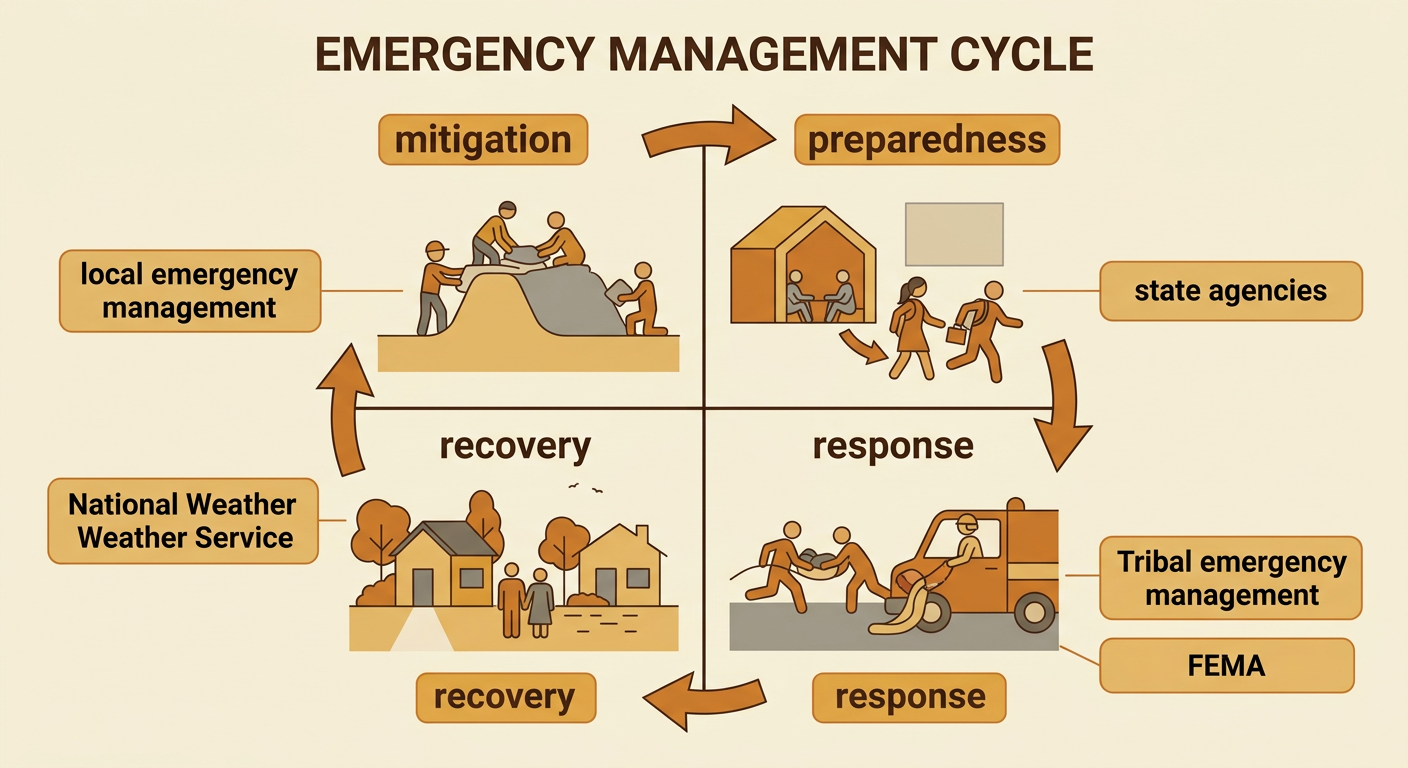
Different agencies perform specialized tasks across four phases: mitigation, preparedness, response, and recovery. Local emergency managers coordinate community plans, evacuation routes, shelters, and first responders. State emergency management agencies support local operations and distribute statewide resources. Tribal emergency management offices protect their communities and coordinate with other governments while exercising tribal sovereignty. At the federal level, the Federal Emergency Management Agency coordinates assistance authorized under federal law, while agencies such as the National Weather Service issue forecasts and warnings and the U.S. Army Corps of Engineers may support infrastructure missions. Nonprofit organizations and private utilities also provide essential services. During a major flood, local firefighters may conduct rescues, the state may deploy high-water vehicles, FEMA may coordinate federal support, and the Red Cross may operate shelters. Effective response depends on defined roles, interoperable communication, and accurate information sharing.
Analyzing Evidence from a Disaster Case
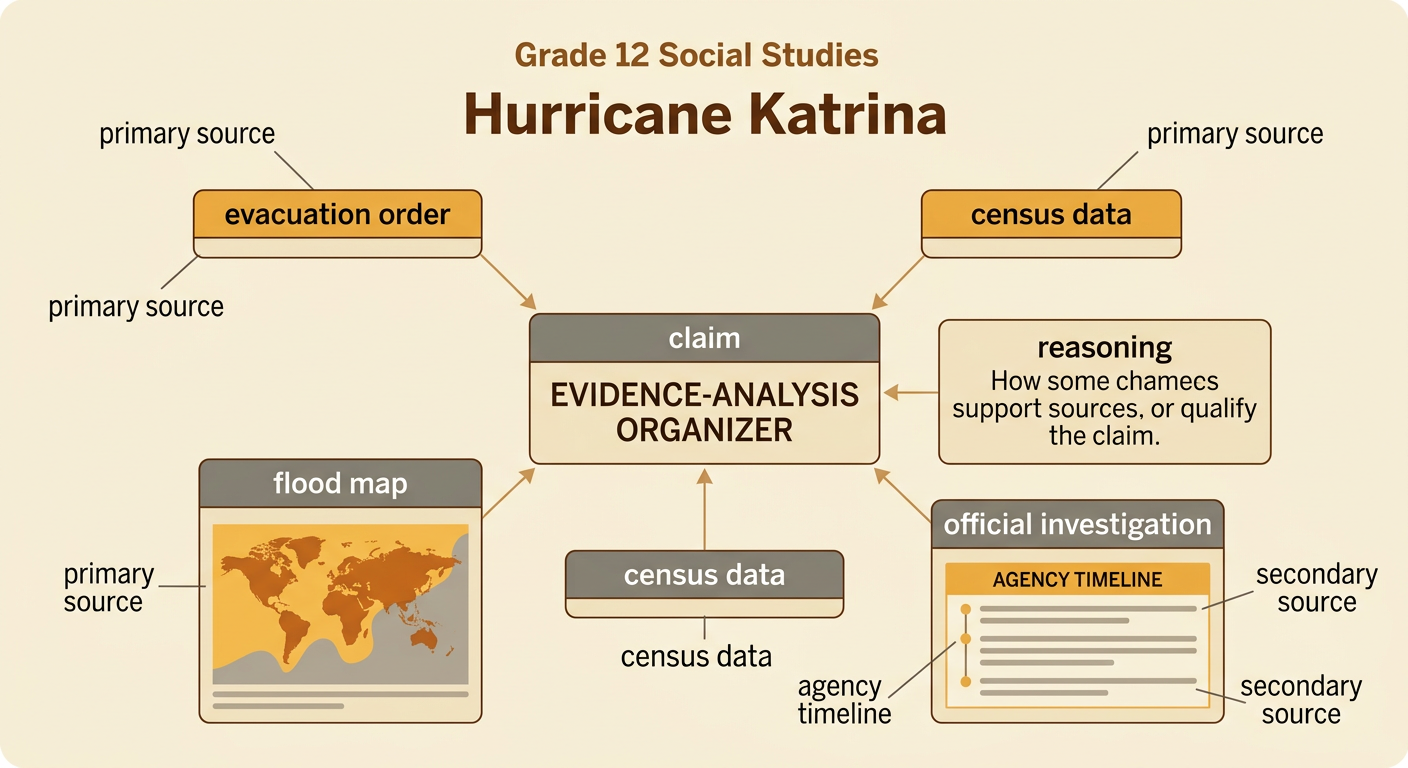
To evaluate a disaster response, students should compare primary and secondary sources and cite specific evidence. Primary sources include emergency orders, agency situation reports, maps, photographs, public statements, and eyewitness accounts. Secondary sources include scholarly studies, investigative reports, and later historical analyses. Hurricane Katrina in 2005 provides evidence of both environmental danger and institutional failure. Storm surge breached flood-protection structures around New Orleans, while evacuation barriers left many residents exposed. A useful analysis might cite the city’s evacuation order, federal timelines, census data on household vehicle access, and official post-disaster investigations. Students should identify each source’s author, date, purpose, and limitations before drawing conclusions. Corroborating several sources can reveal whether an agency acted within its authority, whether warnings reached the public, and whether delays resulted from inadequate planning, communication failures, damaged infrastructure, or limited capacity.
Evaluating Coordination and Accountability
Coordination is effective when governments share timely information, define responsibilities, direct resources toward documented needs, and include affected communities in decisions. Accountability means that officials explain choices, follow the law, track public spending, correct failures, and allow independent review. Students can evaluate performance using measurable criteria such as warning reach, evacuation time, rescue speed, shelter access, service restoration, deaths, costs, and equitable treatment. For example, after a wildfire, investigators might compare evacuation alerts with cell-service coverage, interview residents, review agency timelines, and examine whether people with disabilities received accessible transportation. A fair judgment should distinguish conditions agencies could control from extreme hazard conditions they could not. It should also consider unequal effects across neighborhoods and tribal lands. Effective public action is not simply the absence of damage; it is evidence that institutions reduced preventable harm, used authority responsibly, and improved plans for future disasters.
