
Find Factors and Multiples
Students use arrays, multiplication pairs, and divisibility reasoning to identify factors and multiples of whole numbers.
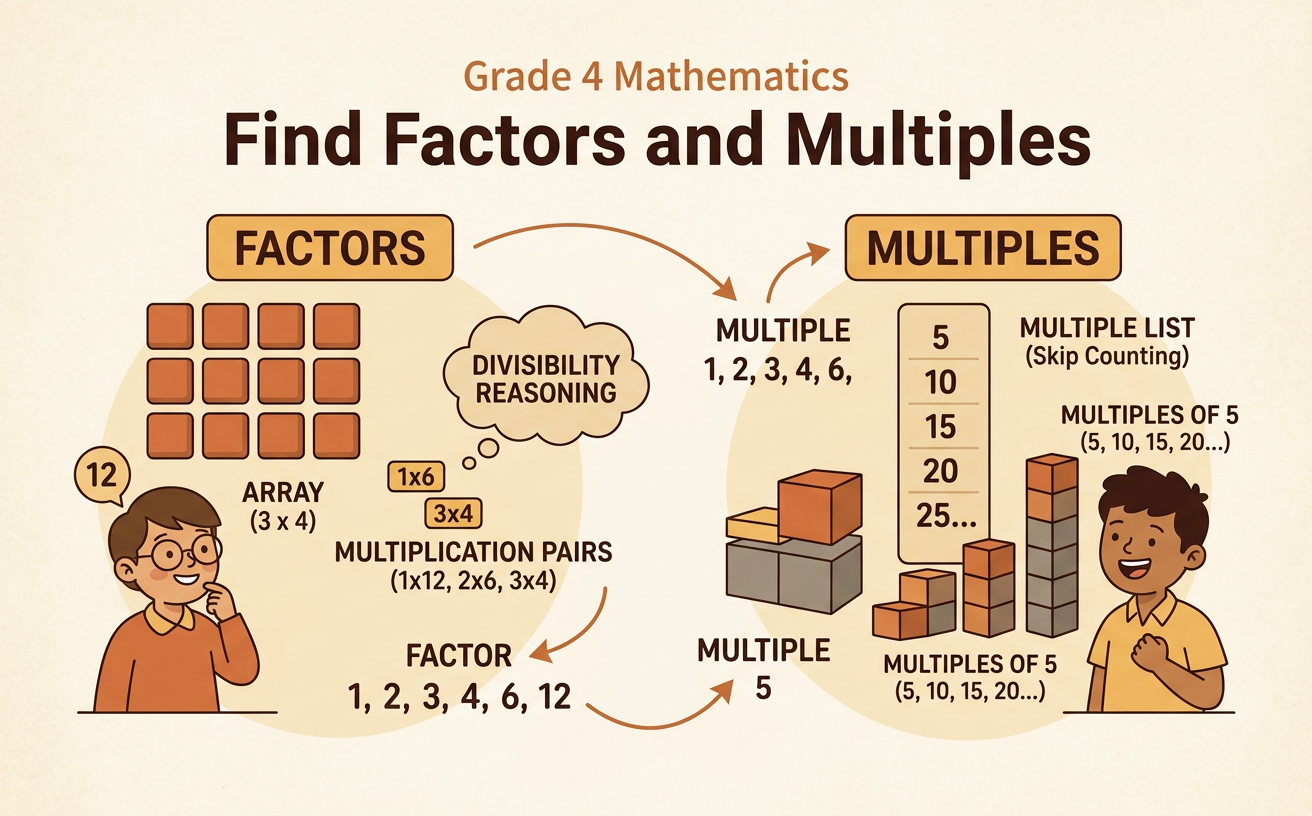
Illustrations are auto-generated and may be placeholders. They can be refreshed to match the narration.
Review Multiplication Pairs
A multiplication pair is two whole numbers that multiply to make a product. For example, 3 and 8 are a multiplication pair for 24 because 3 times 8 equals 24. You can also write 8 times 3 equals 24. Changing the order does not create a new factor pair, so 3 and 8 count as one pair. Think about known multiplication facts to find pairs. For 20, begin with 1 times 20. Then test 2, 3, and 4. Since 2 times 10 and 4 times 5 both equal 20, the multiplication pairs are 1 and 20, 2 and 10, and 4 and 5. Each number in a multiplication pair is a factor of the product.

Build Arrays to Find Factors
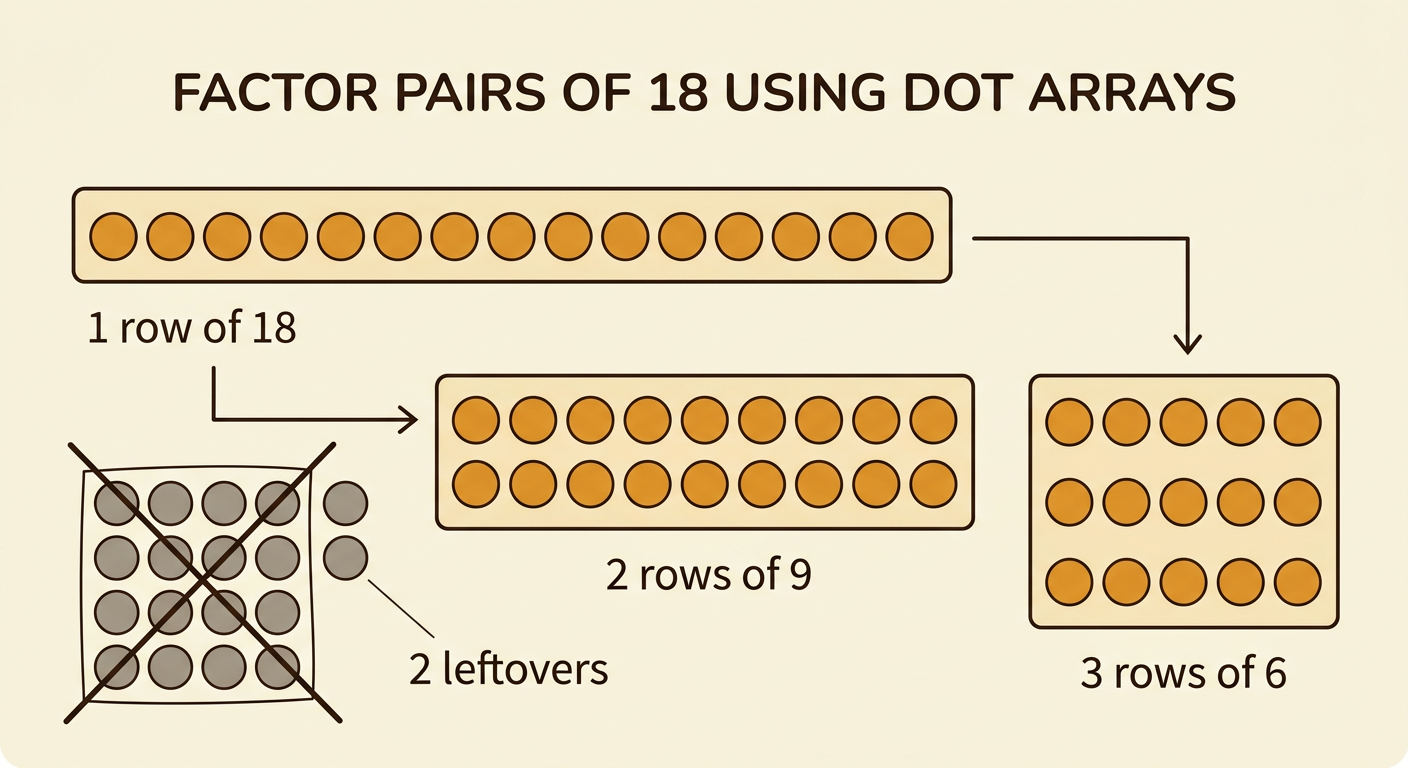
An array arranges objects in equal rows and columns. Arrays help you see which numbers divide a whole number evenly. Suppose you have 18 counters. You can arrange them in 1 row of 18, 2 rows of 9, or 3 rows of 6. These arrays show the factor pairs 1 and 18, 2 and 9, and 3 and 6. An arrangement of 4 equal rows will not work because 18 cannot be divided evenly by 4. Two counters would be left over. When an array has no leftovers, the number of rows and the number in each row are factors. Turning an array does not make a new pair; a 3-by-6 array and a 6-by-3 array show the same factor pair.
List Factor Pairs
To find all factor pairs, test possible factors in order and stop when the pairs begin to repeat. Find the factor pairs of 24. Start with 1: 1 times 24 equals 24. Test 2: 2 times 12 equals 24. Test 3: 3 times 8 equals 24. Test 4: 4 times 6 equals 24. Five does not divide 24 evenly. After 4 and 6, the next successful pair would reverse a pair already listed. Therefore, the complete factor pairs are 1 and 24, 2 and 12, 3 and 8, and 4 and 6. The individual factors of 24 are 1, 2, 3, 4, 6, 8, 12, and 24. Listing pairs carefully helps you avoid missing or repeating factors.

Identify Multiples
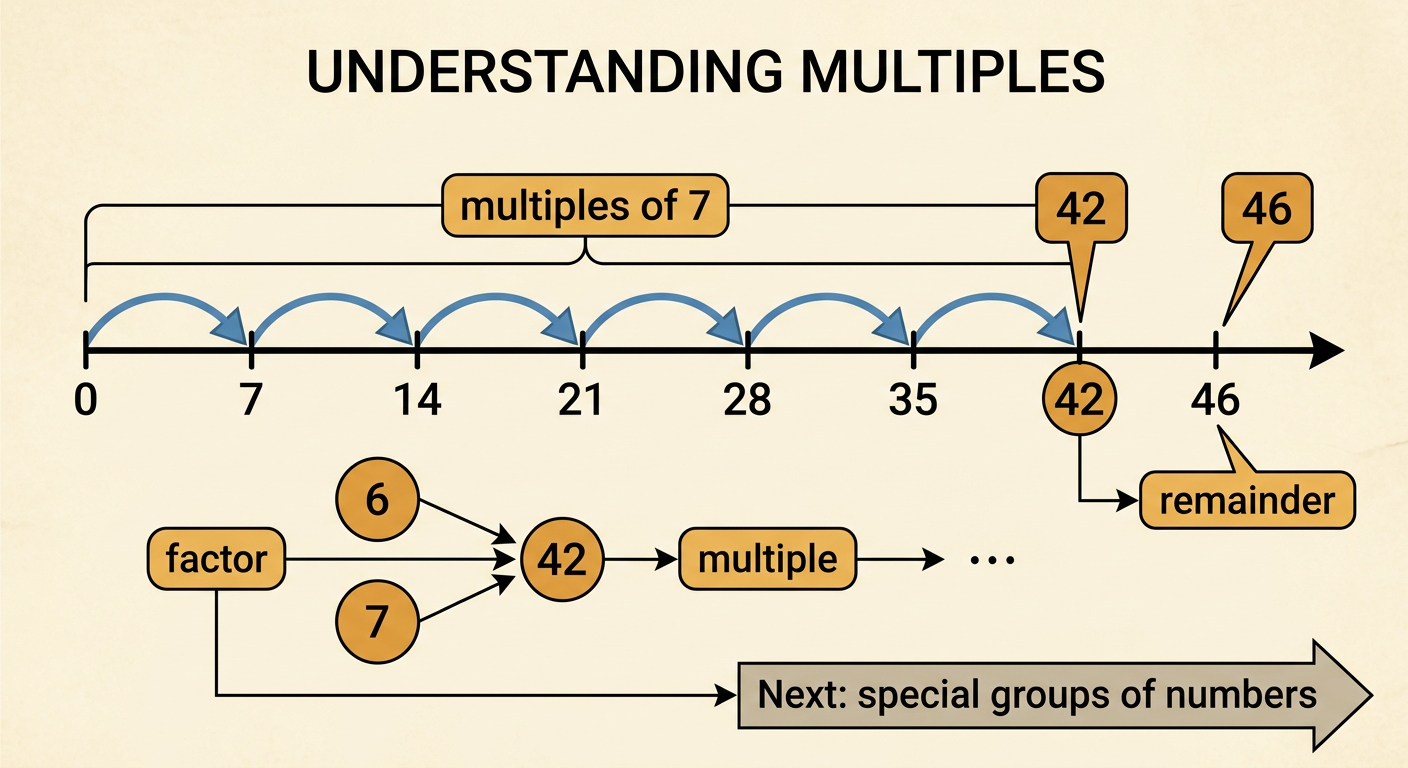
A multiple is the product of a number and a whole number. To find multiples of 7, multiply 7 by 1, 2, 3, and so on. The first several positive multiples are 7, 14, 21, 28, 35, and 42. A whole number is a multiple of each of its factors. Since 6 times 7 equals 42, both 6 and 7 are factors of 42, and 42 is a multiple of both numbers. You can use division to test a possible multiple. Divide 46 by 7. Because the result is not a whole number and there is a remainder, 46 is not a multiple of 7. Multiples continue without ending, while a number has only a limited set of factors.
Classify Prime and Composite Numbers
A prime number has exactly two factors: 1 and itself. For example, 29 has only the factor pair 1 and 29, so 29 is prime. A composite number has more than two factors. For example, 30 has the pairs 1 and 30, 2 and 15, 3 and 10, and 5 and 6. Because 30 has several factor pairs, it is composite. Arrays can help with classification: a prime number makes only a 1-by-itself rectangular array, while a composite number makes at least one additional rectangular array. The number 1 is special. It has only one factor, so it is neither prime nor composite. Always list or test the factor pairs before deciding how to classify a number.

Complete an Exit Check
Use factor pairs, arrays, or divisibility reasoning to show what you learned. First, list every factor pair of 28. Next, decide whether 48 is a multiple of 6 and explain using an equation. Finally, classify 31 as prime or composite. Check your work systematically. For 28, begin with 1 and test each whole number in order. The pairs are 1 and 28, 2 and 14, and 4 and 7. For the multiple question, 6 times 8 equals 48, so 48 is a multiple of 6. For the classification question, 31 has only the factors 1 and 31, so it is prime. If an answer is incorrect, use an array or multiplication fact to find and fix the error.
