
Find the Missing Number in an Addition or Subtraction Equation
Students use number relationships and equations to determine the missing whole number in addition and subtraction equations within 20.
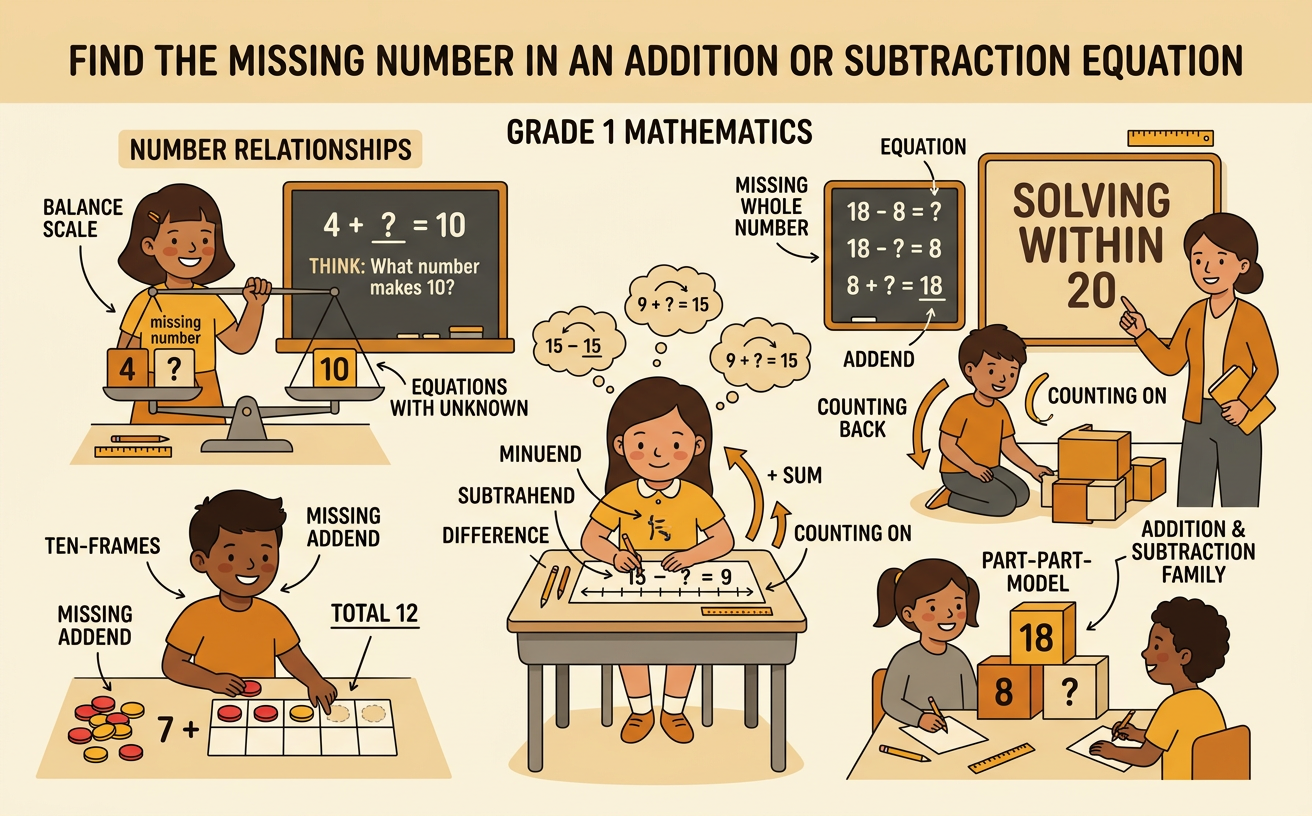
Illustrations are auto-generated and may be placeholders. They can be refreshed to match the narration.
Equation Review
An equation is a number sentence that shows two amounts are equal. The equal sign means “the same amount as.” Addition joins parts to make a total. In 6 + 3 = 9, the parts are 6 and 3, and the total is 9. Subtraction starts with a total and takes away one part. In 9 − 3 = 6, 9 is the total, 3 is the part taken away, and 6 is the part left. Equations can have a missing number. A box can stand for that unknown number. For example, 6 + 3 = □ asks which number makes the equation true. Since 6 and 3 make 9, the missing number is 9.

Identify the Missing Part
First, look carefully at where the box appears. The missing number might be a part, a total, the number taken away, or the number left. In 7 + □ = 12, 12 is the total. Seven is one part, so the box must be the other part. Think, “Seven and what number make twelve?” Count on from 7: 8, 9, 10, 11, 12. You counted five more, so the missing number is 5. You can also connect addition and subtraction. Since 12 − 7 = 5, you know 7 + 5 = 12. Naming the known numbers and deciding what is missing helps you choose a useful way to solve the equation.

Model a Think-Aloud
Let us solve □ − 4 = 9 by thinking aloud. I see that the starting number is missing. Four is taken away, and 9 is left. I ask, “What number can lose 4 and still have 9?” I can begin with the 9 that remains and put back the 4 that was taken away. I count on four numbers: 10, 11, 12, 13. The missing starting number is 13. Now I read the completed equation: 13 − 4 = 9. It makes sense because taking four counters away from a group of thirteen leaves nine counters. Thinking aloud helps me explain what each number means and why my strategy works.

Solve Missing-Number Equations
You can use counters, drawings, counting, or related facts to find a missing number. For □ + 8 = 15, start at 8 and count on until 15. Say 9, 10, 11, 12, 13, 14, 15 while raising one finger for each count. You raised seven fingers, so □ = 7. For 14 − □ = 6, think about the related addition fact: 6 + □ = 14. Count on from 6 to 14 to find 8. Therefore, 14 − 8 = 6. For 16 − 5 = □, count back five from 16 or remove five counters. You land on 11, so the missing number is 11. Choose the strategy that helps you see the number relationship clearly.
Explain and Check
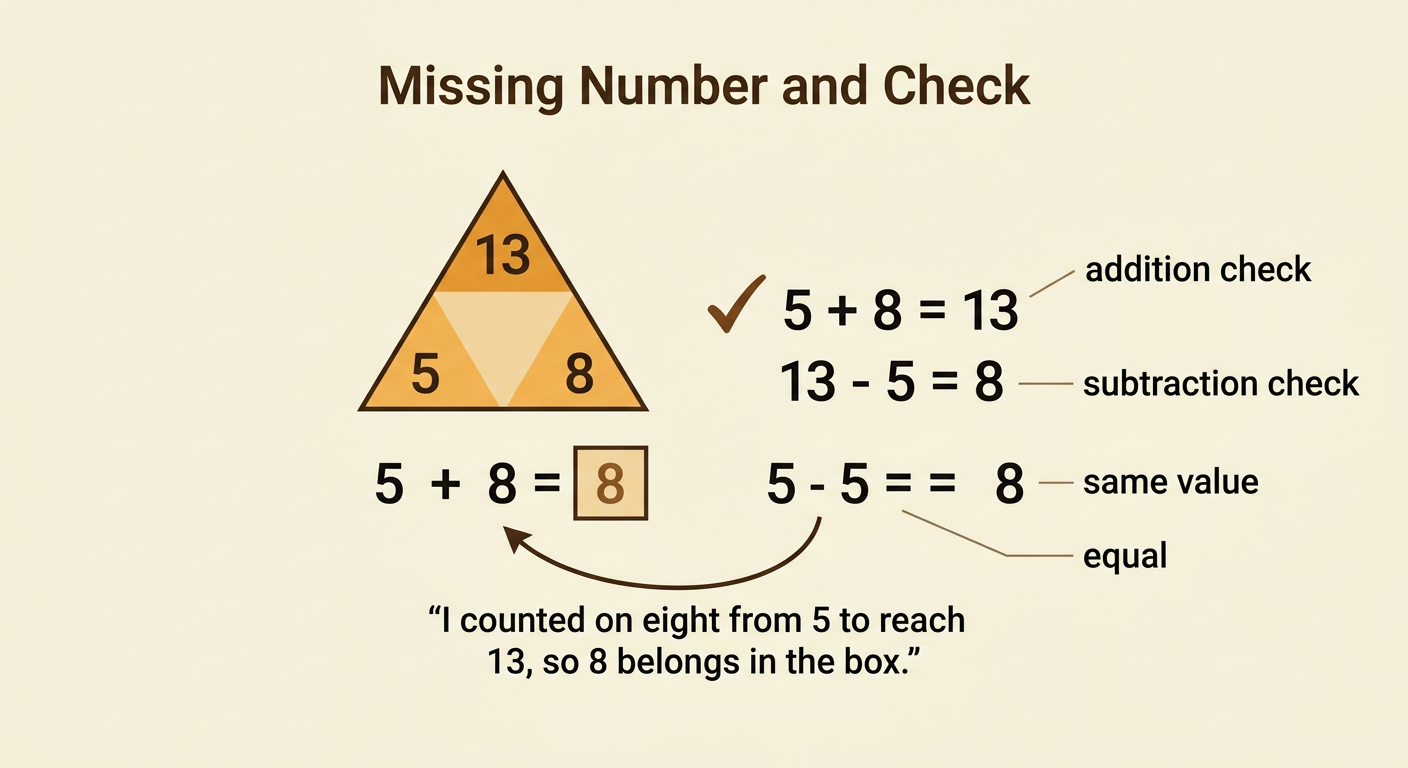
After you find a missing number, place it in the box and check the complete equation. Both sides must have the same value. Suppose you solve 5 + □ = 13 and get 8. Say, “I counted on eight from 5 to reach 13, so the missing number is 8.” Then check with addition: 5 + 8 = 13. You can also check with the related subtraction fact: 13 − 5 = 8. Both facts are true, so the answer works. If your check does not make the equation true, try again. Explaining your strategy with words, objects, a drawing, or an equation shows how you know the missing number is correct.
Quick Exit Check
Try these three equations on your own: 9 + □ = 14, □ − 6 = 7, and 18 − 9 = □. For the first equation, count on from 9 to 14. Five more are needed, so the missing number is 5. For the second equation, begin with the 7 that remains and put back 6. Seven plus six equals 13, so the missing starting number is 13. For the third equation, subtract 9 from 18. Nine remain, so the missing number is 9. Check each answer by reading the completed equation: 9 + 5 = 14, 13 − 6 = 7, and 18 − 9 = 9. Each equation shows equal amounts on both sides.
