Finding Greatest Common Factors and Least Common Multiples
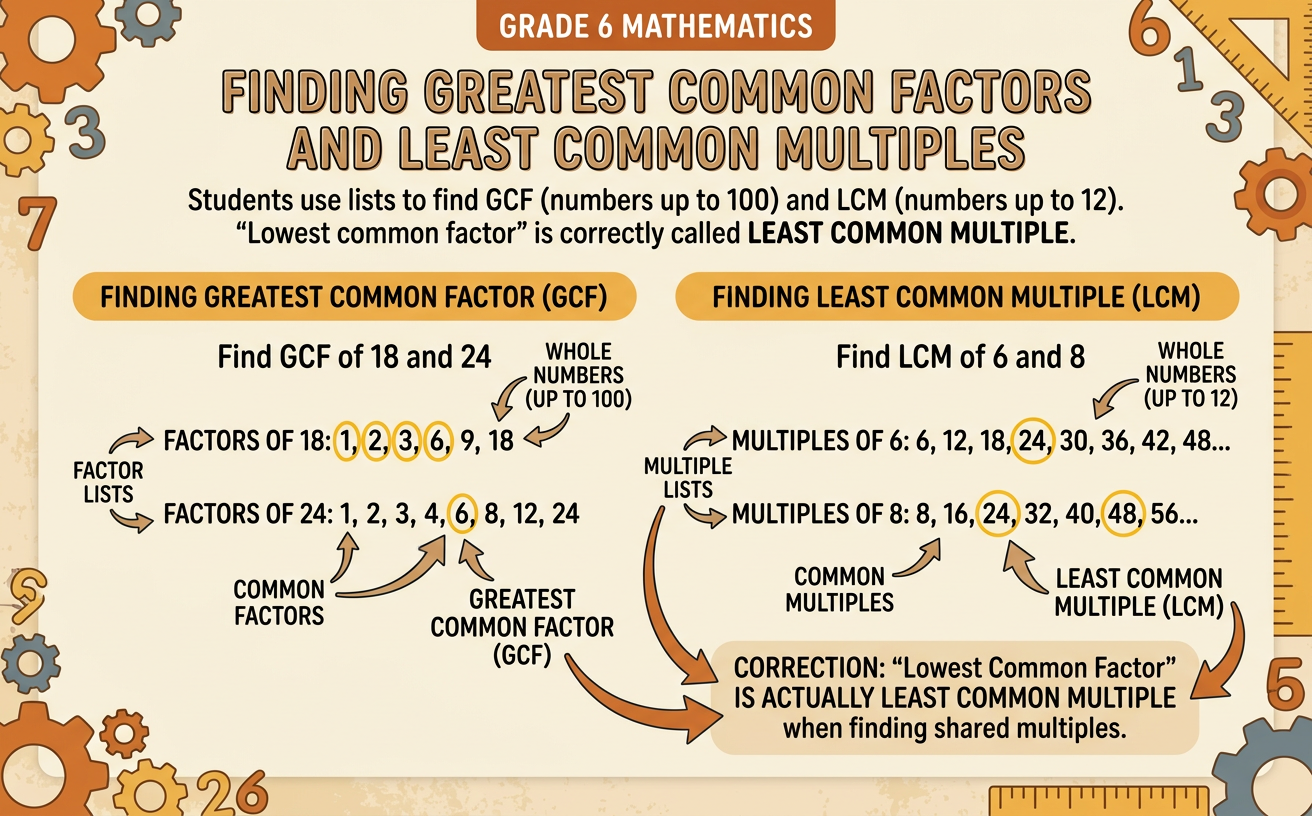
Students use factor and multiple lists to find the greatest common factor of two whole numbers up to 100 and the least common multiple of two whole numbers up to 12, clarifying that “lowest common factor” is correctly called the least common multiple when identifying shared multiples.
Illustrations are auto-generated and may be placeholders. They can be refreshed to match the narration.
Review Factors and Multiples
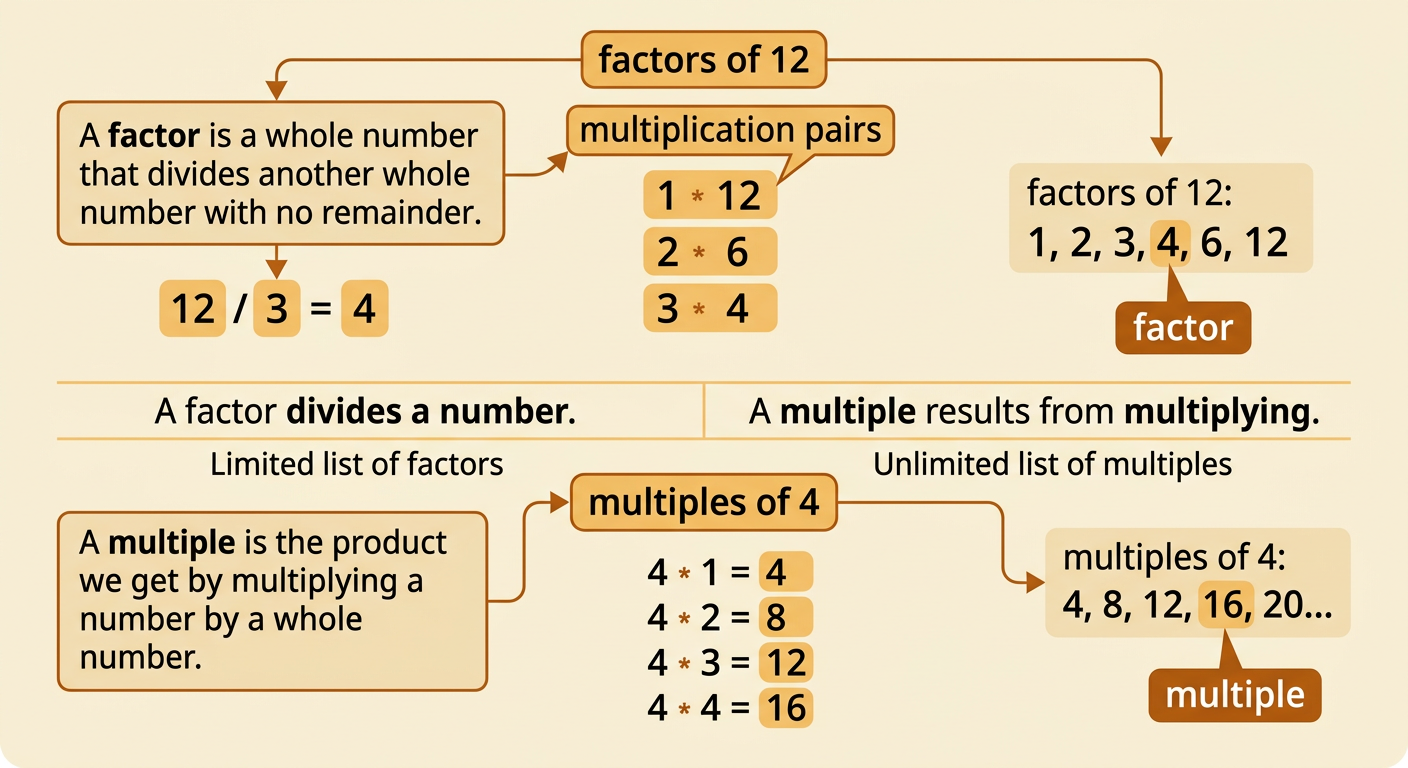
A factor is a whole number that divides another whole number with no remainder. For example, 3 is a factor of 12 because 12 ÷ 3 = 4. Factors can be shown as multiplication pairs: 1 × 12, 2 × 6, and 3 × 4. Therefore, the factors of 12 are 1, 2, 3, 4, 6, and 12. A multiple is the product of a number and a whole number. The multiples of 4 include 4, 8, 12, 16, and 20. You can generate them by multiplying 4 by 1, 2, 3, 4, and 5. Factors divide a number, while multiples result from multiplying a number. Every whole number has a limited number of factors but an unlimited number of multiples.
List Common Factors
Common factors are factors shared by two or more numbers. To find them, first list every factor of each number in order. Consider 18 and 24. The factors of 18 are 1, 2, 3, 6, 9, and 18. The factors of 24 are 1, 2, 3, 4, 6, 8, 12, and 24. Compare the lists carefully. The numbers 1, 2, 3, and 6 appear in both lists, so they are the common factors of 18 and 24. Listing factors in increasing order helps prevent missed or repeated factors. You can check a possible common factor by dividing both original numbers by it. For example, 18 ÷ 6 = 3 and 24 ÷ 6 = 4, with no remainders.

Identify the Greatest Common Factor
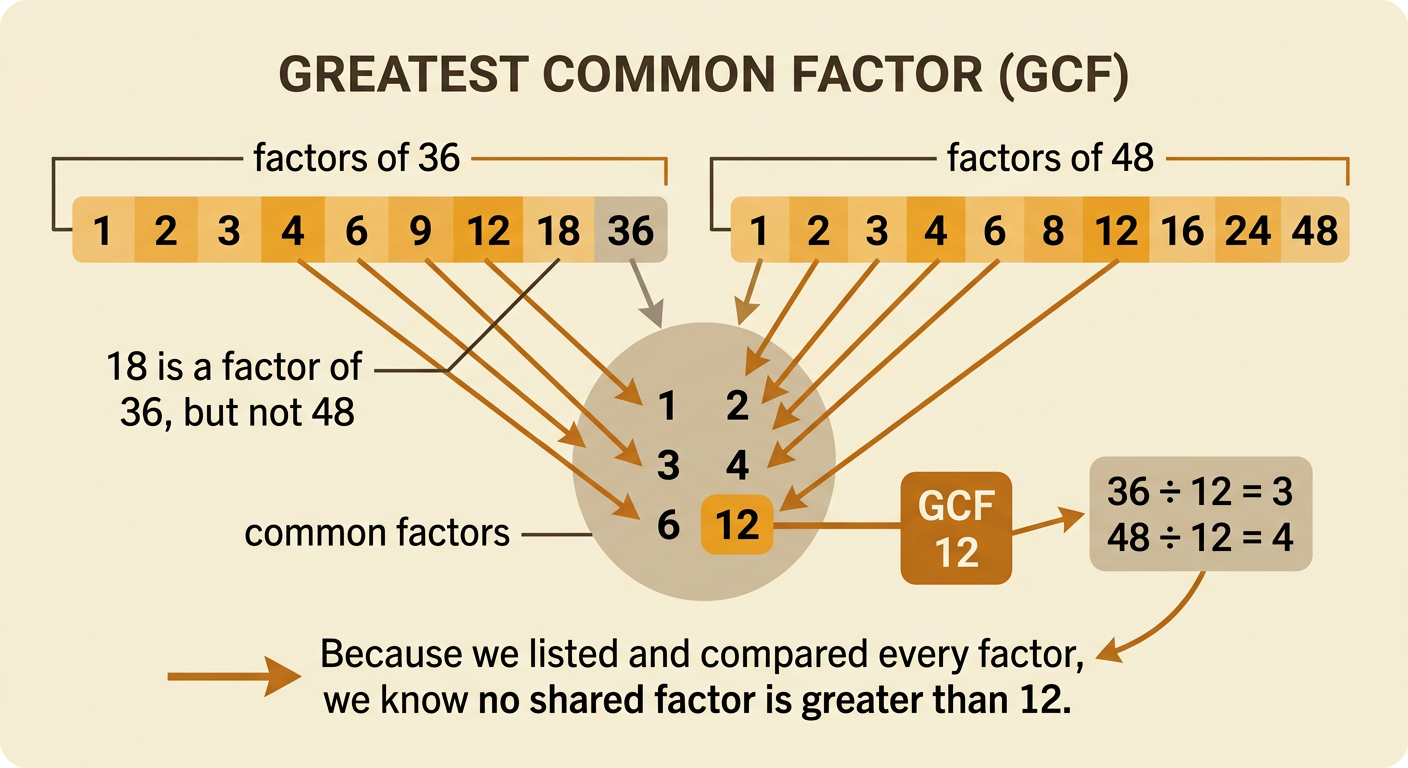
The greatest common factor, or GCF, is the largest factor shared by two numbers. Begin by listing the factors of each number and identifying all factors that occur in both lists. For 36, the factors are 1, 2, 3, 4, 6, 9, 12, 18, and 36. For 48, the factors are 1, 2, 3, 4, 6, 8, 12, 16, 24, and 48. Their common factors are 1, 2, 3, 4, 6, and 12. The greatest number in this common-factor list is 12, so GCF(36, 48) = 12. Check by dividing: 36 ÷ 12 = 3 and 48 ÷ 12 = 4. Both quotients are whole numbers. No common factor can be greater than 12 because all factors have been listed and compared.
List Common Multiples
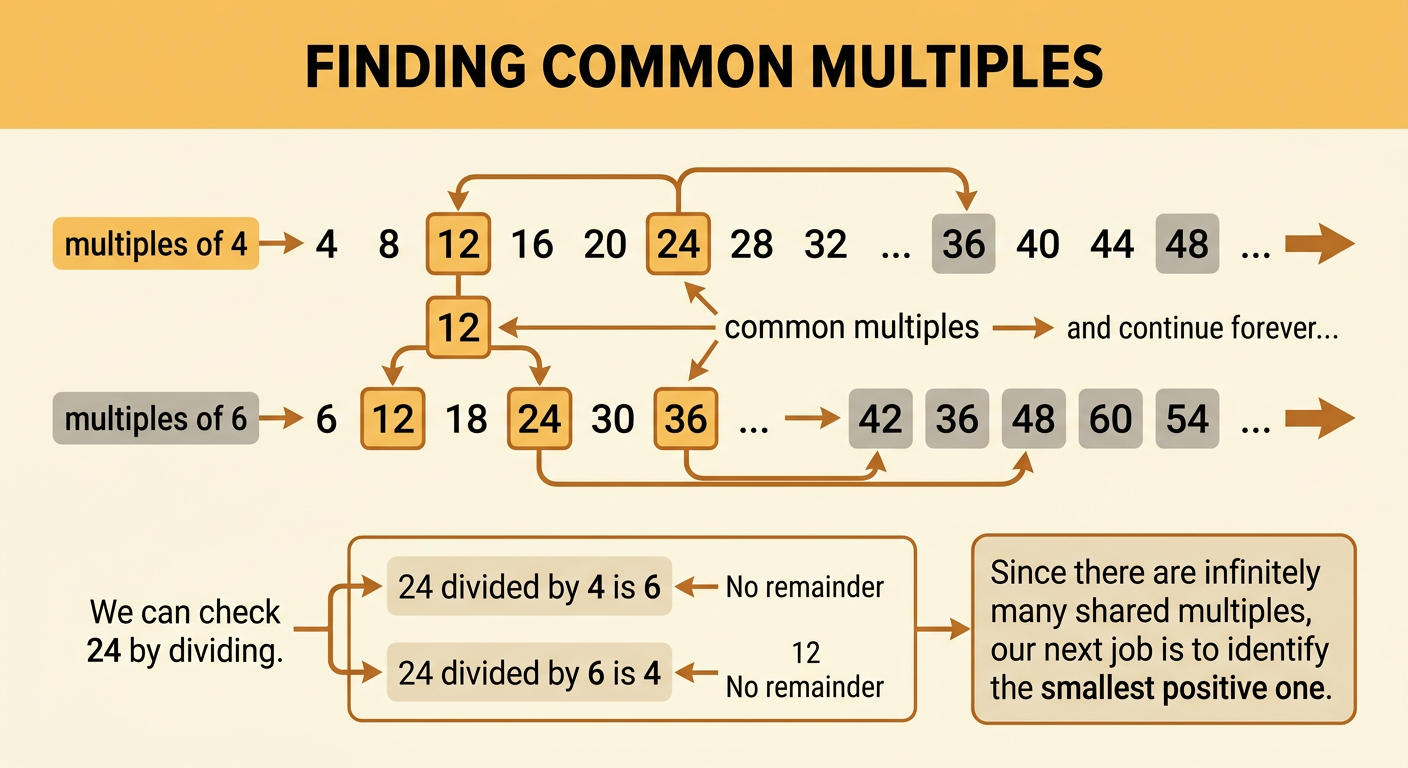
Common multiples are multiples shared by two or more numbers. To find them, write multiples of each number until the lists begin to overlap. For example, the multiples of 4 are 4, 8, 12, 16, 20, 24, 28, 32, and so on. The multiples of 6 are 6, 12, 18, 24, 30, 36, and so on. The numbers 12 and 24 appear in both lists, so they are common multiples of 4 and 6. More common multiples will continue forever, including 36, 48, and 60. A number is a common multiple only if each original number divides it with no remainder. For instance, 24 ÷ 4 = 6 and 24 ÷ 6 = 4, confirming that 24 is a common multiple.
Identify the Least Common Multiple
The least common multiple, or LCM, is the smallest positive multiple shared by two numbers. For 8 and 12, list multiples in order. Multiples of 8 are 8, 16, 24, 32, and 40. Multiples of 12 are 12, 24, 36, and 48. The first number in both lists is 24, so LCM(8, 12) = 24. Check that 24 is divisible by each number: 24 ÷ 8 = 3 and 24 ÷ 12 = 2. Sometimes people incorrectly say “lowest common factor” when they are looking for the first shared multiple. The correct term is least common multiple. Factors divide a number, while multiples are generated by multiplying. Also, 1 is a common factor of every pair of whole numbers, so calling it the “lowest common factor” does not describe the LCM.

Solve and Explain
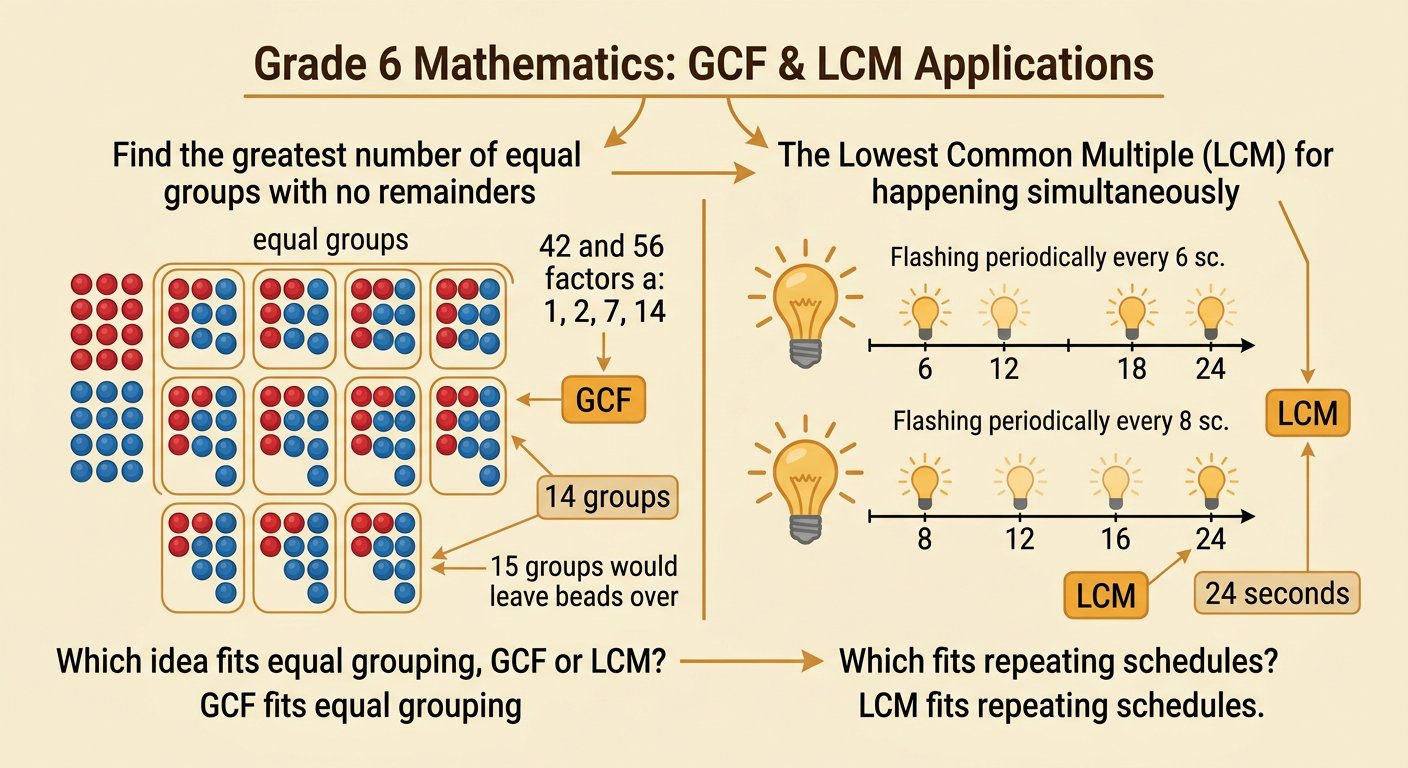
Use the GCF when a problem asks for the greatest number of equal groups with nothing left over. Suppose 42 red beads and 56 blue beads must be divided into identical groups. The common factors of 42 and 56 include 1, 2, 7, and 14, so the GCF is 14. You can make 14 groups, each with 3 red beads and 4 blue beads. Use the LCM when a problem asks when repeating events will happen together. If one light flashes every 6 seconds and another flashes every 8 seconds, list their multiples. The first shared multiple is 24, so both lights flash together after 24 seconds. In an explanation, name the operation, show the factor or multiple lists, state the GCF or LCM, and connect the result to the situation.