
Finding Key Details in Informational Text
Students ask and answer questions to identify important facts in a short informational text.
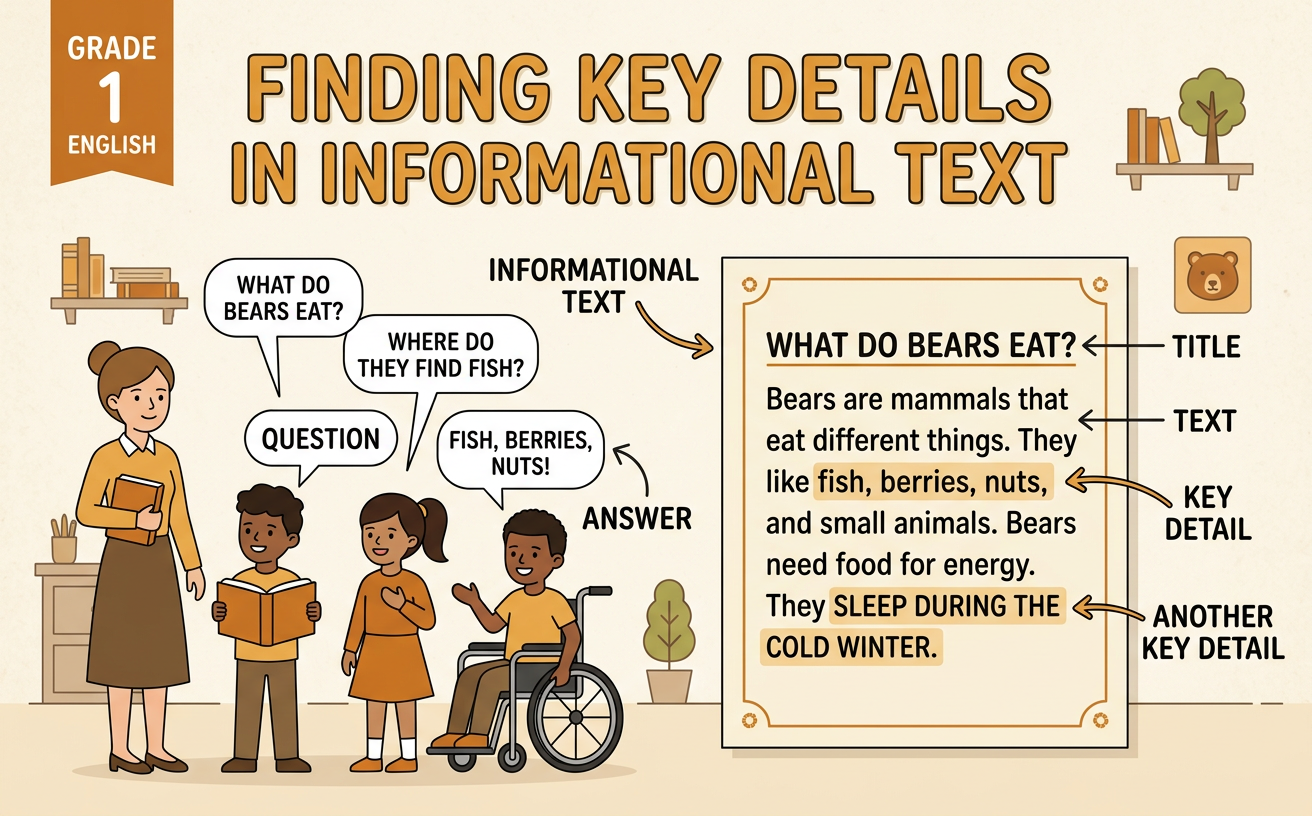
Illustrations are auto-generated and may be placeholders. They can be refreshed to match the narration.
Preview the Topic
Before you read, look at the title, headings, pictures, and captions. These text features give clues about the topic. Suppose the title is Bees at Work. A photograph shows a bee on a flower, and a heading says Collecting Nectar. These clues tell you that the text will probably explain how bees find and use nectar. Think about what you already know. You may know that bees visit flowers and live in groups called colonies. Previewing prepares your mind for new facts. Do not try to answer every question yet. Instead, name the topic and make a careful prediction. You might say, “I think this text will explain how bees collect food from flowers.”
Ask Before Reading
Good readers ask questions before they begin. Questions give you a reason to read and help you notice important facts. Use question words such as who, what, where, when, why, and how. Before reading Bees at Work, you might ask, “Where do bees find nectar?” or “Why do bees collect nectar?” You might also ask, “How does a bee carry nectar?” Write or say one or two questions. Then keep those questions in mind as you read. Your questions should match the topic and be answerable with information from the text. If the title is Bees at Work, a question about ocean animals would not match. A question about bees and flowers would match.
Read for Important Facts
Read slowly and think about which facts help explain the topic. Here is a short informational text: “Worker bees visit flowers to collect nectar. A bee uses its long tongue to sip the nectar. It carries the nectar back to its colony, where other bees help turn it into honey.” Each sentence gives an important fact about how bees collect and use nectar. Ask yourself, “Does this fact help me understand the topic?” The color of the flower might be interesting, but it is not important unless the text is explaining how bees choose flowers. Reread any sentence that seems important. You can point to it, say it in your own words, or place a small note beside it.
Answer Who, What, Where, and Why
After reading, answer questions using details from the text. For the bee text, ask, “Who collects nectar?” The answer is worker bees. Ask, “What do they collect?” They collect nectar. Ask, “Where do they find it?” They find it in flowers. Ask, “Why do they carry it back to the colony?” Other bees help turn the nectar into honey, which the colony uses as food. Check that each answer matches the question. A who answer names a person, animal, or group. A what answer names an action or thing. A where answer names a place. A why answer gives a reason. If you are unsure, reread the sentence that contains the needed detail instead of guessing.
Share Text Evidence
Text evidence is the exact information in a text that supports an answer. When you share an answer, tell which words helped you. If someone asks, “Where do bees find nectar?” you can answer, “Bees find nectar in flowers.” Then point to the sentence, “Worker bees visit flowers to collect nectar.” You may say, “I know because the text says worker bees visit flowers to collect nectar.” This shows that your answer comes from the reading, not from a guess. You can point to the sentence, read it aloud, or copy a short part of it. Use a simple frame: “My answer is ____. The text says ____.” Always choose evidence that directly matches the question and your answer.