
Finding Probabilities of Compound Events
Students use organized lists, tables, and tree diagrams to represent sample spaces and calculate probabilities of compound events.

Illustrations are auto-generated and may be placeholders. They can be refreshed to match the narration.
Review Simple Events
Probability measures how likely an event is to happen. It ranges from 0, meaning impossible, to 1, meaning certain. A simple event has one outcome. Suppose a fair spinner has four equal sections colored red, blue, green, and yellow. The sample space, or set of all possible outcomes, is red, blue, green, and yellow. The simple event “land on blue” has one favorable outcome out of four equally likely outcomes. Therefore, its probability is 1/4. You can write this as P(blue) = 1/4. A probability may also be written as a decimal or percent, so 1/4 equals 0.25 or 25%. Always identify the complete sample space and then count the outcomes that make the event occur.

Define Compound Events
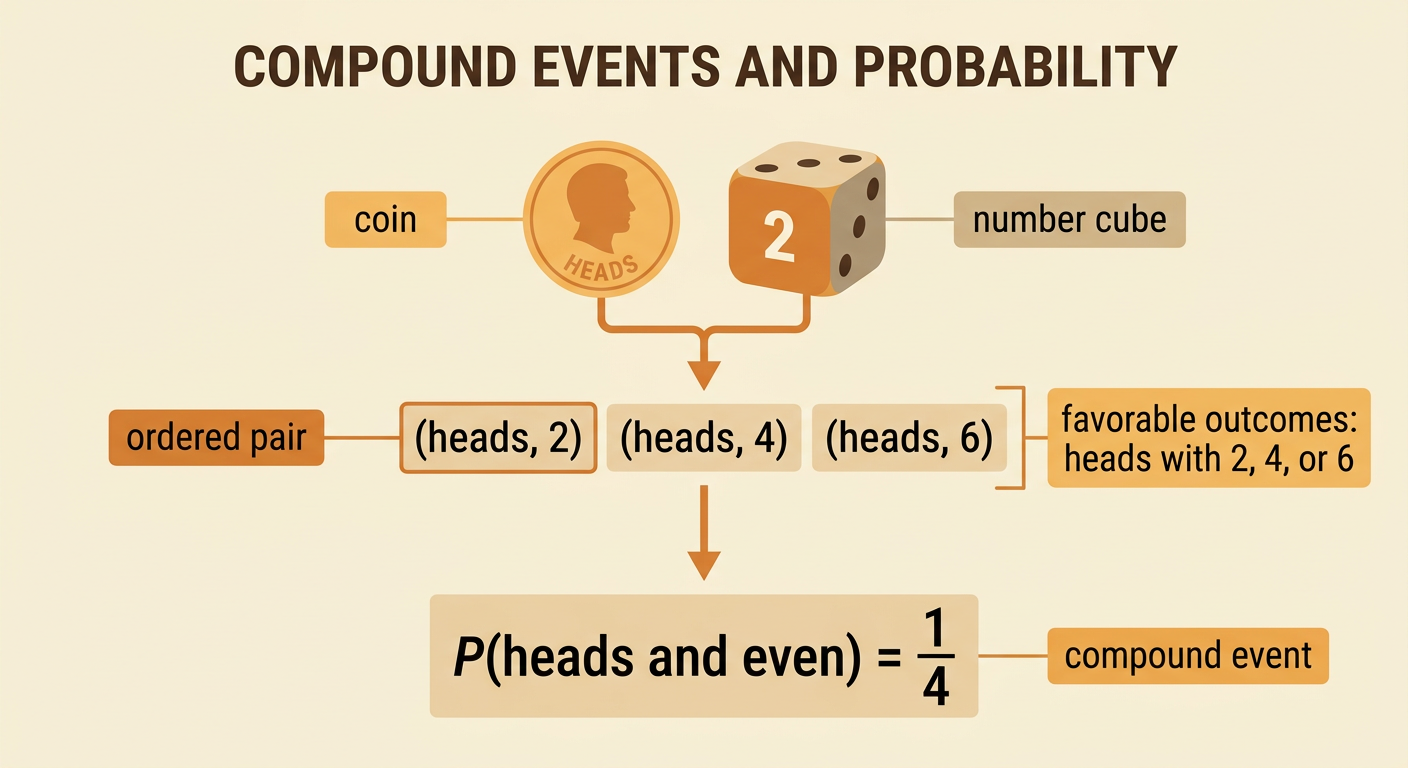
A compound event combines two or more simple events. For example, imagine flipping a fair coin and rolling a fair six-sided number cube. One compound event is “get heads and roll an even number.” Each outcome can be written as an ordered pair, such as (heads, 2). There are 2 possible coin results and 6 possible number cube results, so there are 2 × 6 = 12 equally likely combined outcomes. The favorable outcomes are (heads, 2), (heads, 4), and (heads, 6). Thus, the probability of getting heads and an even number is 3/12, which simplifies to 1/4. The word “and” means that both conditions must be true in the same trial.
Build an Organized Sample Space
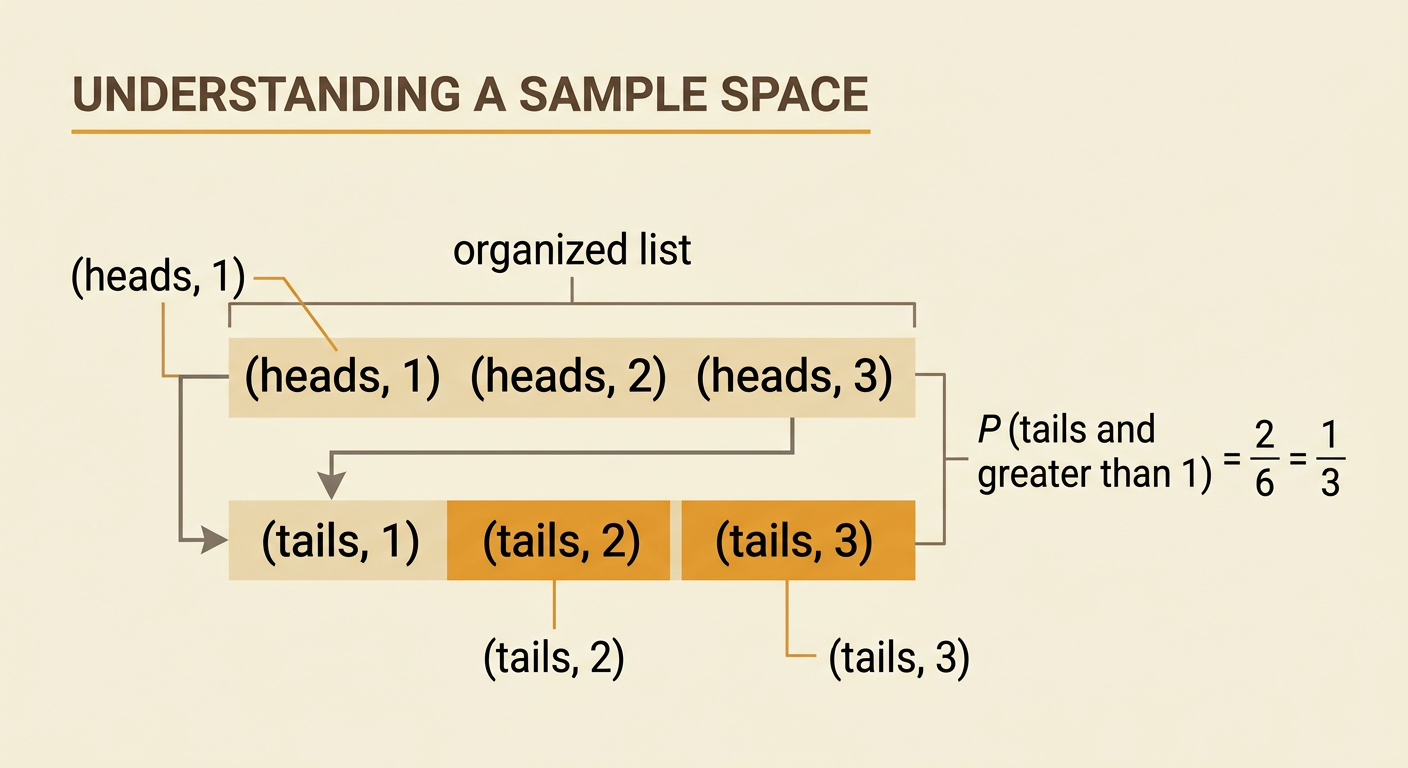
An organized list helps you include every possible outcome exactly once. Suppose you flip a coin and spin a fair spinner labeled 1, 2, and 3. Begin with heads and pair it with each spinner result: (heads, 1), (heads, 2), and (heads, 3). Then repeat the process with tails: (tails, 1), (tails, 2), and (tails, 3). The complete sample space has 6 outcomes because 2 coin results multiplied by 3 spinner results equals 6. For the compound event “tails and a number greater than 1,” the favorable outcomes are (tails, 2) and (tails, 3). Its probability is 2/6, or 1/3. Listing outcomes in a consistent order prevents omissions and repeated outcomes.
Use Tables and Tree Diagrams
Tables and tree diagrams display the same sample space in different ways. For a coin flip followed by a spin of 1, 2, or 3, make a table with heads and tails as row labels and 1, 2, and 3 as column labels. Each cell contains one combined outcome, giving 6 cells in all. A tree diagram begins with two branches, one for heads and one for tails. From each of those branches, draw three more branches labeled 1, 2, and 3. The six branch endpoints match the six cells in the table. To find “heads and a number less than 3,” locate (heads, 1) and (heads, 2). There are 2 favorable outcomes out of 6, so the probability is 1/3.

Calculate Compound Probabilities
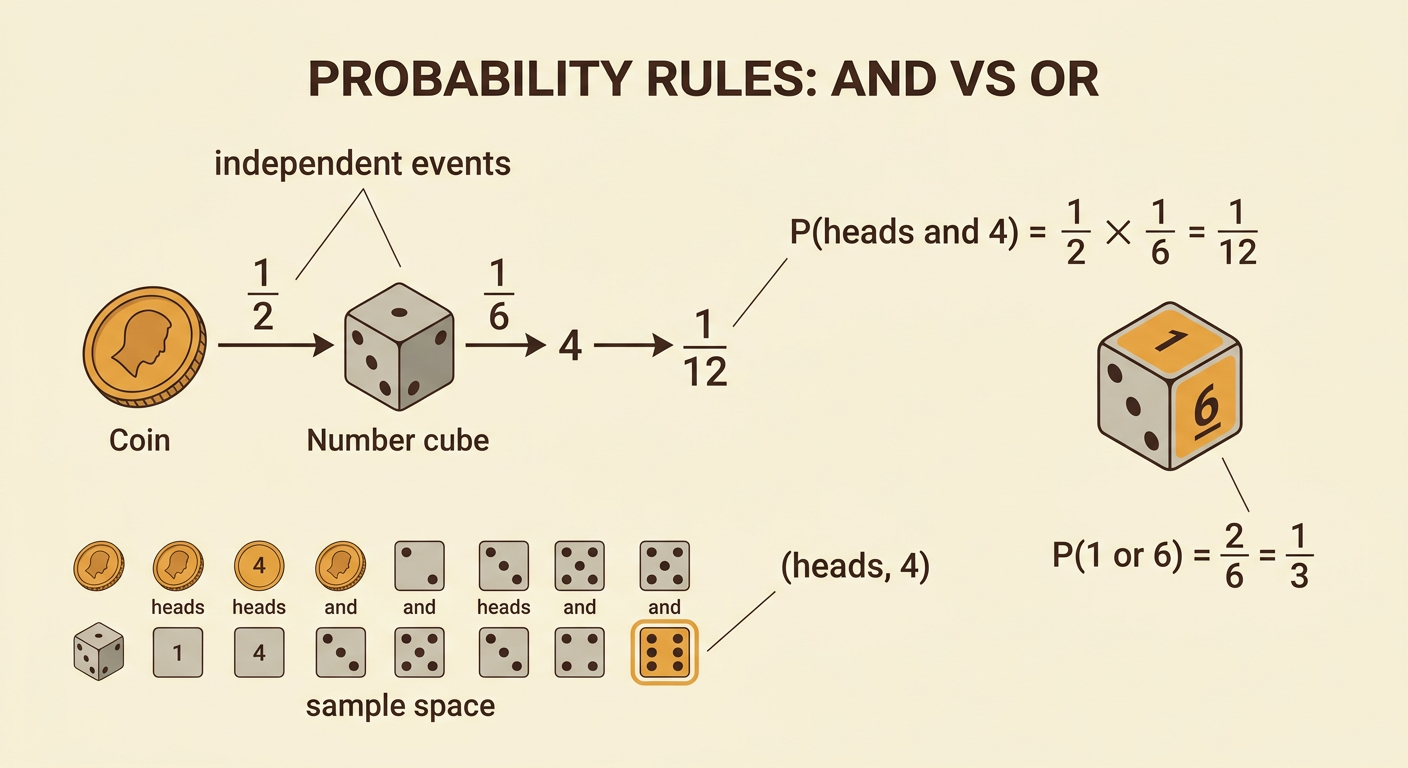
When events are independent, the result of one event does not affect the result of the other. To find the probability that both independent events occur, multiply their probabilities. For example, the probability of flipping heads and rolling a 4 on a fair number cube is 1/2 × 1/6 = 1/12. You can confirm this with a sample space containing 12 equally likely outcomes; only (heads, 4) is favorable. Some compound events use the word “or.” For example, when rolling one number cube, the probability of rolling a 1 or a 6 is 2/6, or 1/3, because either favorable result makes the event occur. Read the event carefully to decide whether all stated conditions or at least one condition must occur.
Complete an Exit Problem
A fair spinner has two equal sections labeled red and blue. After spinning it, you roll a fair six-sided number cube. Find the probability of landing on blue and rolling a number greater than 4. First, determine the total number of outcomes: 2 spinner results × 6 number cube results = 12 outcomes. Next, identify the favorable outcomes. Numbers greater than 4 are 5 and 6, so the favorable outcomes are (blue, 5) and (blue, 6). The probability is 2/12, which simplifies to 1/6. You can also multiply: P(blue) × P(number greater than 4) = 1/2 × 2/6 = 2/12 = 1/6. Check that your representation includes all twelve outcomes before giving your answer.
