
Finding the Area of a Rectangle with Fractional Side Lengths
Students use visual models and multiplication to find the area of rectangles with fractional side lengths.
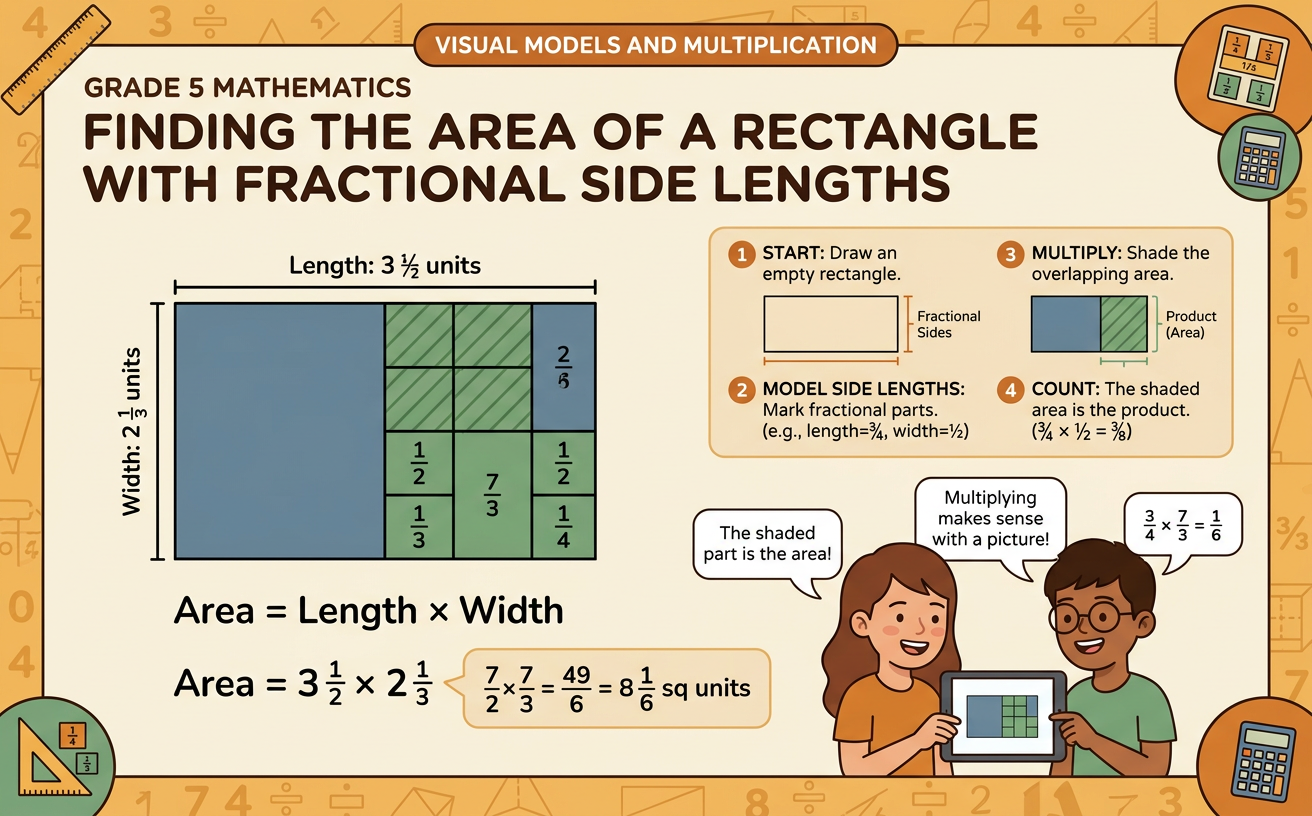
Illustrations are auto-generated and may be placeholders. They can be refreshed to match the narration.
Review Area and Fractional Units
Area is the amount of flat space inside a shape. We measure area with square units, such as square inches or square meters. A rectangle that is 4 units long and 3 units wide contains 12 unit squares, so its area is 12 square units. When side lengths are fractions, we can use smaller tiles. For example, divide each side of a unit square into halves. Each small tile is 1/2 unit long and 1/2 unit wide, so its area is 1/4 square unit. A rectangle that is 3/2 units long and 1 unit wide contains six of these quarter-square-unit tiles. Its area is 6 × 1/4, or 3/2 square units. Always name area with square units.
Model a Rectangle with Fraction Tiles
To model a rectangle that is 3/4 unit long and 2/3 unit wide, begin with one whole unit square. Divide its horizontal side into 4 equal parts and its vertical side into 3 equal parts. This creates 12 equal tiles. Each tile measures 1/4 unit by 1/3 unit, so each tile has an area of 1/12 square unit. The rectangle with the given side lengths covers 3 columns and 2 rows. That is 3 × 2, or 6, small tiles. Because each tile represents 1/12 square unit, the rectangle’s area is 6/12 square unit. Simplify 6/12 to 1/2. Therefore, a rectangle measuring 3/4 unit by 2/3 unit has an area of 1/2 square unit.
Connect Tiling to Fraction Multiplication
Tiling shows why multiplying the side lengths gives the area. In the 3/4-by-2/3 rectangle, the grid has 4 equal columns and 3 equal rows. A single tile has area 1/4 × 1/3 = 1/12 square unit. The rectangle contains 3 columns of tiles and 2 rows of tiles, so it contains 3 × 2 = 6 tiles. Its area is 6 × 1/12 = 6/12 = 1/2 square unit. We get the same result by multiplying the side lengths directly: 3/4 × 2/3 = 6/12 = 1/2. The numerators tell how many fractional lengths are used, while the denominators determine the equal partitions. Thus, the area formula A = length × width works for fractional side lengths.
Solve Fractional Area Problems
Use the formula A = length × width to solve an area problem. Suppose a garden bed is 1 1/2 yards long and 2 1/4 yards wide. First, rewrite the mixed numbers as improper fractions: 1 1/2 = 3/2 and 2 1/4 = 9/4. Then multiply: 3/2 × 9/4 = 27/8. Convert the improper fraction to a mixed number: 27/8 = 3 3/8. The garden bed has an area of 3 3/8 square yards. A tile model confirms the answer. Partition one direction into halves and the other into fourths. Each small tile has an area of 1/8 square yard. The rectangle contains 3 × 9 = 27 tiles, so its area is 27/8 square yards.
Explain and Check the Solution
A complete solution states the operation, shows the calculation, names the unit, and checks whether the answer is reasonable. Consider a rectangle that is 2 2/3 feet long and 3/4 foot wide. Rewrite 2 2/3 as 8/3. Then multiply: 8/3 × 3/4 = 24/12 = 2. The area is 2 square feet. To check with tiles, divide the length into thirds and the width into fourths. The rectangle contains 8 × 3 = 24 tiles, and each tile has an area of 1/12 square foot. Thus, 24 × 1/12 = 2 square feet. Estimation also supports the answer. The length is less than 3 feet and the width is less than 1 foot, so the area should be less than 3 square feet. An area of 2 square feet is reasonable.