
Finding the Main Idea and Key Details in Informational Text
Students identify the main idea of an informational passage and explain how key details support it.

Illustrations are auto-generated and may be placeholders. They can be refreshed to match the narration.
Main Idea vs. Topic
The topic tells what a text is mostly about. It is often a word or short phrase, such as beavers, rain forests, or recycling. The main idea tells the most important point the author wants you to understand about the topic. It is usually a complete sentence. For example, if the topic is beavers, the main idea might be, “Beavers change their habitats by building dams.” Ask yourself two questions: What subject appears throughout the text? What does the author want me to know about that subject? Do not choose a detail as the main idea. A detail gives one smaller piece of information, such as, “Beavers use branches in their dams.” Several important details work together to explain or prove the main idea.

Read the Informational Passage
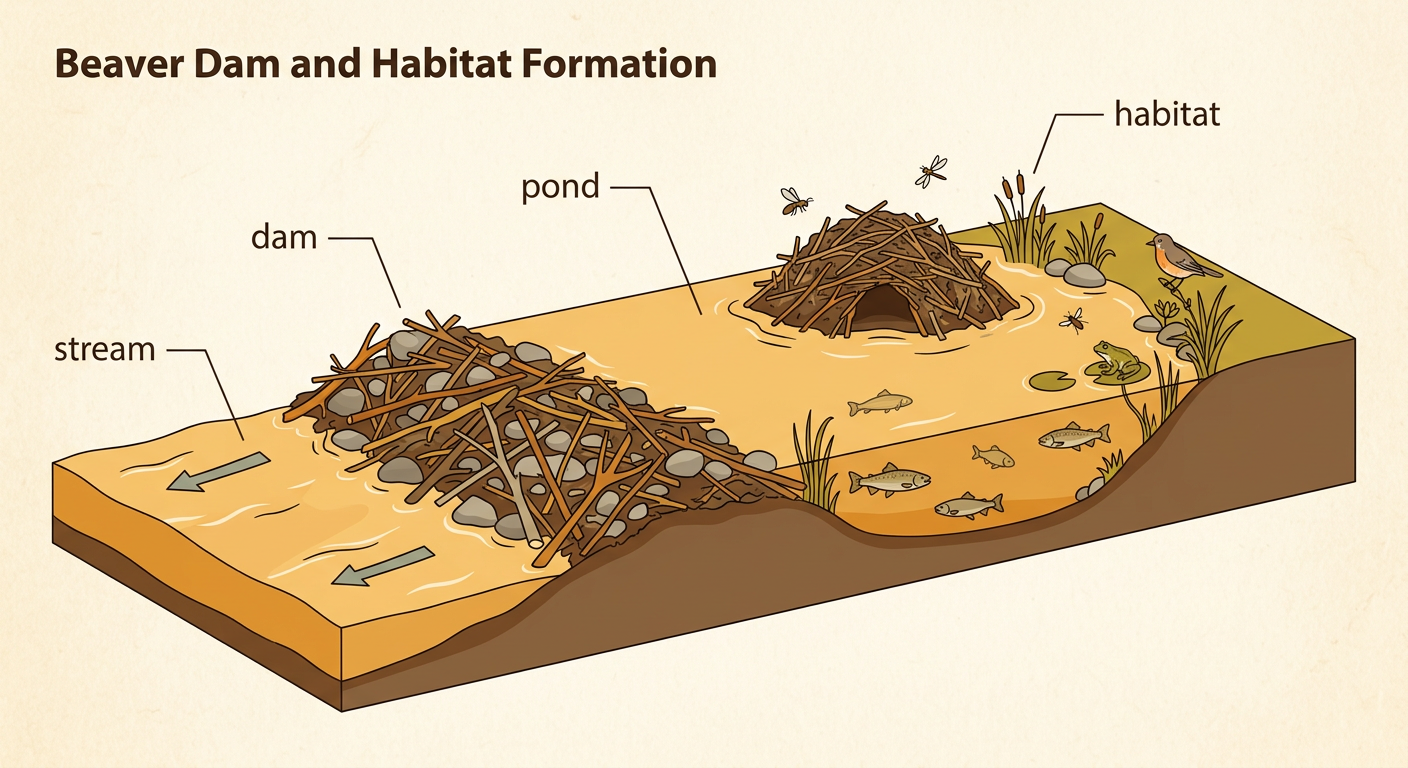
Read this passage slowly and think about what all the sentences have in common. Beavers are animals that can change the places where they live. They cut down small trees and gather branches, sticks, stones, and mud. Beavers use these materials to build dams across streams. A dam slows the moving water and creates a pond. The pond gives beavers a protected place to build their homes. It may also become a habitat for frogs, fish, insects, and birds. By building dams, beavers create watery environments that many living things can use. As you read, notice repeated ideas about building, changing the environment, and helping create habitats. These clues can lead you to the passage’s main idea.
Identify Important Details
Key details are facts that directly help explain the main idea. Return to the passage and select information that appears important, not merely interesting. One key detail is that beavers use branches, sticks, stones, and mud to build dams. A second key detail is that a dam slows water and creates a pond. A third key detail is that the pond can provide habitat for beavers, frogs, fish, insects, and birds. These details show what beavers do and what happens because of their work. A detail such as “Beavers cut down small trees” is useful when it explains how they gather building materials. When choosing details, ask, “Does this fact help me understand the author’s most important point?” If it does not, it may be a minor detail.

Connect Details to the Main Idea
Now combine the key details to state the main idea: “By building dams, beavers change streams into pond habitats that help many living things.” Each detail supports a different part of this idea. The fact that beavers gather materials explains how they build dams. The fact that dams slow water explains how a stream becomes a pond. The fact that many animals use the pond explains why the new habitat matters. To explain the connection, use a sentence frame such as, “This detail supports the main idea because it shows...” For example, “The detail that frogs, fish, insects, and birds use the pond supports the main idea because it shows that the habitat helps many living things.” A strong explanation tells how the detail proves or clarifies the main idea.

Independent Practice and Exit Check
Read this new passage: Hummingbirds have body parts that help them feed from flowers. Their long, narrow bills can reach deep inside blossoms. Their tongues quickly collect nectar, a sweet liquid made by flowers. Hummingbirds can also hover in one place while they drink. Try the work on your own. First, name the topic. Next, write the main idea as a complete sentence. Then list two key details and explain how each one supports the main idea. A strong answer might state, “Hummingbirds have special body parts and movements that help them get nectar from flowers.” For your exit check, answer this question: How does the detail about hovering support the main idea? It supports the idea because hovering helps a hummingbird stay beside a flower while it drinks nectar.
