
Finding the Main Idea
Students determine the main idea of an informational text and explain how key details support it.
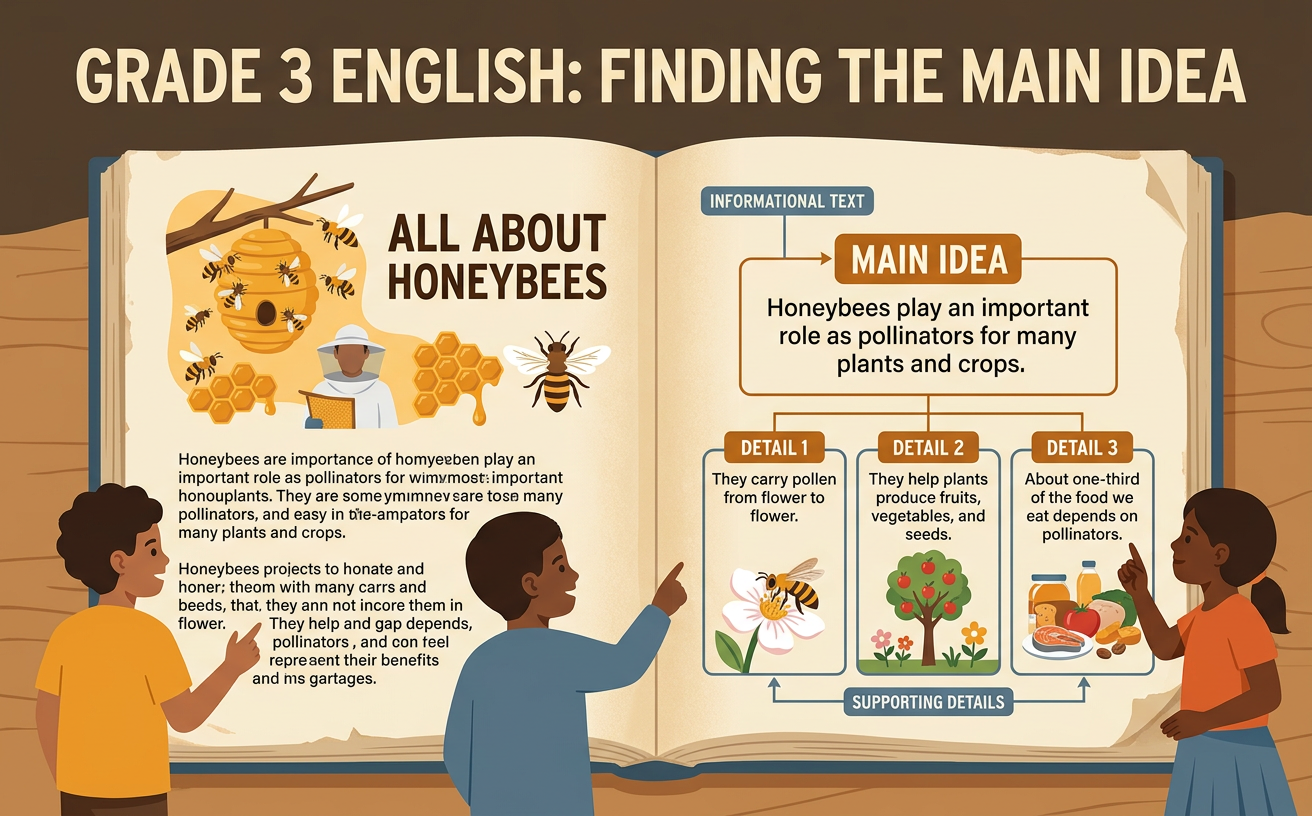
Illustrations are auto-generated and may be placeholders. They can be refreshed to match the narration.
Topic or Main Idea
The topic tells what an informational text is mostly about. It can often be named with one or two words, such as bees, weather, or recycling. The main idea tells the most important point the author wants readers to understand about the topic. It is usually a complete sentence. For example, the topic of a text might be honeybees. Its main idea might be, “Honeybees help many plants reproduce by carrying pollen from flower to flower.” Before deciding on the main idea, ask, “What subject appears throughout the text?” Then ask, “What does the author want me to understand about that subject?” A main idea should be broad enough to cover the whole text, but specific enough to express one clear point.
Read the Informational Text
Read this short informational text carefully. “Beavers Help Wetlands. Beavers use branches, logs, and mud to build dams across streams. A dam slows the moving water and forms a pond. The pond gives frogs, fish, insects, and birds places to find food or shelter. Water stored near the dam also keeps the surrounding soil wet, which helps many plants grow. By building dams, beavers create and improve wetland habitats for many living things.” As you read, notice ideas that appear more than once or connect to several sentences. Pay attention to the title, the first and last sentences, and repeated words such as dam, pond, wetland, and habitat. Do not choose a main idea after reading only one sentence. Read the entire text so your choice covers all of its information.
Identify Key Details
Key details are important facts that explain, describe, or prove the main idea. They are not simply interesting facts. In the beaver text, one key detail is that a dam slows a stream and forms a pond. Another is that the pond gives many animals food or shelter. A third is that stored water keeps nearby soil wet and helps plants grow. These details belong together because each one shows how a beaver dam helps a wetland habitat. To find key details, ask, “Does this fact help explain the text’s most important point?” Recount the details by stating them in your own words and in a sensible order. Leave out small examples if they do not help explain the overall message.
State the Main Idea
After finding the key details, think about what they all have in common. Then state the main idea in one complete sentence. For the beaver text, a strong main idea is, “By building dams, beavers create wetland habitats that help many plants and animals.” This sentence names the topic, beavers and their dams, and tells the author’s most important point. “Beavers build dams” is too narrow because it does not include the effects on the habitat. “Beavers are amazing animals” is too broad and gives no clear information from the text. Check your main idea against every paragraph or major part of the passage. If most key details fit under it, the main idea is likely accurate.
Explain the Support
To explain support, tell how each key detail helps prove or clarify the main idea. Use words such as because, so, and this shows. For example, the detail that a dam forms a pond supports the main idea because the pond becomes part of the wetland habitat. The detail about animals finding food and shelter shows that the new habitat helps living things. The detail about wet soil and plant growth shows that the dam also improves conditions for plants. Together, these details explain more than the fact that beavers build dams. They show the helpful effects of the dams. A clear explanation can follow this pattern: “The main idea is ____. One key detail is ____. This supports the main idea because ____.”