Finding the Volume of Rectangular Prisms
Students use unit cubes and multiplication to calculate the volume of right rectangular prisms and solve real-world problems.

Illustrations are auto-generated and may be placeholders. They can be refreshed to match the narration.
Review Cubic Units
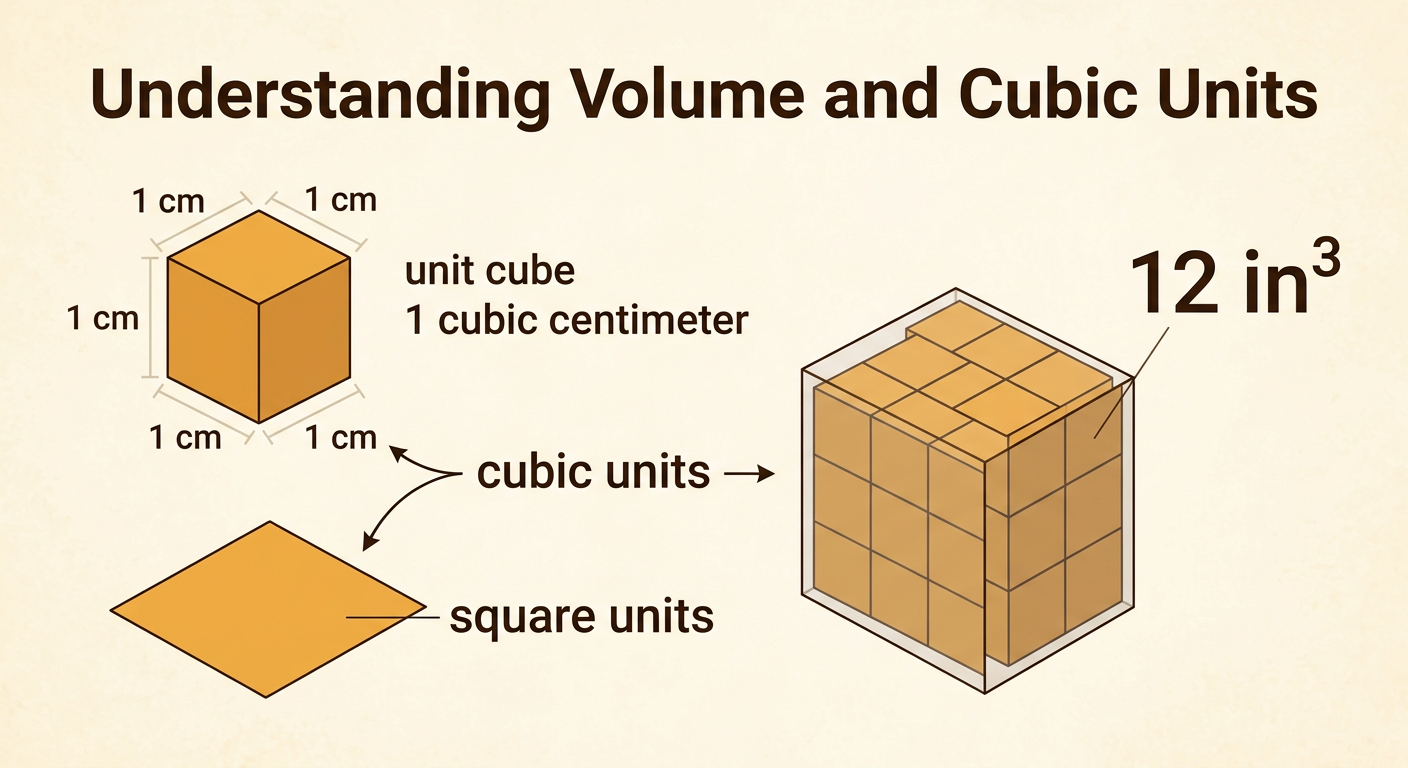
Volume measures the amount of space inside a three-dimensional object. We measure volume with cubic units. A unit cube has a length, width, and height of 1 unit. Its volume is 1 cubic unit. For example, a cube that is 1 centimeter long, 1 centimeter wide, and 1 centimeter high has a volume of 1 cubic centimeter. Cubic units are different from square units. Square units measure flat area, while cubic units measure space in three dimensions. If a small box can be completely filled with 12 one-inch cubes without gaps or overlaps, its volume is 12 cubic inches. Always write volume with a raised 3 or with the word “cubic,” such as 12 in³ or 12 cubic inches.
Build Prisms with Unit Cubes
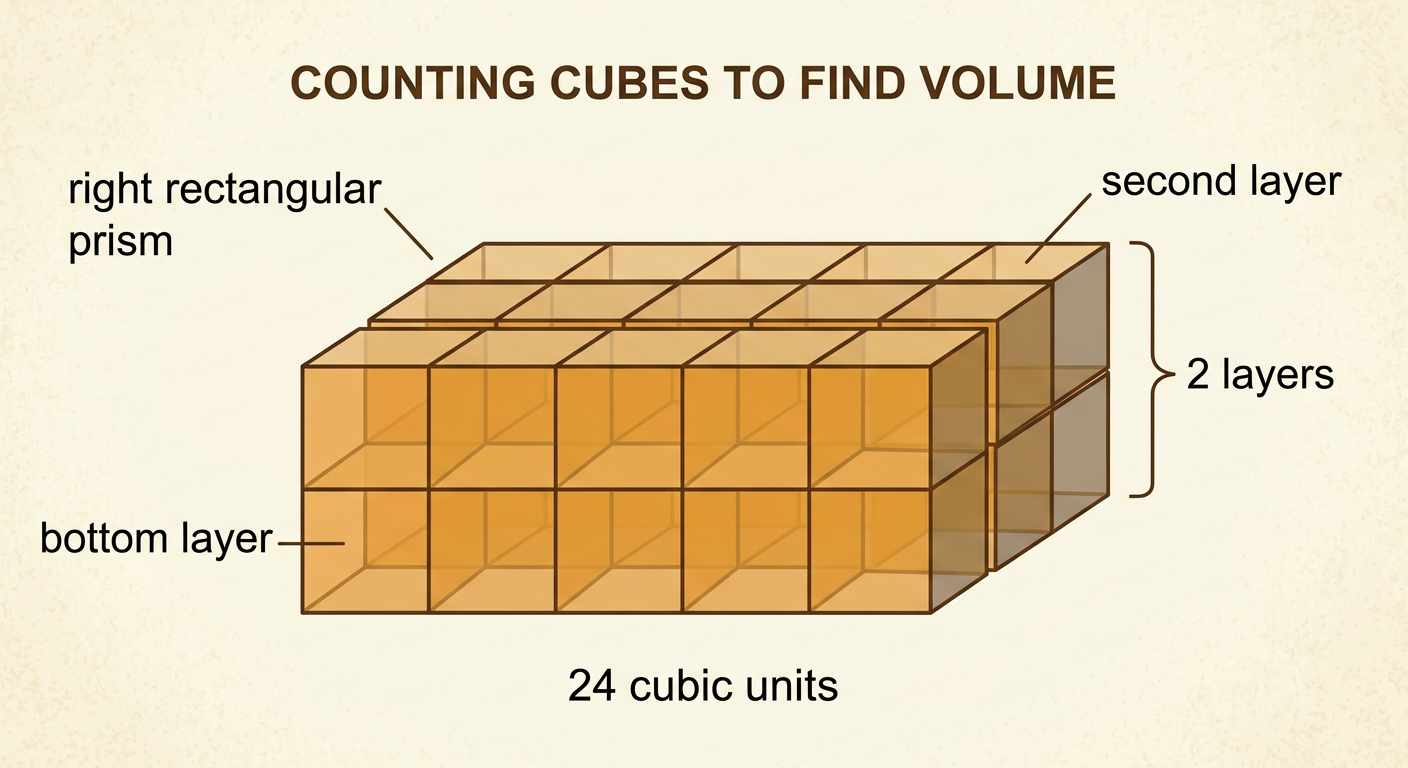
A right rectangular prism can be built by arranging unit cubes in straight rows and complete layers. Suppose you make a bottom layer that is 4 cubes long and 3 cubes wide. That layer contains 4 × 3, or 12, unit cubes. Now place a second identical layer directly on top of the first. The prism is 2 cubes high and contains 12 + 12, or 24, unit cubes. Because every cube represents 1 cubic unit, the prism’s volume is 24 cubic units. The cubes must fill the prism completely, with no gaps and no cubes sticking out. Building prisms this way helps you see that volume is not just the number of cubes visible on the outside. It is the total number of cubes throughout the solid.
Connect Layers to Multiplication
Each horizontal layer of a rectangular prism has the same number of unit cubes. First, multiply the number of cubes in each row by the number of rows to find the cubes in one layer. Then multiply by the number of layers. For example, consider a prism that is 5 units long, 2 units wide, and 3 units high. One layer contains 5 × 2 = 10 cubes. Since there are 3 equal layers, the total is 10 + 10 + 10 = 30 cubes. Multiplication gives the same result more quickly: 10 × 3 = 30. Therefore, the prism has a volume of 30 cubic units. This shows how repeated addition and multiplication are connected when finding volume.

Use the Volume Formula
You do not need to draw or count every unit cube to find the volume of a right rectangular prism. Use the formula V = l × w × h, where V is volume, l is length, w is width, and h is height. The product l × w gives the number of unit cubes in one layer. Multiplying that product by h gives the number of cubes in all the layers. For example, a prism is 8 centimeters long, 3 centimeters wide, and 4 centimeters high. Substitute the measurements into the formula: V = 8 × 3 × 4. First, 8 × 3 = 24. Then, 24 × 4 = 96. The volume is 96 cubic centimeters, written as 96 cm³.

Solve a Real-World Volume Problem
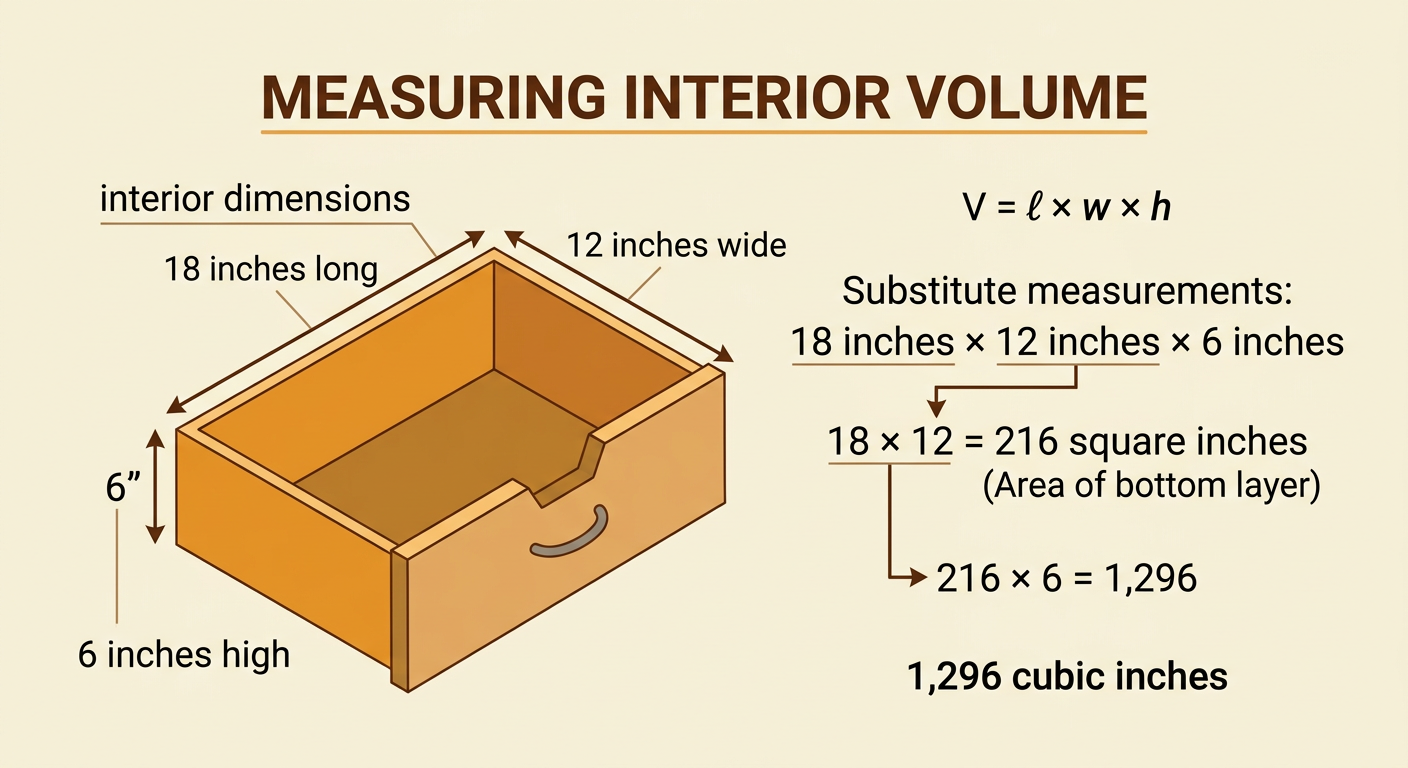
Volume can help determine how much space is available inside a container. Imagine a rectangular storage drawer with interior dimensions of 18 inches long, 12 inches wide, and 6 inches high. To find its interior volume, use V = l × w × h. Substitute the measurements: V = 18 × 12 × 6. First, multiply 18 × 12 to find the area of the bottom layer, which is 216 square inches. Then multiply by the height: 216 × 6 = 1,296. The drawer’s interior volume is 1,296 cubic inches. This answer describes the space inside the drawer, not the amount of material used to make it. Using interior measurements is important when deciding whether objects will fit inside a container.