
First Line of Defense: Stopping Germs
Students model how germs spread and explain how body structures and community health practices help prevent infection.

Illustrations are auto-generated and may be placeholders. They can be refreshed to match the narration.
What Are Germs?
Germs are tiny organisms or particles that can sometimes cause disease. They include certain bacteria, viruses, fungi, and protozoa. Most bacteria and fungi do not make people sick, and some are helpful. Disease-causing germs can enter the body, reproduce, or take over living cells. This may lead to an infection. The body has structures that help stop germs before they cause harm. For example, an influenza virus may travel from a sick person to another person’s nose or mouth. If the virus enters body cells, it can make more copies of itself. Because germs are too small to see without special tools, people use microscopes, tests, and models to study them.

How Germs Travel
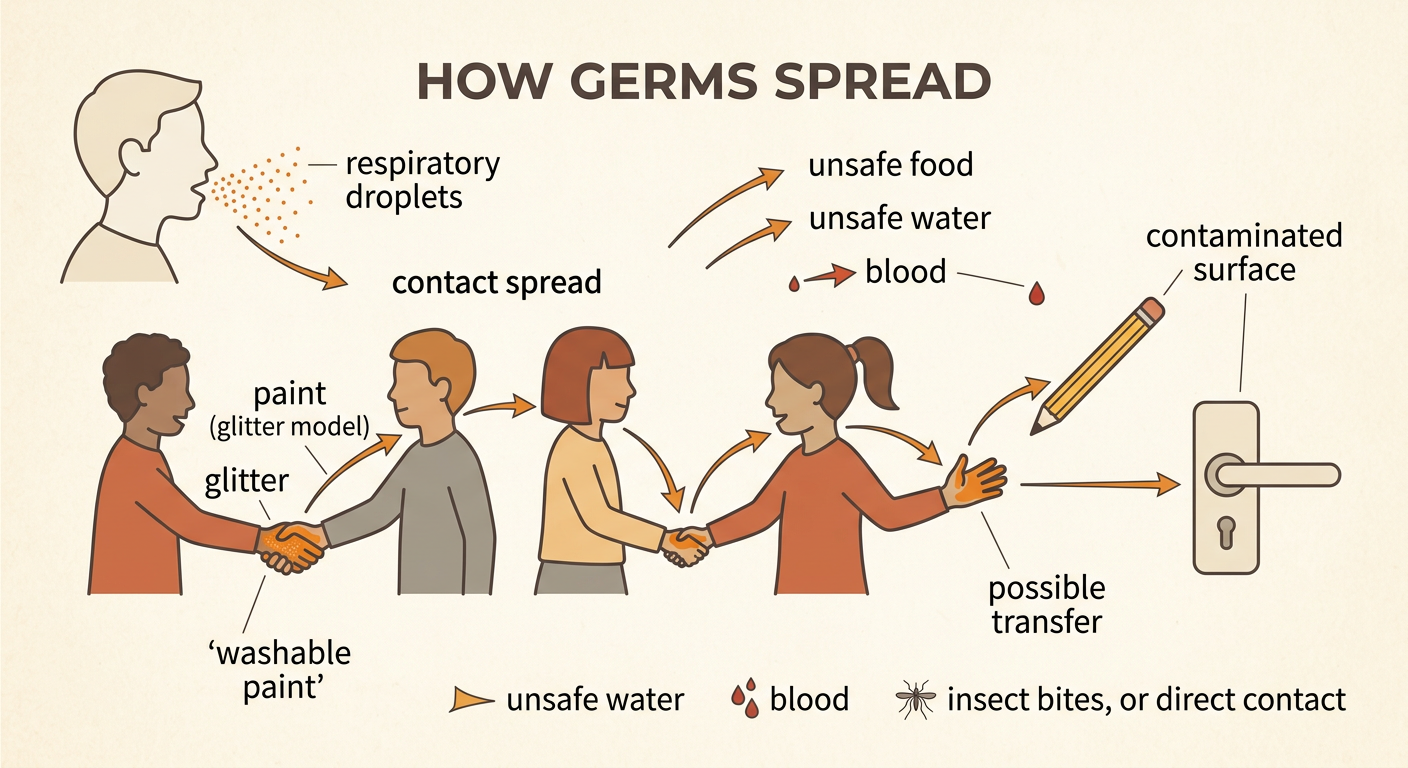
Germs can travel in several ways. Respiratory droplets may leave a person’s mouth or nose during a cough, sneeze, or conversation. Some germs spread when hands touch a contaminated surface and then touch the eyes, nose, or mouth. Others travel through unsafe food, unsafe water, blood, insect bites, or direct contact. A classroom can model contact spread with washable paint or glitter. If one student has a small amount on a hand and shakes hands with two classmates, traces may appear on their hands. When those classmates touch pencils or door handles, the material may spread farther. The paint or glitter represents possible transfer, but it does not behave exactly like real germs. Real transmission depends on the germ, the amount transferred, time, and other conditions.
Skin and Mucus: Protective Barriers
The body’s external and internal structures work together to support survival. Unbroken skin forms a strong outer barrier that blocks many germs. Oils and helpful microbes on the skin also make it harder for some harmful germs to grow. Inside the nose and airways, sticky mucus traps dust and germs. Tiny hairlike structures called cilia move mucus toward the throat, where it can be swallowed or coughed out. Tears help wash particles from the eyes, and stomach acid destroys many swallowed germs. A cut creates an opening in the skin barrier. Washing a small cut with clean water and covering it with a clean bandage helps protect the opening while the skin repairs itself. These barriers are called the first line of defense because they act before many germs enter body tissues.

Model and Calculate the Spread
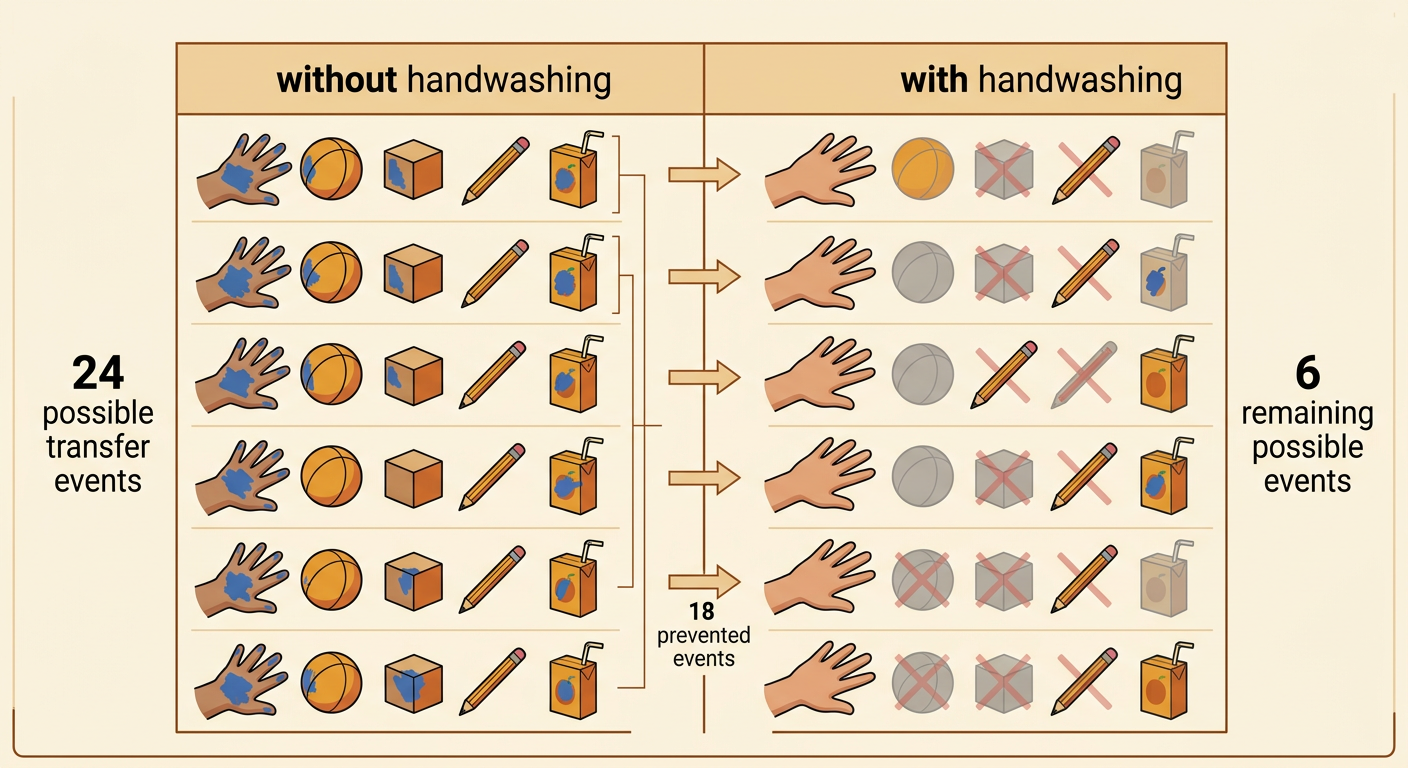
A model can help students measure patterns of possible germ transfer. Suppose six students have washable marker on their hands, and each student touches four shared objects. That produces 6 × 4 = 24 possible transfer events. Next, imagine that handwashing occurs before three of each student’s four touches. The number of prevented events is 6 × 3 = 18. The number of remaining possible events is 24 − 18 = 6. This multistep calculation compares two conditions in the model. Students can organize the data in a table and explain each operation. The answer does not mean exactly six infections will occur. A touch may not transfer a germ, and contact does not always cause infection. The model only shows how changing one behavior can reduce opportunities for spread.
Community Practices That Protect Health
Communities use shared practices to reduce opportunities for germs to spread. Schools may provide soap, schedule cleaning, improve ventilation, teach safe food handling, and ask people to cover coughs. Vaccination programs help the immune system prepare for specific diseases and can reduce spread in a community. Rules and laws can make these practices more consistent, such as requirements for safe drinking water or clean restaurant kitchens. Such policies affect how people act and can improve public health. People can also work to change a rule. For example, students who notice empty soap dispensers could collect observations, propose a daily supply check, speak at a school meeting, and ask leaders to adopt the plan. Leaders should consider scientific evidence, costs, fairness, and community needs before creating or changing a health rule.

Make an Evidence-Based Claim
An evidence-based argument includes a claim, evidence, and reasoning. A claim answers a question. Evidence provides specific facts, observations, or data. Reasoning explains how the evidence supports the claim. For example, a student might claim, “Washing hands before touching shared objects reduces opportunities for germs to spread.” The model provides evidence: possible transfer events decreased from 24 to 6, a reduction of 18 events. Scientific information adds more evidence: unbroken skin blocks many germs, while mucus traps particles that enter the nose. The reasoning connects these facts by explaining that fewer contaminated touches mean fewer chances for germs to reach the eyes, nose, mouth, or broken skin. A strong argument should also state a limitation: the classroom material models transfer, not actual infection. Students can revise their claims when new data or better evidence becomes available.
