
Fizzing Reactions: Evidence of a New Substance
Students mix baking soda and vinegar, measure the materials, and use observations such as gas formation and temperature change to explain that a chemical reaction occurred.

Illustrations are auto-generated and may be placeholders. They can be refreshed to match the narration.
Physical Change or Chemical Reaction?
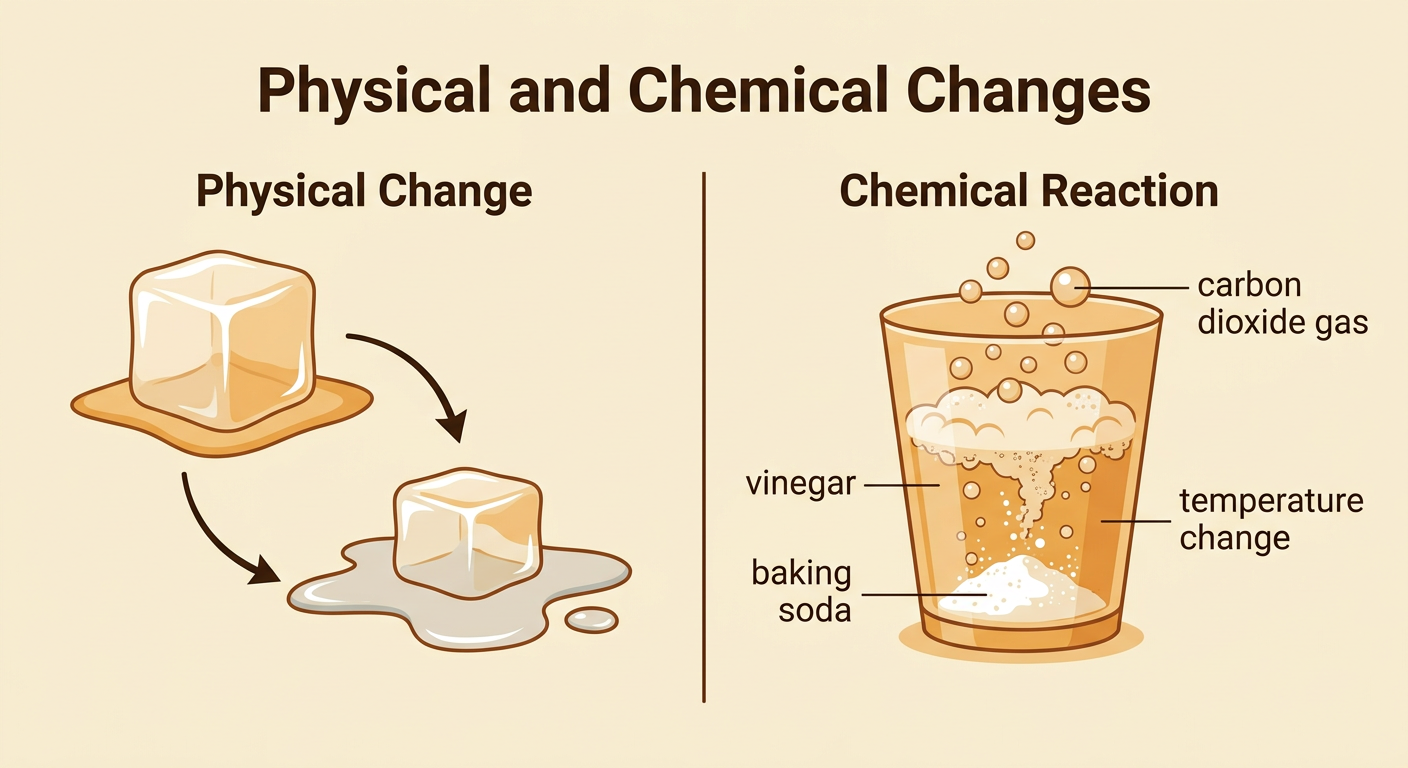
A physical change changes a material’s size, shape, or state, but it does not create a different substance. For example, an ice cube melting into liquid water is a physical change because the material is still water. A chemical reaction occurs when substances interact and form one or more new substances. Baking soda is a white solid, and vinegar is a clear liquid. When they are mixed, bubbles quickly appear. The bubbles contain carbon dioxide gas, a new substance produced by the reaction. The mixture may also become colder. Gas formation and temperature change are clues that a chemical reaction occurred. One clue alone may not prove a reaction, so scientists collect several observations and measurements before reaching a conclusion.
Measure the Starting Materials
Careful measurements make an investigation fair and repeatable. Use a balance to measure the mass of the baking soda in grams. Place an empty container on the balance, set the display to zero, and then add the baking soda. Use a graduated cylinder or measuring cup to measure the vinegar’s liquid volume in milliliters. Read the scale at eye level. For example, a group might measure 10 grams of baking soda and 50 milliliters of vinegar. Record each number and unit before mixing. Groups should use the same amounts if they want to compare their results. Students can also measure the starting temperature of the vinegar in degrees Fahrenheit or degrees Celsius. Accurate measurements help explain what was tested and allow another group to repeat the investigation.

Mix and Observe Safely
Wear safety goggles and work on a tray to catch spills. Keep the materials away from your eyes and mouth, and do not taste them. Pour the measured vinegar into a clear, open cup. Add the measured baking soda, start a timer, and watch without leaning over the cup. Do not close the mixture inside a rigid container because the gas can build pressure. Notice what happens during the first few seconds and over the next minute. For example, the mixture may fizz, foam, and rise in the cup as bubbles form. Touch only the outside of the cup to notice whether it feels cooler, or use a thermometer for a safer, more accurate measurement. Follow your teacher’s directions for cleanup, and wash your hands after the investigation.

Record Evidence of New Substances
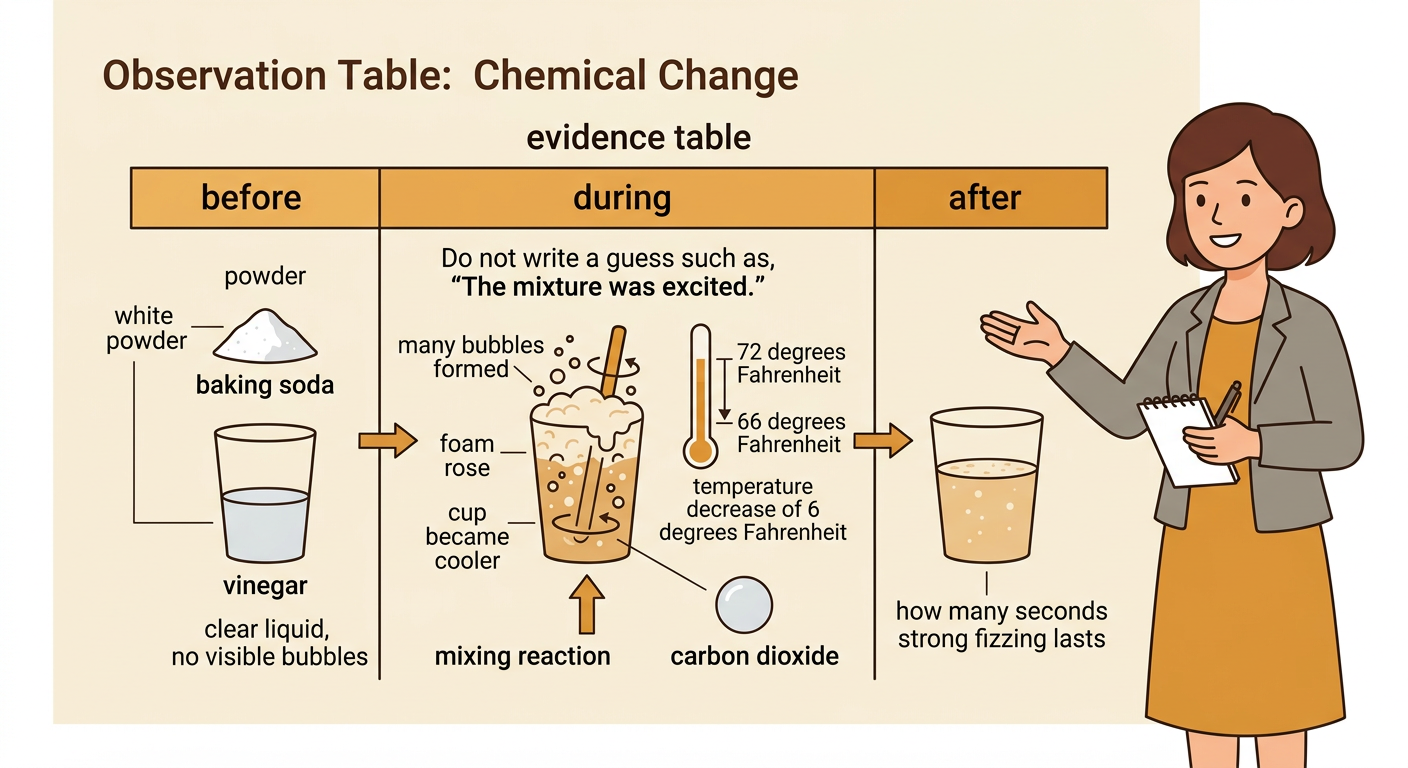
Scientists write down what they observe instead of relying on memory. Make a table with columns for evidence before, during, and after mixing. Record facts, not guesses. Before mixing, the baking soda is a white powder and the vinegar is a clear liquid with no visible bubbles. During mixing, many bubbles and foam may form. A thermometer may show that the temperature decreases. For example, the temperature might change from 72 degrees Fahrenheit to 66 degrees Fahrenheit, a decrease of 6 degrees. Record how long the strong fizzing lasts. The bubbles are evidence that a gas formed, and the temperature change shows that energy was transferred. A reliable science source can help identify the gas as carbon dioxide. Together, observations, measurements, and research provide stronger evidence than one clue by itself.
Make a Claim from the Evidence
A scientific argument includes a claim, evidence, and reasoning. The claim answers the investigation question. A useful claim is: Mixing baking soda and vinegar caused a chemical reaction that formed new substances. Evidence should include specific observations and measurements. For example, bubbles formed even though neither starting material was bubbly, and the temperature decreased by 6 degrees Fahrenheit. A trusted science source explains that the gas produced in this reaction is carbon dioxide. The reasoning connects the evidence to the claim: forming a gas with properties different from the starting materials shows that a new substance was made, and the temperature change supports that a reaction occurred. Compare results from more than one group or source. If the results differ, describe the difference honestly and explain which evidence best supports the claim.
