
Flowers and Pollinators: Partners in Plant Reproduction
Students investigate how flower structures attract pollinators and help flowering plants produce seeds.
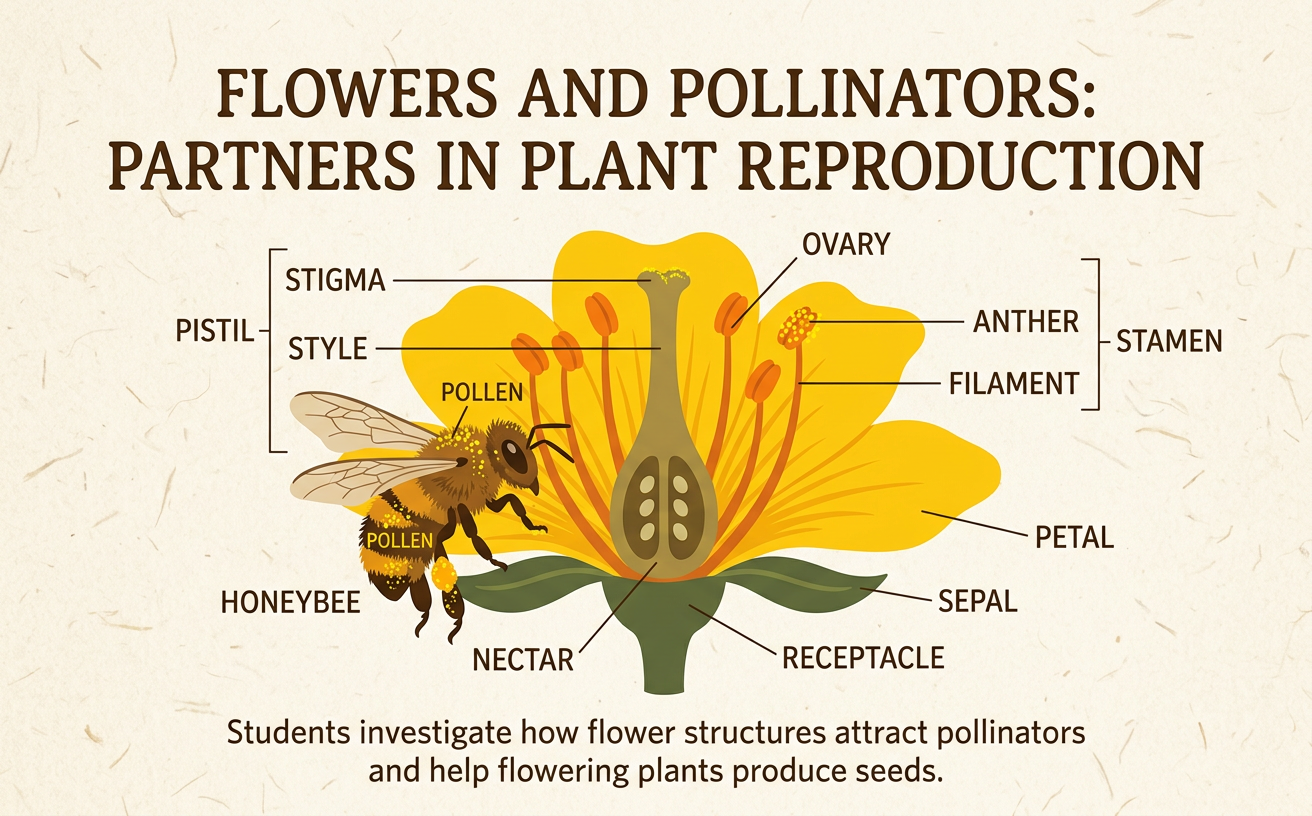
Illustrations are auto-generated and may be placeholders. They can be refreshed to match the narration.
Inside a Flower
A flower has structures that help a plant reproduce. Colorful petals and scents can attract animals to the flower. Near the center, the stamens make pollen in small parts called anthers. The pistil includes the sticky stigma, a tube called the style, and the ovary. The ovary holds ovules, which can develop into seeds after fertilization. Sepals protect the flower before it opens, and nectaries may produce sugary nectar for visiting animals. For example, when a bee enters an apple blossom to drink nectar, its body brushes against the anthers and stigma. Each structure has a job that supports the plant’s chance of producing seeds and, later, new apple trees.

The Job of Pollen
Pollen is a fine powder made in a flower’s anthers. Each tiny pollen grain carries cells needed for plant reproduction. Pollination happens when pollen reaches the stigma of a flower of the same species. A pollen tube may then grow down through the style toward an ovule inside the ovary. Fertilization occurs when a reproductive cell from the pollen joins an egg cell in the ovule. The fertilized ovule can develop into a seed, while the ovary may develop into a fruit. For example, pollen from one pumpkin flower can be carried to another pumpkin flower. If fertilization follows, the plant may form a pumpkin containing many seeds. Pollen must reach the correct kind of flower for reproduction to succeed.

How Pollinators Help
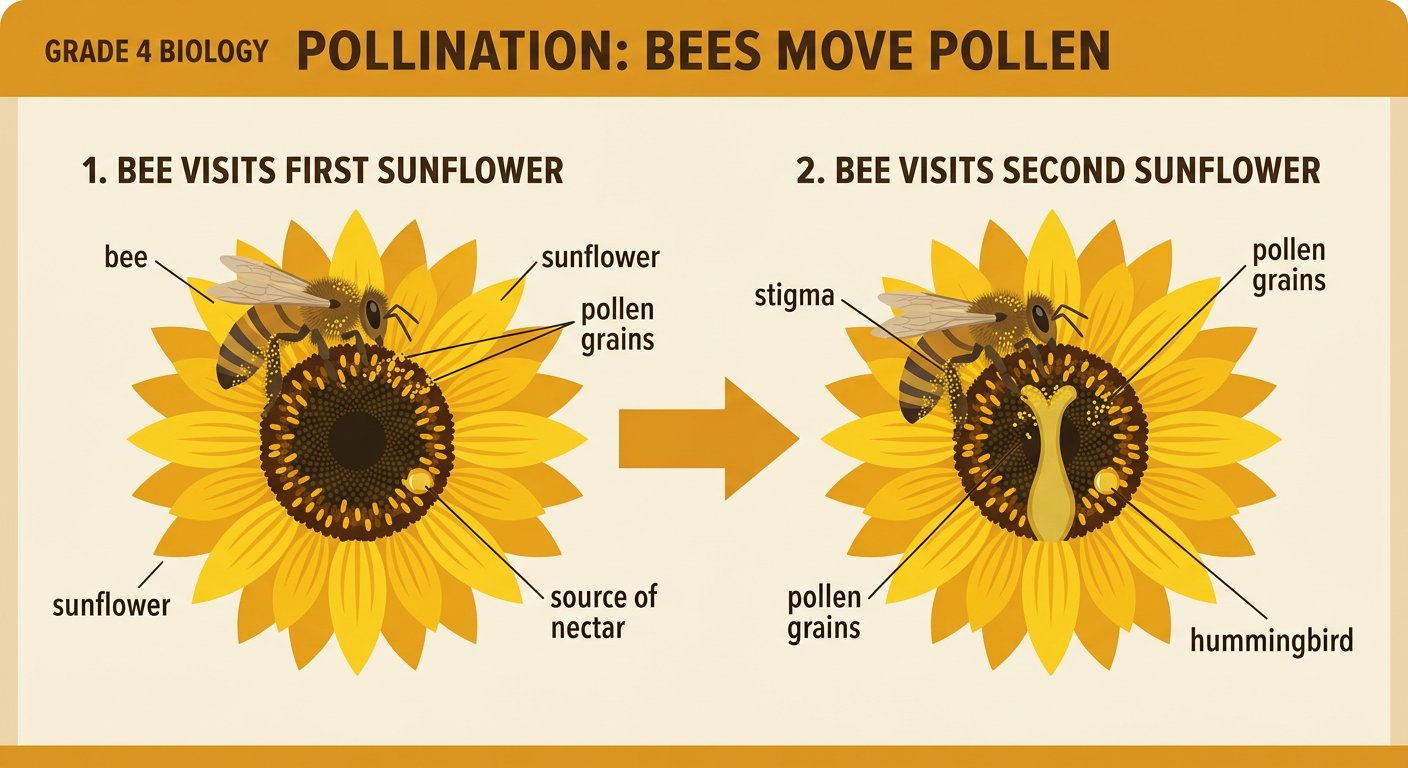
Pollinators are animals that move pollen between flowers as they search for food. Bees, butterflies, moths, beetles, hummingbirds, and some bats can be pollinators. Flowers attract them with colors, shapes, scents, nectar, or pollen. When a bee lands on a sunflower, pollen grains may stick to hairs on its body. At the next sunflower, some grains may rub onto a stigma. The bee is gathering food, but its movement also helps the plants reproduce. Different flowers attract different visitors. A long, tube-shaped flower may hold nectar that a hummingbird can reach with its long bill. Pollinators do not choose to fertilize flowers; they carry pollen, and the plant’s structures complete the later steps that can produce seeds.
Graphing Pollinator Visits
Scientists can collect data by watching flowers for equal amounts of time. Suppose a class counts bee visits during six 10-minute observation periods. The counts are 2, 3, 3, 3, 4, and 5 visits. A line plot organizes these results. Write the possible numbers of visits along a number line, and place one X above a number for each observation with that result. Three Xs above 3 show that three observation periods had exactly three bee visits. The tallest stack shows the most frequent result, which is called the mode. Students can also compare values: the greatest count, 5, is three more than the least count, 2. A line plot makes patterns easier to notice, but the data describe only the place, flowers, weather, and times that were observed.

Protecting Pollinator Habitats
Pollinators need places that provide food, water, shelter, and safe nesting sites. Human activities can change these environmental characteristics. Replacing a meadow with pavement removes flowering plants and bare soil where some bees nest. Mowing every flower at once can reduce food, and incorrect pesticide use can harm pollinators. People can also improve a place. A school can plant native flowers that bloom in spring, summer, and fall, leave a small patch of bare ground, and avoid spraying pesticides near open flowers. For example, a parking-lot edge with only short grass may offer little food. Changing it into a garden with milkweed, asters, and other native plants creates nectar, pollen, and shelter. Protecting habitats helps pollinators survive and helps flowering plants reproduce.
