
Fluently Computing with Multi-Digit Decimals
Students use place value and standard algorithms to accurately add, subtract, multiply, and divide multi-digit decimals in practical contexts.
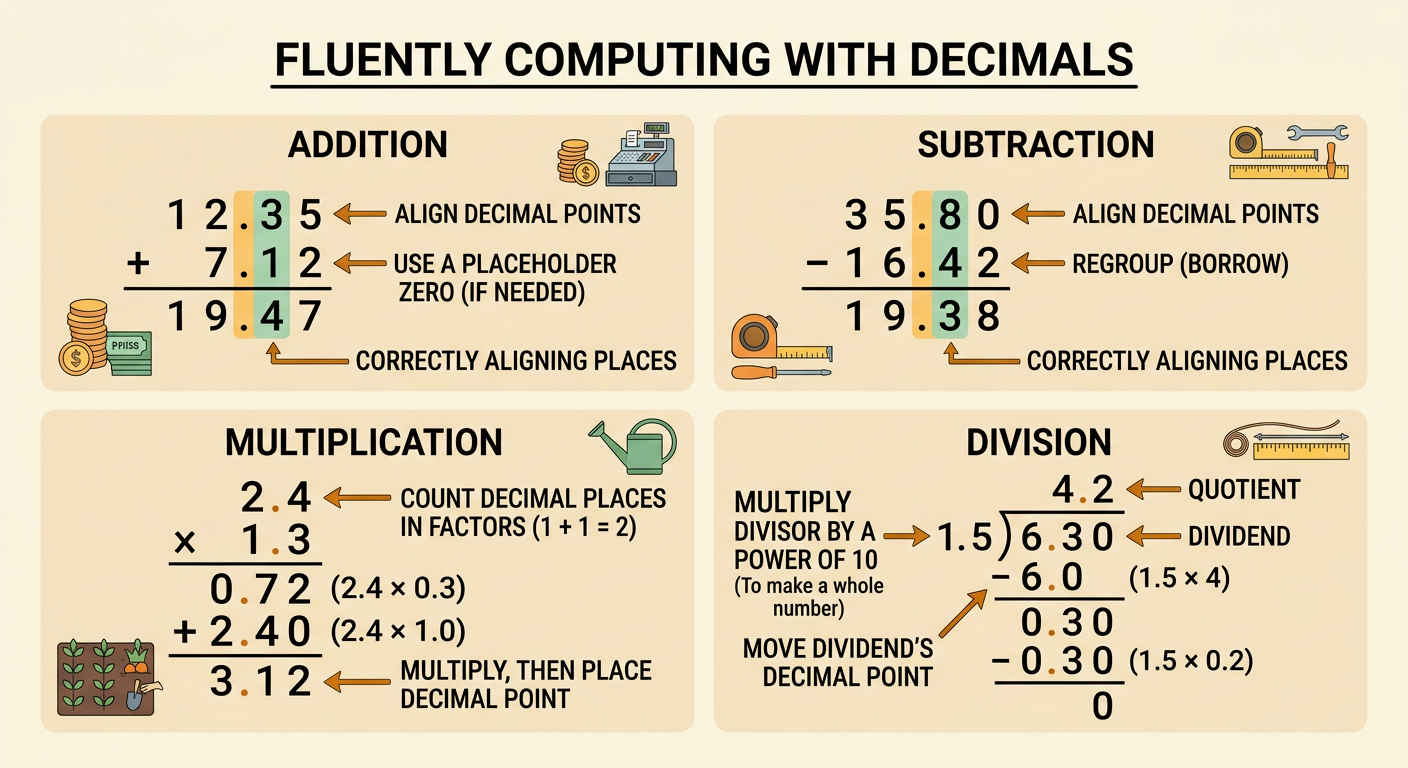
Illustrations are auto-generated and may be placeholders. They can be refreshed to match the narration.
Decimal Place-Value Review
A decimal’s value depends on the position of each digit. Positions to the left of the decimal point represent ones, tens, hundreds, and greater values. Positions to the right represent tenths, hundredths, thousandths, and smaller values. In 407.306, the 4 represents 400, the 7 represents 7, the 3 represents 3 tenths, and the 6 represents 6 thousandths. The zeros hold important places even though they add no value. You may write extra zeros at the end of a decimal without changing its value, so 5.2 equals 5.200. Place value also explains regrouping: one whole can be regrouped as ten tenths, and one tenth can be regrouped as ten hundredths. Understanding these relationships helps you use every decimal algorithm accurately.

Adding and Subtracting Decimals
To add or subtract decimals, write the numbers vertically and align their decimal points. This places digits with the same place value in one column. Add zeros when they help show empty places. For example, write 18.75 as 18.750 before adding 4.086. Working from right to left gives 18.750 + 4.086 = 22.836. Use regrouping when a column has a sum of 10 or more. Subtraction follows the same alignment rule. To find 32.4 − 7.86, write 32.400 − 7.860. Regroup across the place-value columns as needed to get 24.540, or 24.54. Bring the decimal point straight down into the answer. Never align decimal numbers by their final digits because those digits may represent different place values.

Multiplying Multi-Digit Decimals
To multiply multi-digit decimals, first multiply as if both factors were whole numbers. Then place the decimal point in the product. Count the total number of decimal places in the factors; the product must have that many decimal places. For example, consider 3.24 × 1.6. Multiply 324 × 16 using the standard algorithm. The first partial product is 1,944, and the second partial product is 3,240 because the 1 in 16 represents one ten. Their sum is 5,184. The factors 3.24 and 1.6 have three decimal places altogether, so place the decimal three digits from the right: 5.184. Multiplication may produce a product with more decimal places than either factor, so counting carefully is essential.
Dividing Multi-Digit Decimals
When dividing by a decimal, first make the divisor a whole number. Move the divisor’s decimal point to the right, and move the dividend’s decimal point the same number of places. This keeps the quotient unchanged because both numbers are multiplied by the same power of ten. For example, 12.96 ÷ 2.4 becomes 129.6 ÷ 24 after both decimal points move one place right. Use long division to find that 24 goes into 129 five times, with 9.6 remaining. Then 9.6 ÷ 24 equals 0.4, so the quotient is 5.4. Place the quotient’s decimal point directly above the new decimal point in the dividend. Check the result by multiplying: 2.4 × 5.4 = 12.96.

Choosing an Operation
Before calculating, decide what the quantities mean and how they are related. Use addition to combine amounts, subtraction to find a difference or an amount left, multiplication to find equal groups, and division to separate an amount into equal groups or find a rate. Do not choose an operation from one keyword alone. Instead, identify what is known and what the question asks. Suppose three notebooks cost $4.75 each and a coupon reduces the total by $2.20. First multiply to find the cost of three equal items: 3 × $4.75 = $14.25. Then subtract the coupon: $14.25 − $2.20 = $12.05. This problem requires two operations because the situation has two steps. Labeling amounts and units helps show whether your plan makes sense.

Estimate and Check
Estimate before calculating so you know the approximate size of a reasonable answer. Use compatible numbers or round to convenient place values. For example, to estimate 47.82 × 3.09, round 47.82 to 48 and 3.09 to 3. The estimate is 48 × 3 = 144. Using the standard algorithm gives the exact product 147.7638, which is close to 144 and therefore reasonable. A misplaced decimal could produce 14.77638 or 1,477.638, but the estimate shows that those answers are not sensible. You can also check with an inverse operation: addition checks subtraction, subtraction checks addition, multiplication checks division, and division checks multiplication. Finally, review decimal placement, regrouping, and copied digits. Estimation and inverse operations help detect errors, but they do not replace an accurate calculation.
