Fluid Mechanics: Pressure, Buoyancy, and Flow
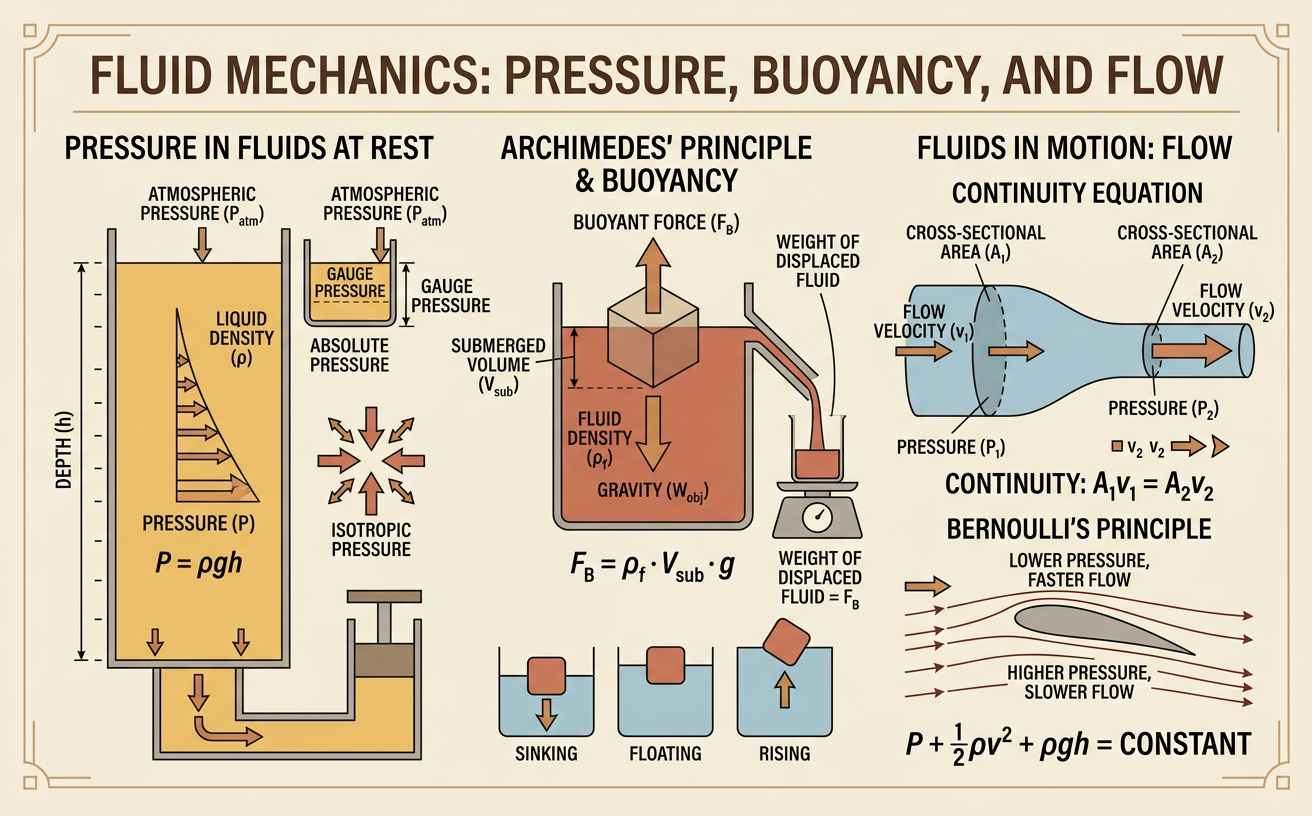
Students use pressure, Archimedes’ principle, the continuity equation, and Bernoulli’s principle to explain and predict the behavior of fluids at rest and in motion.
Illustrations are auto-generated and may be placeholders. They can be refreshed to match the narration.
Density and Fluid Pressure
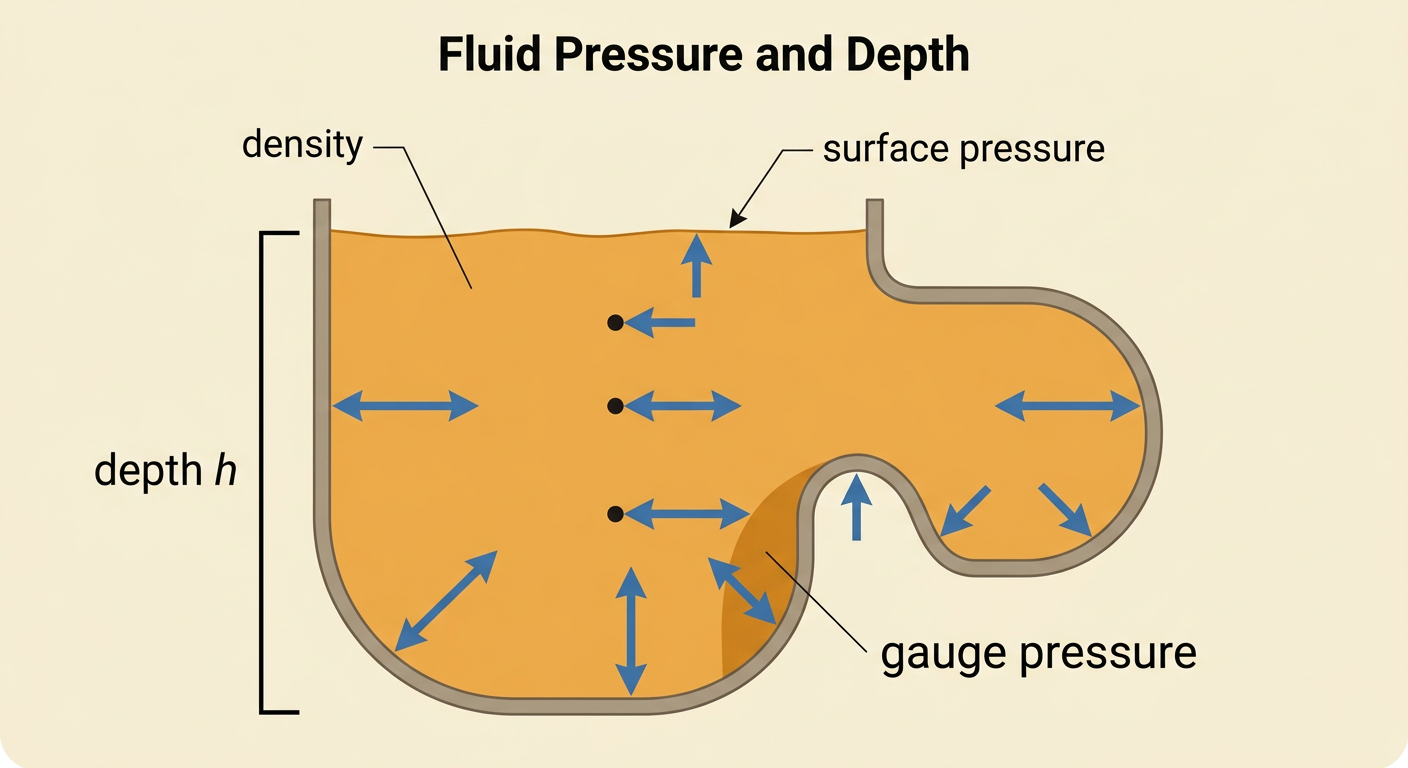
Density describes how much mass occupies a given volume: ρ = m/V. A fluid exerts pressure, defined as force per unit area, P = F/A, in every direction and perpendicular to any surface it touches. In a fluid at rest, pressure increases with depth because deeper points support more fluid above them. The pressure at depth h is P = P₀ + ρgh, where P₀ is surface pressure. For example, 3.0 meters below the surface of freshwater, the gauge pressure is approximately (1000 kg/m³)(9.8 m/s²)(3.0 m), or 29,400 pascals. Two points at the same depth in the same connected fluid have equal pressure, regardless of container shape. This model assumes nearly constant fluid density and uniform gravitational acceleration.
Pascal’s Principle and Hydraulic Systems
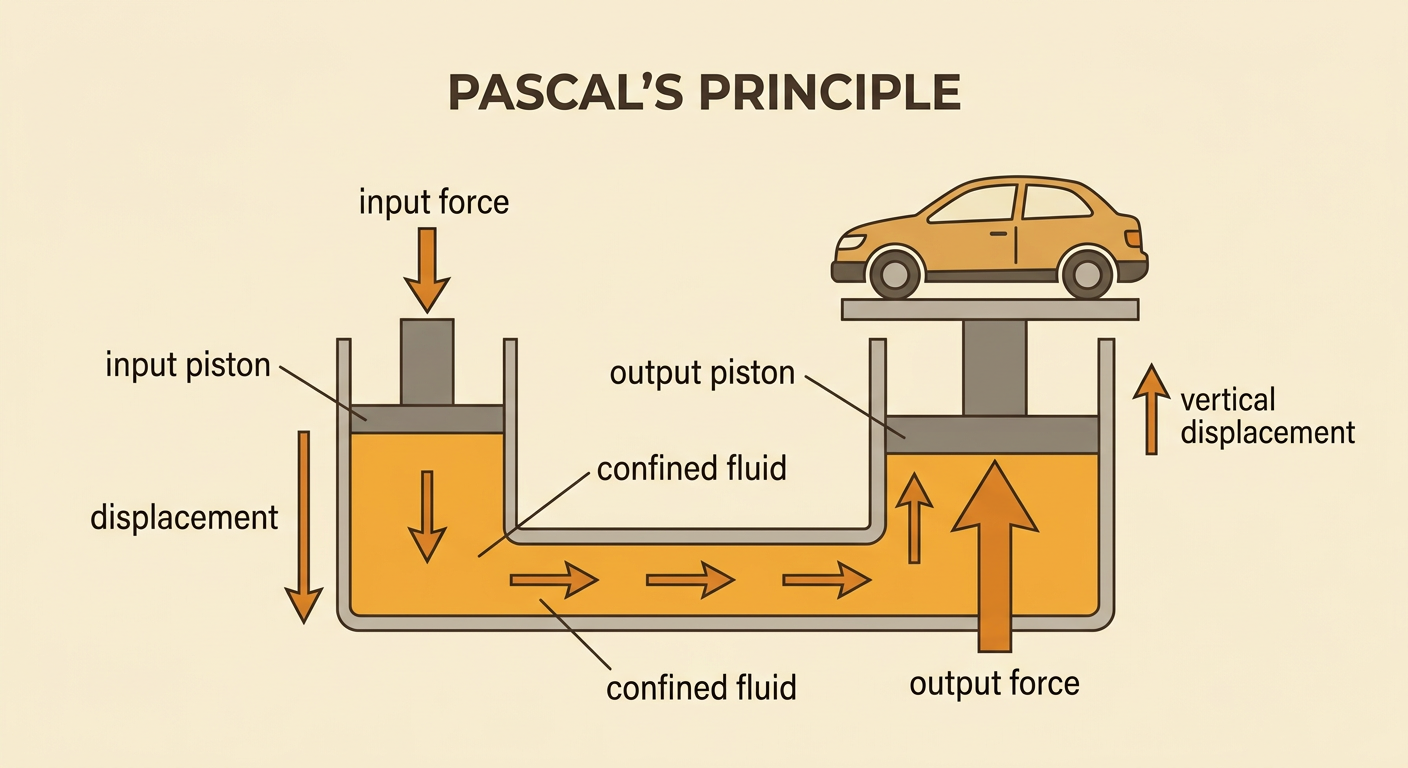
Pascal’s principle states that a pressure change applied to a confined fluid is transmitted throughout the fluid. In an ideal hydraulic system, the input and output pressures are equal, so F₁/A₁ = F₂/A₂. Rearranging highlights the output force: F₂ = F₁(A₂/A₁). If a mechanic applies 200 newtons to a piston with an area of 0.010 square meter connected to a lift piston with an area of 0.20 square meter, the ideal output force is 4,000 newtons. The system multiplies force, but it does not create energy. The smaller piston must move farther than the larger piston because input work approximately equals output work. Actual lifts produce slightly less force because of friction, fluid viscosity, leaks, and small pressure differences caused by height.
Buoyant Force and Archimedes’ Principle
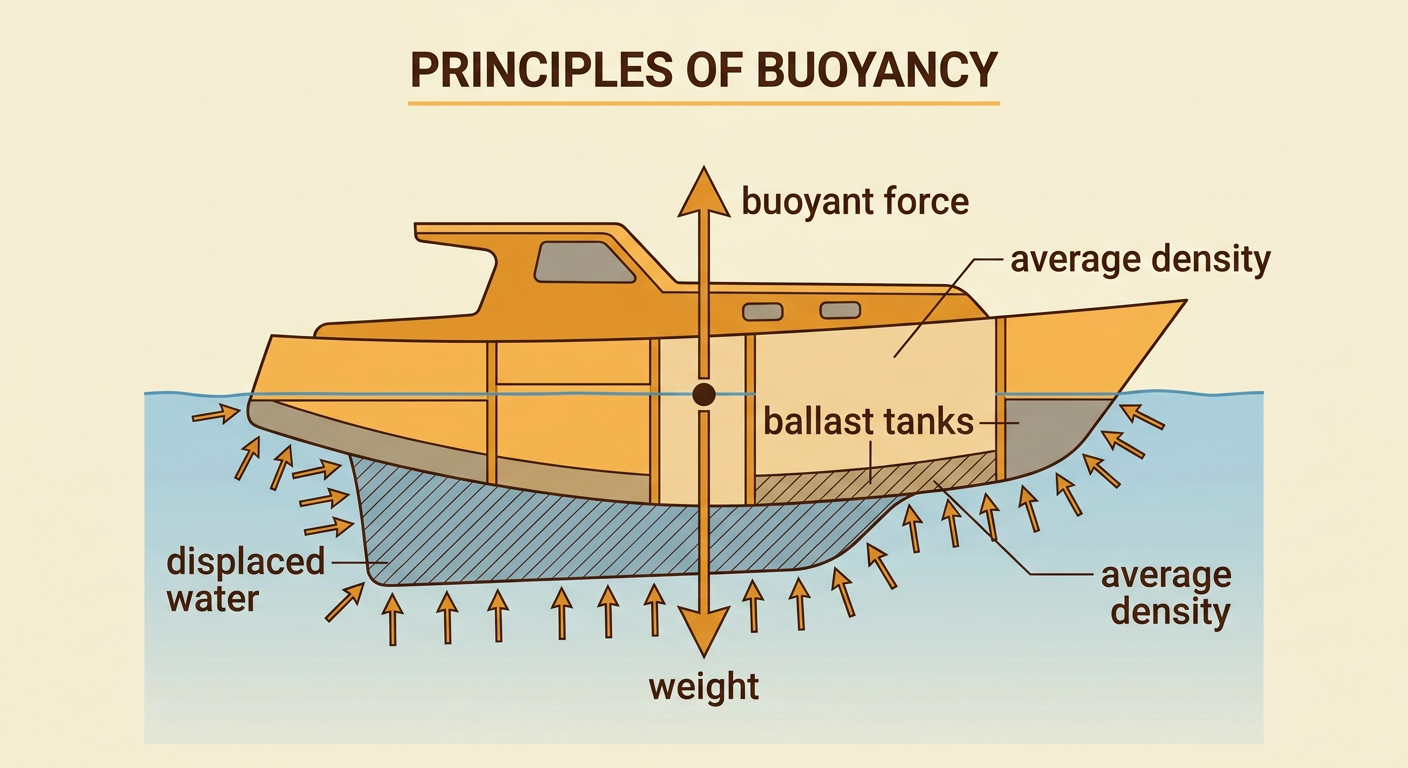
A submerged object experiences greater fluid pressure on its lower surface than on its upper surface, producing a net upward buoyant force. Archimedes’ principle gives this force as Fᵦ = ρfluid gVdisplaced. For a floating object, the buoyant force equals the object’s weight, so the object displaces a weight of fluid equal to its own weight. For example, a 500-kilogram boat floating at rest must displace about 500 kilograms of water, corresponding to approximately 0.50 cubic meter of freshwater. If an object’s average density is less than the fluid’s density, it can float; if greater, it tends to sink. A submarine changes its average density by taking water into or forcing water out of ballast tanks. Predictions may differ slightly when fluid density varies with temperature or salinity.
Continuity and Fluid Flow
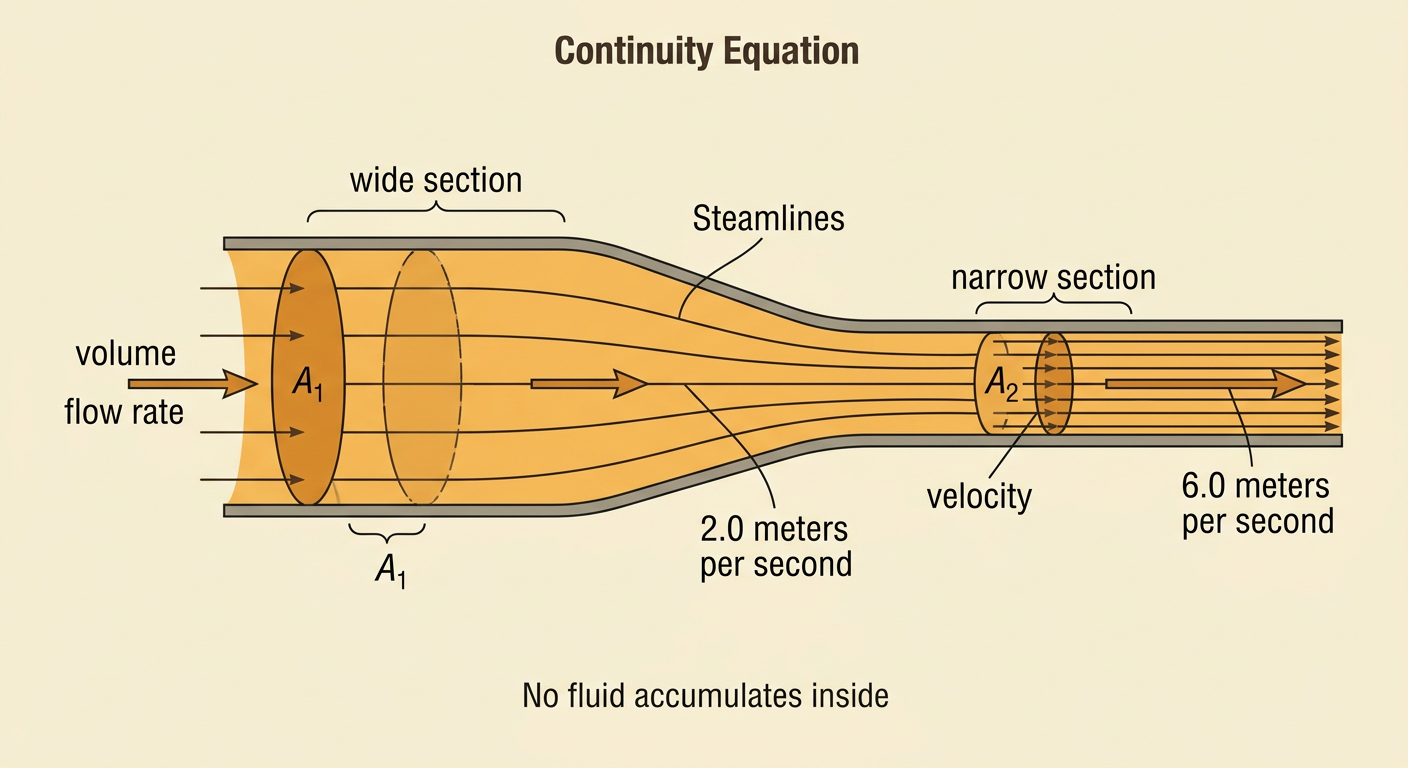
The continuity equation expresses conservation of mass in a flowing fluid. For steady flow of an incompressible fluid, the volume flow rate remains constant: Q = Av, so A₁v₁ = A₂v₂. Fluid therefore moves faster where a pipe is narrower. Suppose water flows at 2.0 meters per second through a pipe with an area of 0.030 square meter and then enters a section with an area of 0.010 square meter. Rearranging gives v₂ = A₁v₁/A₂, so the speed in the narrow section is 6.0 meters per second. This relationship explains why water speeds up when a hose opening is partly covered. Continuity alone predicts speed changes, not pressure changes. For gases whose density changes significantly, mass flow must instead be written as ρAv = constant.
Bernoulli’s Principle in Real-World Systems
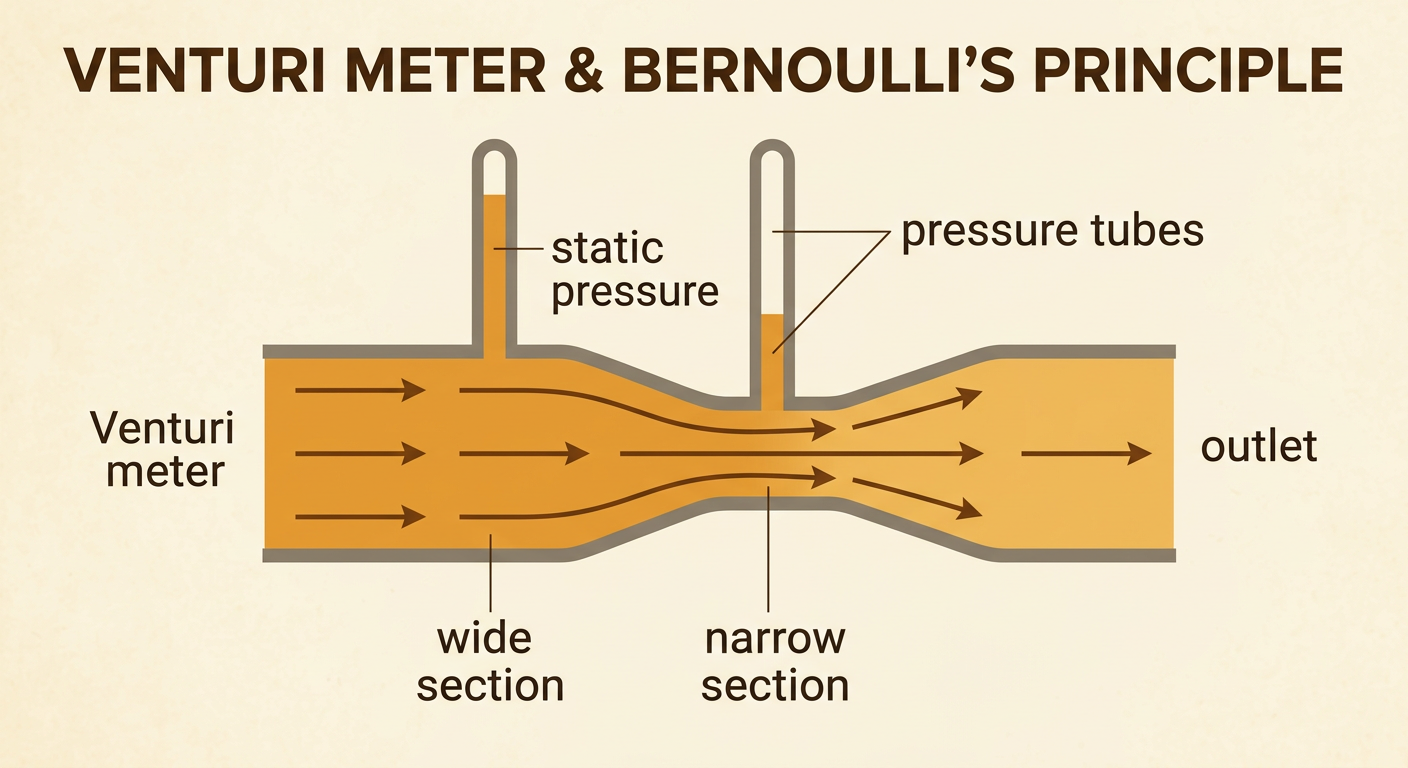
Bernoulli’s principle relates pressure, speed, and height along a streamline: P + ½ρv² + ρgh = constant. In steady, incompressible flow with negligible viscosity, an increase in speed is associated with a decrease in pressure when height stays constant. A Venturi meter uses this relationship. As water enters a narrow section, continuity requires its speed to increase, while Bernoulli’s equation predicts lower static pressure there. Pressure tubes attached to the wide and narrow sections show different fluid-column heights, providing data that can be used to calculate flow speed. Bernoulli’s principle also helps explain atomizers and pressure changes in piping systems. Real fluids lose mechanical energy through viscosity and turbulence, while pumps add energy. Therefore, engineers include energy-loss and pump terms when the ideal equation does not fit measured data.