Fluid Pressure and Buoyancy
Students calculate pressure in fluids, apply Pascal's and Archimedes' principles, and explain how density and buoyant force determine whether objects float or sink.

Illustrations are auto-generated and may be placeholders. They can be refreshed to match the narration.
Density and States of Matter
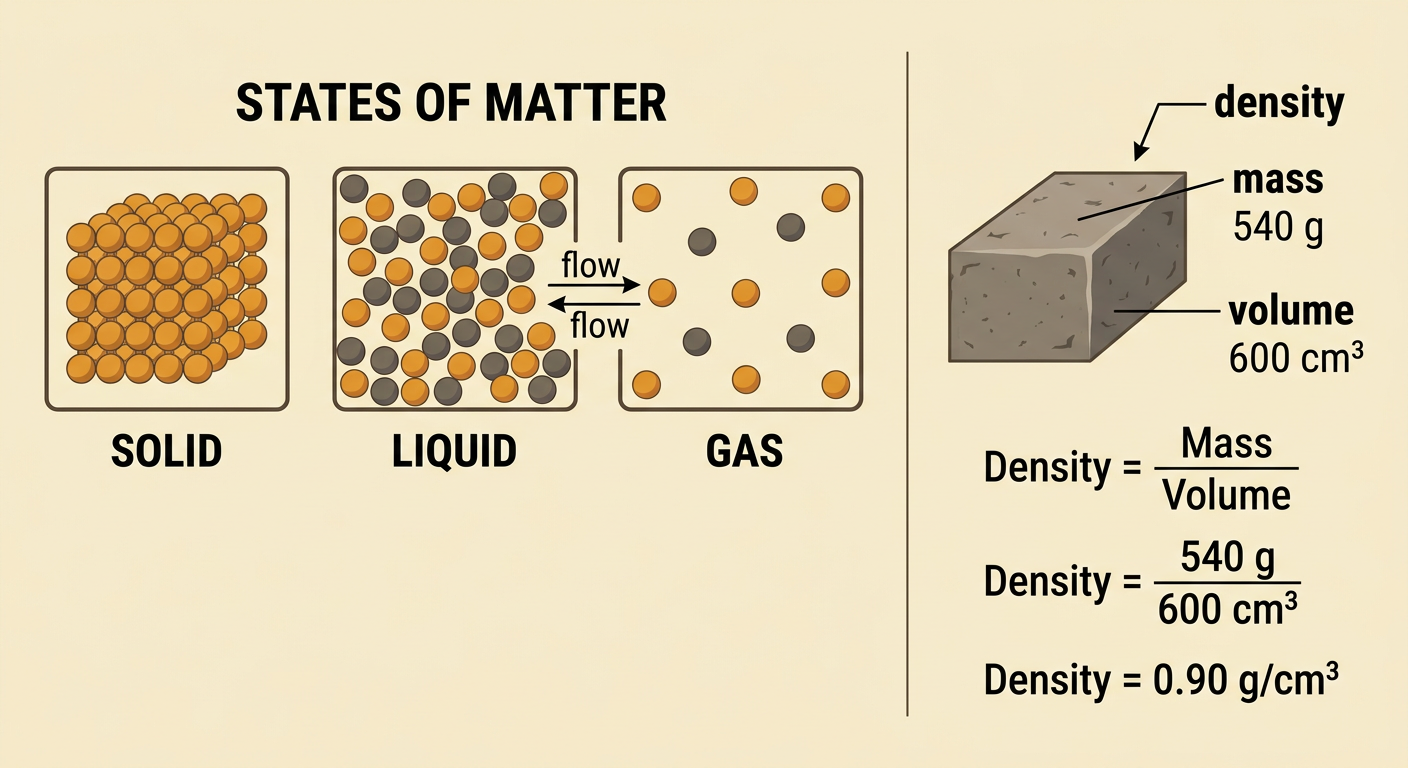
Density describes how much mass is packed into a given volume. It is calculated with ρ = m/V, where ρ is density, m is mass, and V is volume. The formula can be rearranged as m = ρV or V = m/ρ. Solids usually keep a fixed shape and volume, liquids keep a fixed volume but take the shape of their container, and gases expand to fill their container. Liquids and gases are called fluids because they can flow. Density helps predict how substances behave in fluids. For example, a 540-gram block with a volume of 600 cubic centimeters has a density of 0.90 grams per cubic centimeter. Because this is less than water’s density of about 1.00 gram per cubic centimeter, the block can float in water.
Pressure in Fluids
Pressure is force distributed over an area and is calculated using P = F/A. Its SI unit is the pascal, equal to one newton per square meter. A fluid at rest pushes in every direction, and its pressure increases with depth because deeper points support more fluid above them. In a liquid of constant density, pressure is P = Psurface + ρgh, where ρ is fluid density, g is gravitational acceleration, and h is depth. The gauge pressure, which excludes surface pressure, is ρgh. For example, at a depth of 3.0 meters in freshwater, the gauge pressure is approximately (1,000 kg/m³)(9.8 m/s²)(3.0 m), or 29,400 pascals. This is why a swimmer’s ears experience greater pressure when the swimmer dives deeper.

Pascal's Principle and Hydraulics
Pascal’s principle states that a pressure change applied to a confined fluid is transmitted throughout the fluid without being reduced. Hydraulic systems use this principle to multiply force. For two connected pistons, F₁/A₁ = F₂/A₂ when the pistons are at the same height and losses are ignored. If a mechanic applies 50 newtons to a small piston with an area of 5 square centimeters, and the large piston has an area of 100 square centimeters, then F₂ = F₁A₂/A₁ = 1,000 newtons. The large piston can therefore lift a heavy load. However, force multiplication does not create energy: the small piston must move farther than the large piston. Hydraulic brakes, vehicle lifts, and construction equipment all use this relationship between pressure, force, area, and distance.

Archimedes' Principle
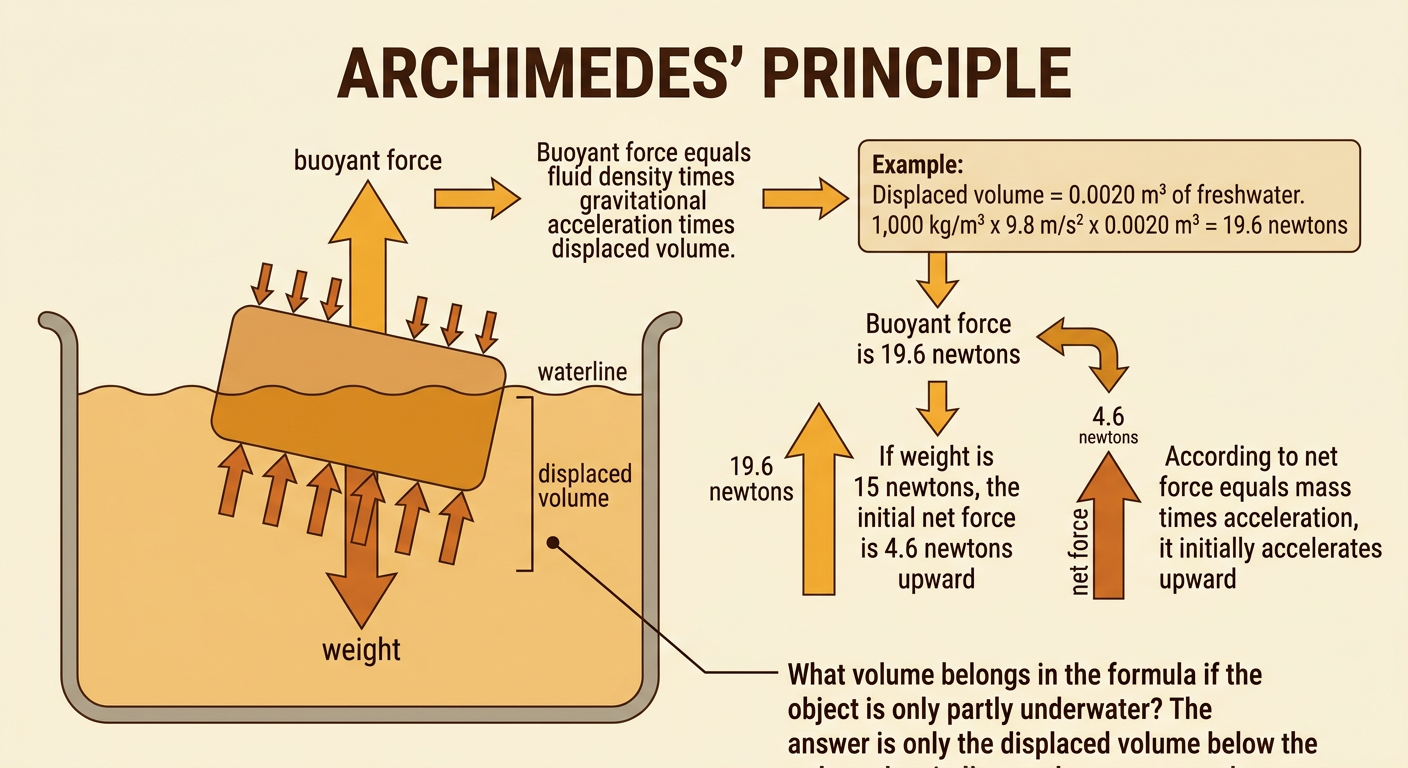
Archimedes’ principle states that the buoyant force on an object equals the weight of the fluid the object displaces. The force is calculated with Fᵦ = ρfluidgVdisplaced. Buoyant force acts upward because fluid pressure is greater on the object’s lower surface than on its upper surface. For example, an object that displaces 0.0020 cubic meter of freshwater experiences a buoyant force of (1,000 kg/m³)(9.8 m/s²)(0.0020 m³), or 19.6 newtons. If the object weighs 15 newtons, the initial net force is 4.6 newtons upward. Using Fnet = ma, this net force produces upward acceleration until other conditions, such as partial submersion or fluid resistance, change the forces. The displaced volume refers only to the portion of the object below the fluid surface.
Floating, Sinking, and Equilibrium
Whether an object floats or sinks depends on the relationship between its weight and the buoyant force. An object accelerates downward when its weight is greater than the buoyant force and upward when the buoyant force is greater. It is in equilibrium when the forces are equal, so the net force and acceleration are zero. Average density provides a useful prediction: an object less dense than the fluid floats, one more dense sinks, and one with equal density can remain suspended. A wooden block with an average density of 750 kilograms per cubic meter floats in water. At equilibrium, the fraction submerged is ρobject/ρfluid, so about 0.75, or 75 percent, of the block is underwater. A steel ship also floats because its hollow shape includes air, making its overall average density less than that of water.

Buoyancy and Maritime Safety
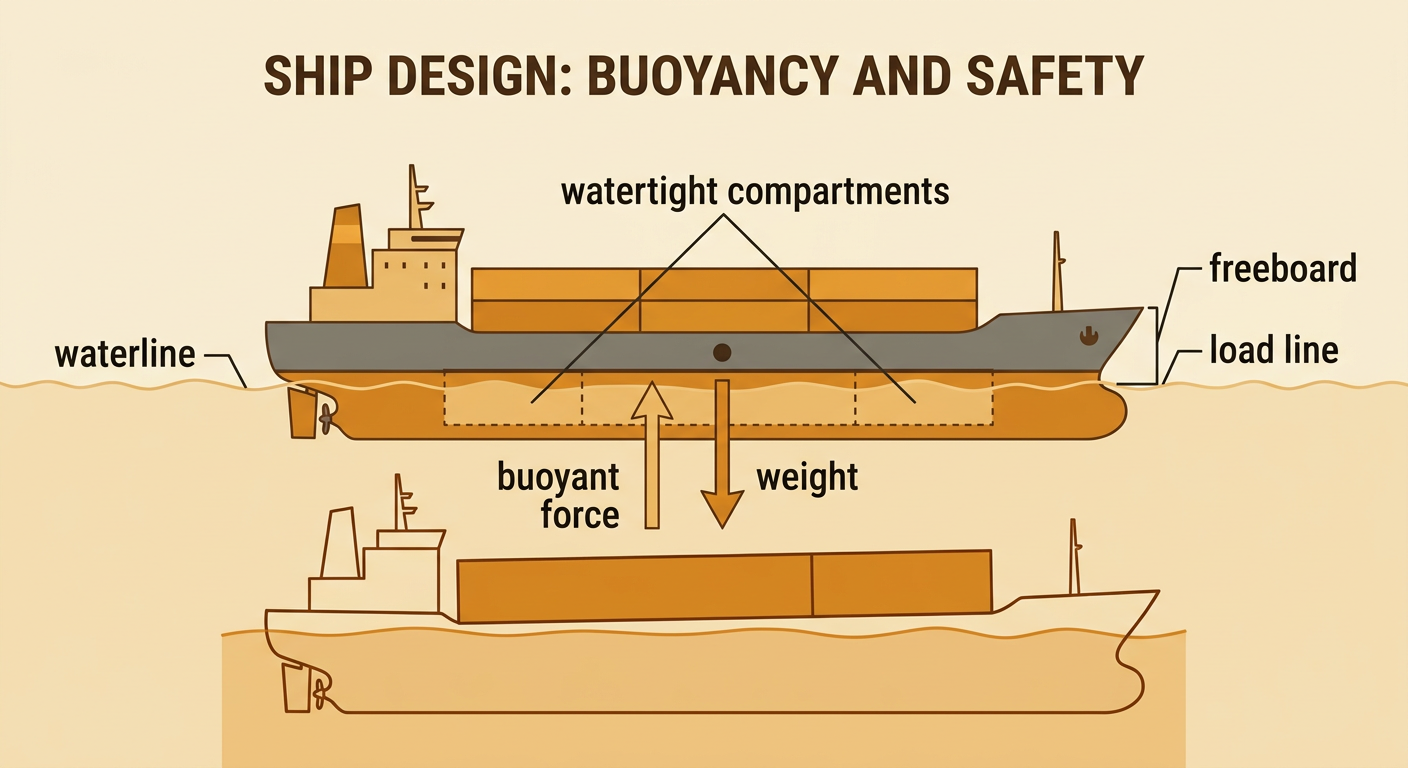
Ship designers apply buoyancy principles while balancing safety, carrying capacity, fuel use, and cost. Adding cargo increases a vessel’s weight, so the hull must displace more water and sit lower until buoyant force again equals weight. If a ship is overloaded, damaged, or filled with water, its freeboard—the distance from the waterline to the main deck—may become dangerously small. Safety measures include load lines, watertight compartments, life jackets, inspections, and limits on cargo. Each measure has marginal benefits and costs. An extra watertight compartment may reduce flooding risk, but it also adds construction cost and weight. Designers and regulators compare the added cost with benefits such as fewer injuries, less cargo loss, and reduced environmental damage. For example, obeying a load line can reduce immediate cargo revenue but greatly lower the risk of sinking in rough seas.