
Fluid Pressure, Buoyancy, and Floating Design
Students apply fluid pressure and Archimedes’ principle to predict whether objects will float and evaluate the design of a safe floating structure.

Illustrations are auto-generated and may be placeholders. They can be refreshed to match the narration.
Pressure in Fluids
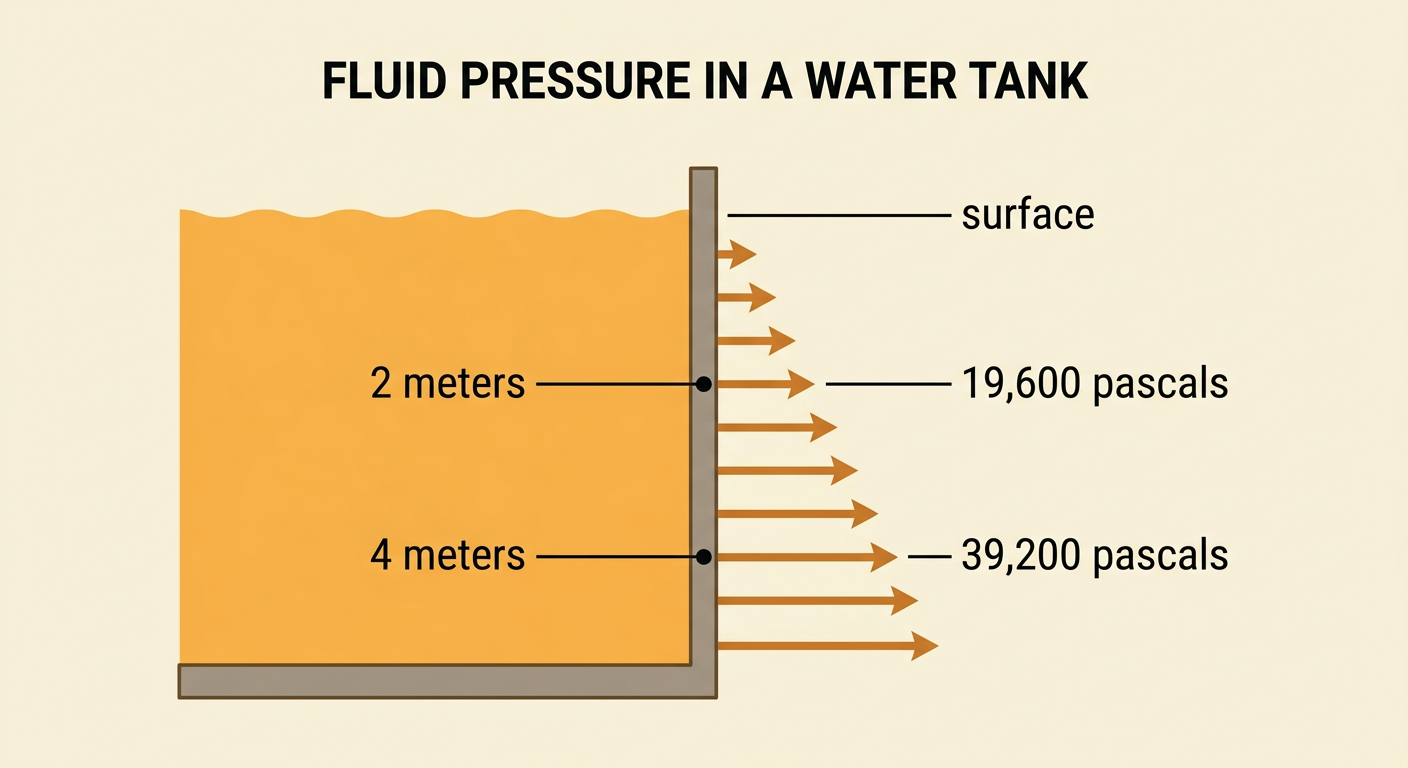
Pressure describes how force is spread over an area: P = F/A. In a fluid at rest, pressure acts in every direction and increases with depth because deeper points support more fluid above them. The gauge pressure caused by a liquid is P = ρgh, where ρ is fluid density, g is gravitational acceleration, and h is depth. Rearranging the equation to find depth gives h = P/(ρg), highlighting the quantity of interest. For example, in freshwater with density 1,000 kilograms per cubic meter, the gauge pressure 2 meters below the surface is about 19,600 pascals. At 4 meters, it is about 39,200 pascals. This depth-pressure relationship explains why the lower parts of dams and aquarium walls must be stronger than the upper parts.
Pascal’s Principle
Pascal’s principle states that a pressure change applied to a confined fluid is transmitted equally throughout the fluid. Hydraulic systems use this principle to multiply force. If two pistons are connected by an enclosed liquid, their pressures are equal: F1/A1 = F2/A2. Solving for the output force gives F2 = F1A2/A1. Suppose a mechanic pushes with 200 newtons on a piston with an area of 0.01 square meter. If the lifting piston has an area of 0.10 square meter, the output force is 2,000 newtons. The force increases by a factor of ten because the output area is ten times larger. However, the larger piston moves a shorter distance, so the system does not create energy. Hydraulic brakes, lifts, and rescue tools all rely on this relationship.

Archimedes’ Principle
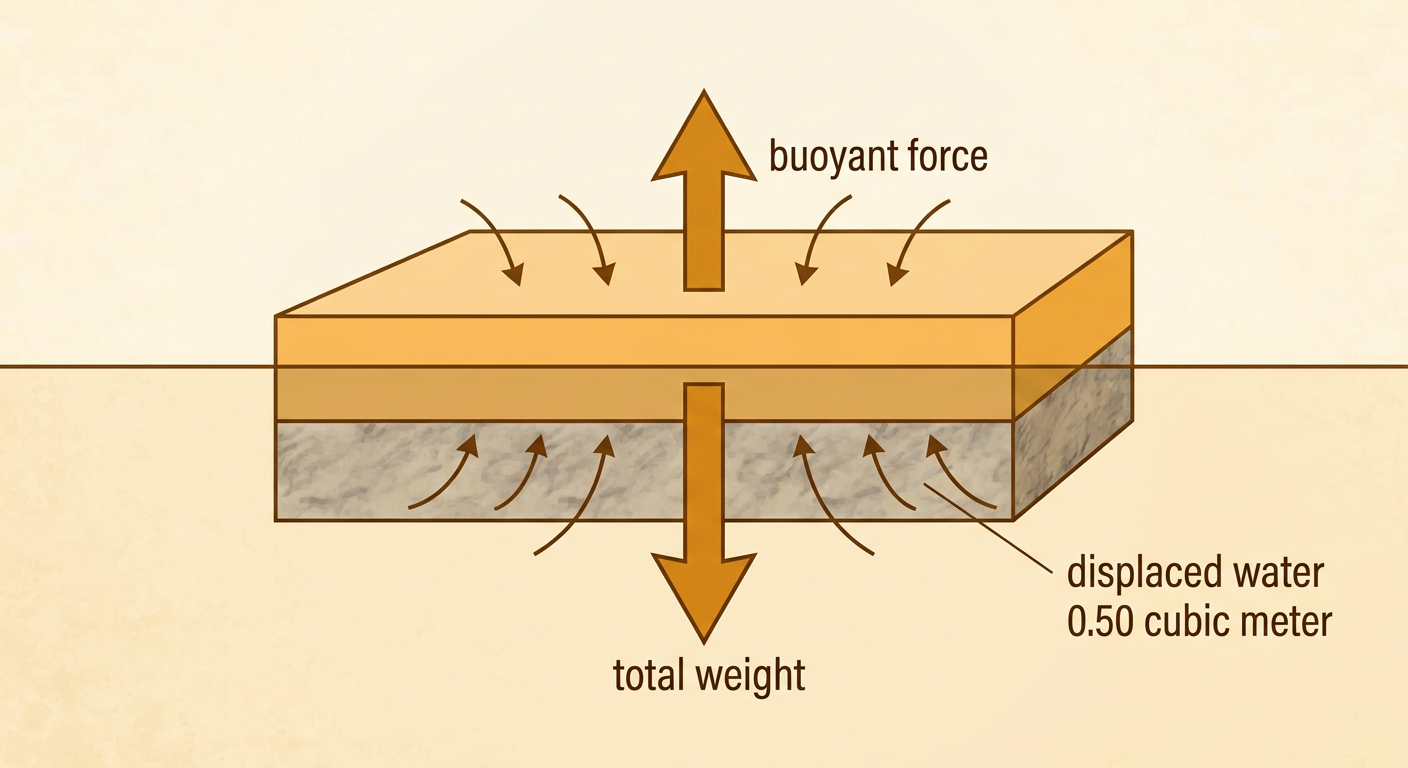
Archimedes’ principle states that a fluid pushes upward on an immersed object with a buoyant force equal to the weight of the fluid displaced by the object. The relationship is Fb = ρfluidgVdisplaced. Solving for displaced volume gives Vdisplaced = Fb/(ρfluidg). For example, a floating platform and its load have a total mass of 500 kilograms, so their weight is about 4,900 newtons. To float in freshwater, the platform must displace about 0.50 cubic meter of water because 4,900/(1,000 × 9.8) = 0.50. Fluid pressure is greater on the platform’s bottom than on its top, producing the net upward force. When the buoyant force equals the total weight, the platform has no vertical acceleration and floats at a steady level.
Floating, Sinking, and Density
An object’s average density helps predict whether it will float. Density is mass divided by volume: ρ = m/V. An object floats in a fluid if its average density is less than the fluid’s density, remains suspended if the densities are equal, and sinks if its density is greater. A solid steel block sinks in water because steel is much denser than water. A steel ship can float because its hollow hull contains air, increasing its total volume without adding much mass and lowering its average density. For a floating object, the fraction of its volume underwater equals ρobject/ρfluid. A boat with an average density of 750 kilograms per cubic meter floats in freshwater with about 75 percent of its volume submerged. Loading the boat adds mass and increases its average density, causing it to sit lower in the water.

Floating-Structure Design Challenge
In this design challenge, create a model floating structure that safely supports a specified load. Begin with measurable criteria, such as carrying 1 kilogram, remaining upright for five minutes, and keeping the deck at least 2 centimeters above the water. Constraints might include a limited sheet of aluminum foil, a maximum width, and a fixed construction time. Calculate the minimum displaced-water volume using Vdisplaced = mtotal/ρwater. A total mass of 1.2 kilograms requires at least 0.0012 cubic meter, or 1.2 liters, of displaced freshwater. Build and test the model, then record load capacity, freeboard, tilt, and any leaks. Compare designs using the same procedure. A wide hull may improve stability but increase material use and drag, while separate sealed compartments may improve safety but add complexity and mass.

Safety Standards and Design Trade-Offs
Real floating structures must satisfy safety standards as well as performance goals. Designers evaluate load limits, stability, freeboard, emergency flotation, evacuation access, weather resistance, cost, and environmental effects. A public rule requiring passenger boats to carry life jackets has the intended outcome of reducing drowning risk. Possible unintended outcomes include added storage needs, inspection costs, and improperly maintained equipment that creates false confidence. Similarly, a rule requiring more watertight compartments can improve survival after hull damage but may increase mass, construction cost, and maintenance. Engineers and public officials should compare evidence from tests, accident reports, and community input. A strong recommendation explains which design best meets the criteria, identifies trade-offs, and considers who receives the benefits or bears the costs. Safety decisions should protect people without ignoring access, affordability, or environmental consequences.
