
Food Energy Begins with the Sun
Students use models and evidence to trace energy from sunlight through plants and food to the movement and growth of animals.

Illustrations are auto-generated and may be placeholders. They can be refreshed to match the narration.
Where Does Food Energy Come From?
Animals need energy to move, grow, repair their bodies, and stay warm. They get this energy from food, but the energy pathway usually begins with the sun. Consider a child eating an apple. The apple grew on a tree that captured energy from sunlight. The tree stored some of that energy as chemical energy in sugars and other food molecules. When the child eats and digests the apple, the child’s body can use that stored energy. Even foods from animals connect back to sunlight. A glass of milk comes from a cow that ate plants, such as grass. Those plants captured sunlight. Matter moves into and through living things, while energy is transferred and transformed along the pathway. A model using arrows can help us trace these energy changes.

Plants Capture Energy from Sunlight
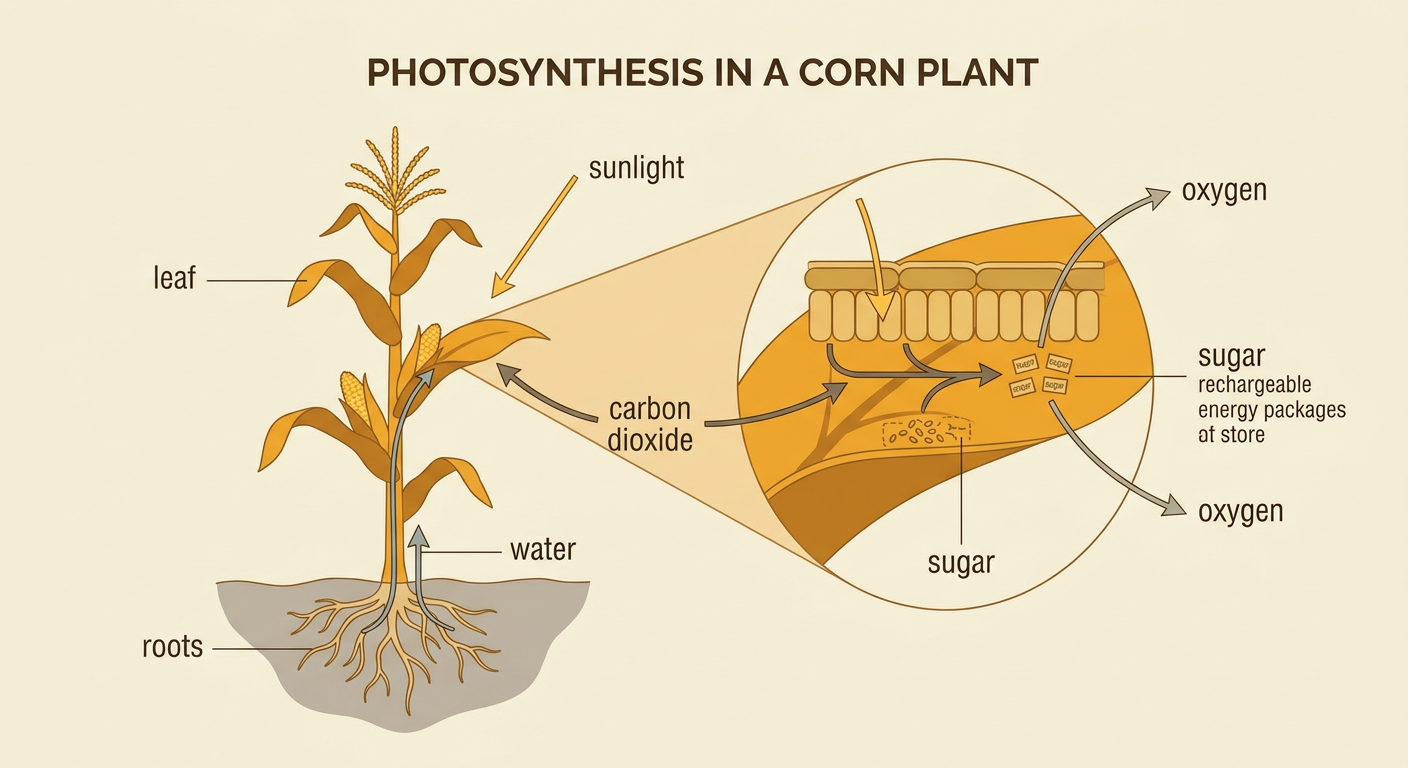
Plants use sunlight to make energy-rich sugars through photosynthesis. In a leaf, light energy from the sun is transformed into chemical energy stored in sugar. The plant also takes in carbon dioxide from the air and absorbs water through its roots. Using light energy, the plant rearranges these materials to form sugar and releases oxygen. The sugar becomes a source of energy and matter for the plant. It helps the plant grow new roots, stems, leaves, fruits, and seeds. For example, a corn plant captures sunlight and stores some of that energy in sugars that help form kernels. When an animal eats the kernels, it receives chemical energy that was once light energy. Plants do not create energy; they transform and store energy from sunlight.
Energy Moves Through Food Chains
A food chain models how energy is transferred when one organism eats another. It begins with a producer, usually a plant that captures sunlight. Next come consumers, which get energy by eating plants or other animals. For example, sunlight reaches grass, a rabbit eats the grass, and a hawk eats the rabbit. The arrows point in the direction that energy moves: from the sun to the grass, from the grass to the rabbit, and from the rabbit to the hawk. At every step, organisms use much of the available energy for life processes, including movement, growth, and body repair. Some energy is transferred to the surroundings as heat. Therefore, not all the energy stored in one organism becomes food energy for the next organism. Food webs combine many connected food chains.

Modeling an Energy Pathway
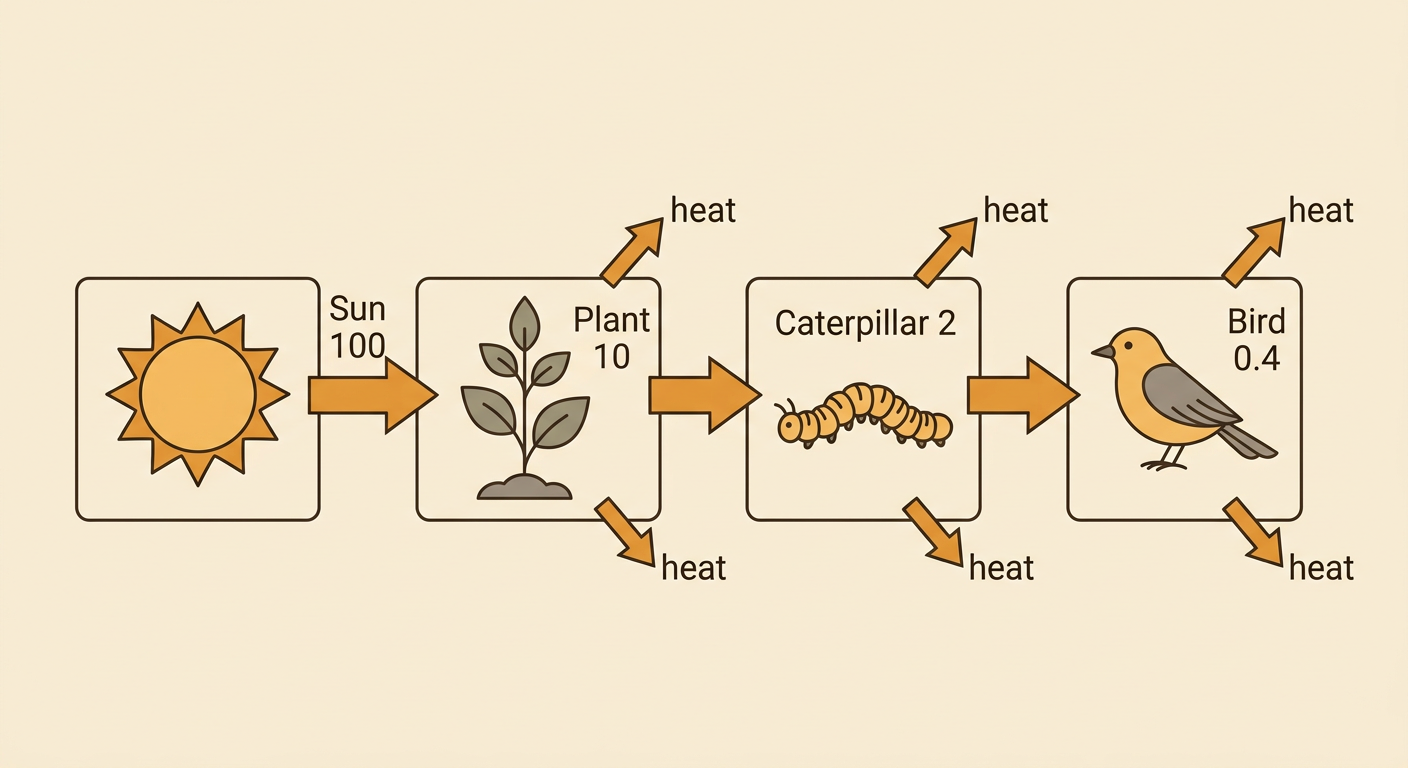
Models simplify a real system so that we can explain and compare energy transfers. Suppose a model starts with 100 energy units of sunlight reaching a small garden. The plants capture only part of that energy. In this simplified example, they store 10 units as chemical energy in plant material. A caterpillar eats some leaves and receives 2 of those units. A bird eats the caterpillar and receives 0.4 unit. We can represent the pathway as Sun 100, Plant 10, Caterpillar 2, Bird 0.4. The decreasing numbers do not mean energy disappears. At each stage, energy is used for life processes or transferred to the surroundings, often as heat. These invented numbers are useful for comparing steps, but they are not measurements for every real food chain. The arrows and values together form a mathematical model.
Connecting Solar Energy to Food Production
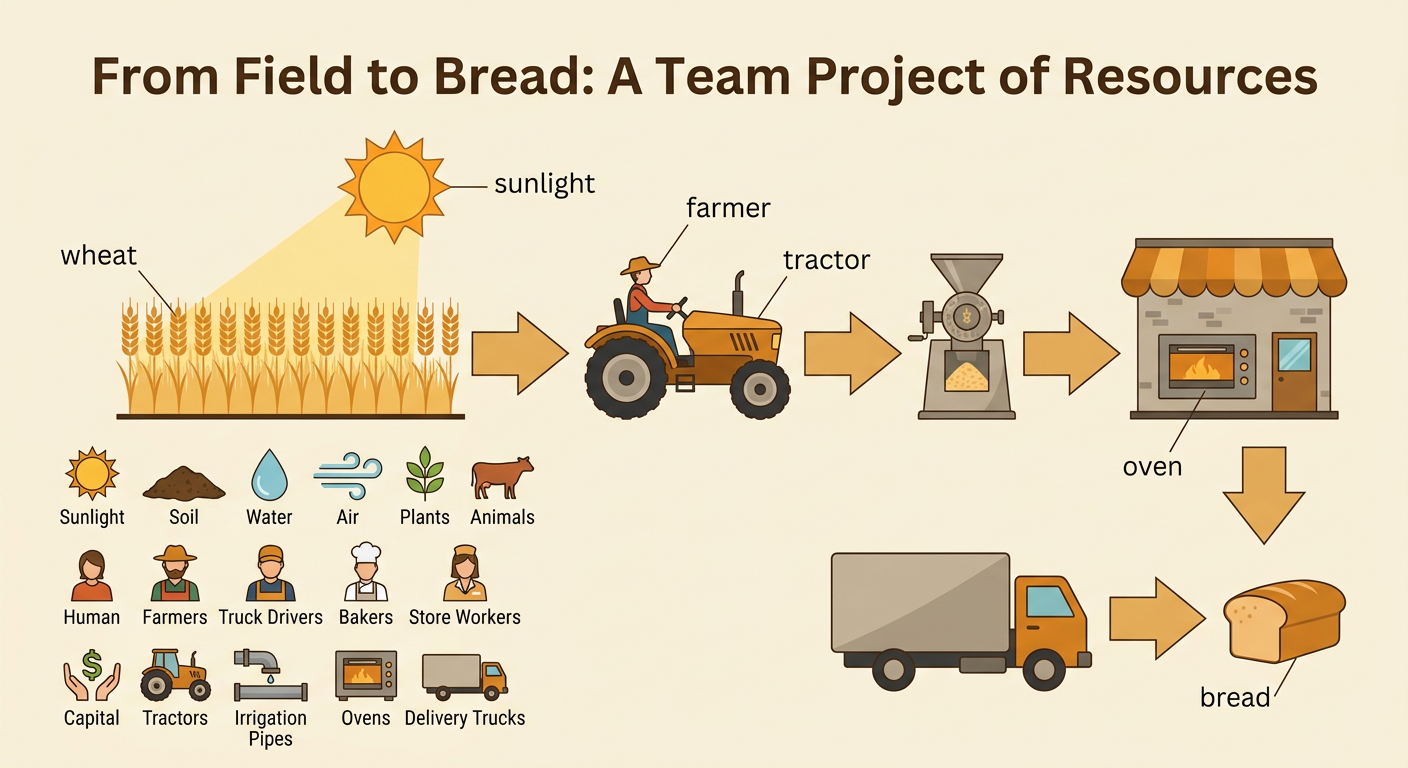
Producing food depends on natural, human, and capital resources. Natural resources come from nature and include sunlight, soil, water, air, plants, and animals. Human resources are the people whose work helps produce food, such as farmers, truck drivers, bakers, and store workers. Capital resources are tools and equipment people make and use, including tractors, irrigation pipes, barns, ovens, and delivery trucks. Consider a loaf of bread. Wheat plants capture solar energy and store it as chemical energy in grain. Farmers use soil and water to grow the wheat and machinery to harvest it. Workers transport the grain to a mill and bakery, where equipment turns it into bread. Fuel and electricity may provide additional energy for machines, but the food energy stored in the wheat originally came from sunlight.
Exit Check: Trace the Energy
Use evidence from the lesson to trace the energy in this example: A chicken eats corn, and a student eats an egg from the chicken before riding a bicycle. Begin with sunlight, not with the corn or chicken. The corn plant captured light energy and transformed some of it into chemical energy stored in its tissues and kernels. The chicken received some of that chemical energy by eating the corn. Some energy became stored in materials that helped produce the egg. After eating and digesting the egg, the student’s body used chemical energy for movement, growth, repair, and warmth. A complete model should show Sun to corn plant to chicken to egg to student to bicycle movement. Explain what each arrow means and identify the natural resource, human work, and equipment involved in producing and delivering the egg.
