
Food Webs and Energy Flow
Students model how energy moves and matter cycles among producers, consumers, decomposers, and nonliving parts of an ecosystem.
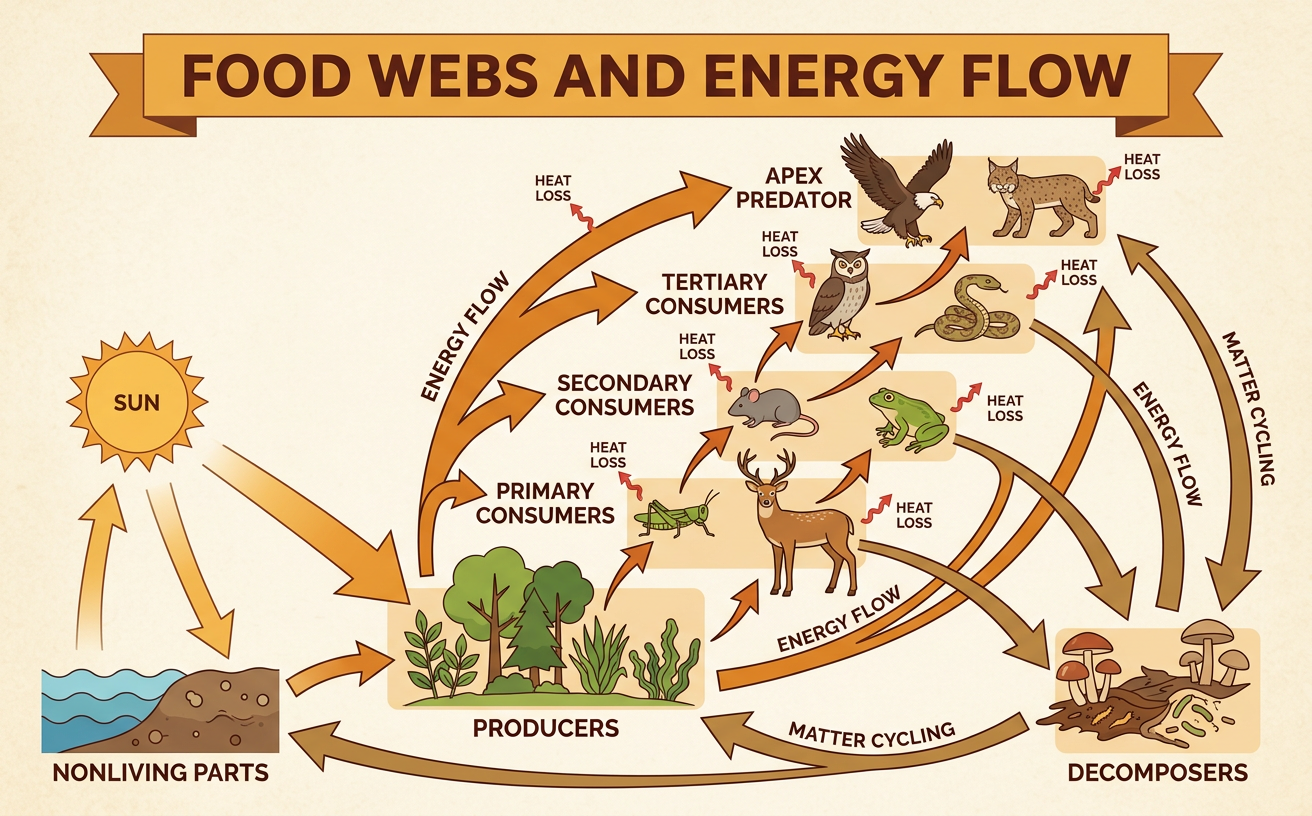
Illustrations are auto-generated and may be placeholders. They can be refreshed to match the narration.
Ecosystem Components
An ecosystem includes all the living organisms in an area and the nonliving environment with which they interact. Living components include plants, animals, fungi, and microorganisms. Nonliving components include sunlight, water, air, soil, minerals, and temperature. Energy usually enters an ecosystem as sunlight, moves through organisms, and eventually leaves as heat. Matter, including water, carbon, oxygen, and mineral nutrients, is reused and cycles between living and nonliving parts. In a pond ecosystem, algae use sunlight, carbon dioxide, water, and nutrients to grow. Tadpoles eat algae, fish eat tadpoles, and herons eat fish. When organisms release waste or die, decomposers return nutrients to the water and sediment. A complete ecosystem model must therefore show both the one-way flow of energy and the repeated cycling of matter.
Producers and Consumers
Producers make energy-rich food from nonliving materials. Most producers, including plants and algae, use sunlight, water, and carbon dioxide during photosynthesis to make sugars. Consumers cannot make all their own food, so they obtain energy and matter by eating other organisms. Primary consumers usually eat producers, while secondary and tertiary consumers eat other consumers. Omnivores eat both producers and consumers. In an Indiana grassland, grass is a producer, a grasshopper that eats grass is a primary consumer, a frog that eats the grasshopper is a secondary consumer, and a hawk that eats the frog is a tertiary consumer. At every step, organisms use much of the transferred energy for movement, growth, repair, and other life processes. Some energy is released as heat, so less usable energy is available to the next consumer.
Decomposers and Nutrients
Decomposers break down dead organisms and wastes into simpler substances. Bacteria and fungi are major decomposers, although detritivores such as earthworms and pill bugs also help by shredding dead material. During decomposition, nutrients such as nitrogen and phosphorus are released into soil or water. Producers absorb these nutrients and use the matter to build new cells. Consumers then obtain the matter by eating producers or other consumers. For example, a fallen oak leaf contains carbon and mineral nutrients. Fungi and bacteria break down the leaf, releasing mineral nutrients into the soil. An oak tree’s roots absorb those nutrients, so the same matter can become part of new leaves. Matter cycles, but energy does not cycle. Decomposers use chemical energy in dead material and release some of it as heat, which eventually leaves the ecosystem.
Food Chains and Food Webs
A food chain models one pathway through which energy and matter move as organisms eat one another. A food web combines many connected food chains and better represents the feeding relationships in a real ecosystem. Each arrow points from the organism being eaten to the organism that receives its energy and matter. In a meadow web, grass may be eaten by rabbits, mice, and grasshoppers. Hawks may eat rabbits and mice, while frogs may eat grasshoppers and then be eaten by snakes. Because the chains overlap, a change in one population can affect several others. If the mouse population decreases, hawks may depend more heavily on rabbits. Proportions can describe these relationships. If a hawk’s diet is 60 percent mice and 40 percent rabbits, then 6 of every 10 equal food-energy units come from mice and 4 come from rabbits.
Energy Pyramids
An energy pyramid compares the usable energy available at each feeding level, called a trophic level. Producers form the wide base because they contain the most energy available to the ecosystem’s consumers. Primary consumers occupy the next level, followed by secondary and tertiary consumers. On average, about 10 percent of the energy stored at one level becomes biomass available to the next level, although the actual percentage varies among ecosystems. For example, if grass stores 10,000 kilojoules of energy, grasshoppers may receive about 1,000 kilojoules, frogs about 100 kilojoules, and hawks about 10 kilojoules. These amounts form a proportional pattern: each level has about one-tenth the energy of the level below it. Most of the remaining energy supports life processes or is released as heat. This loss limits the number of trophic levels an ecosystem can support.