
Forces, Acceleration, and Newton’s Laws
Students apply Newton’s three laws and the relationship among net force, mass, and acceleration to predict changes in motion.
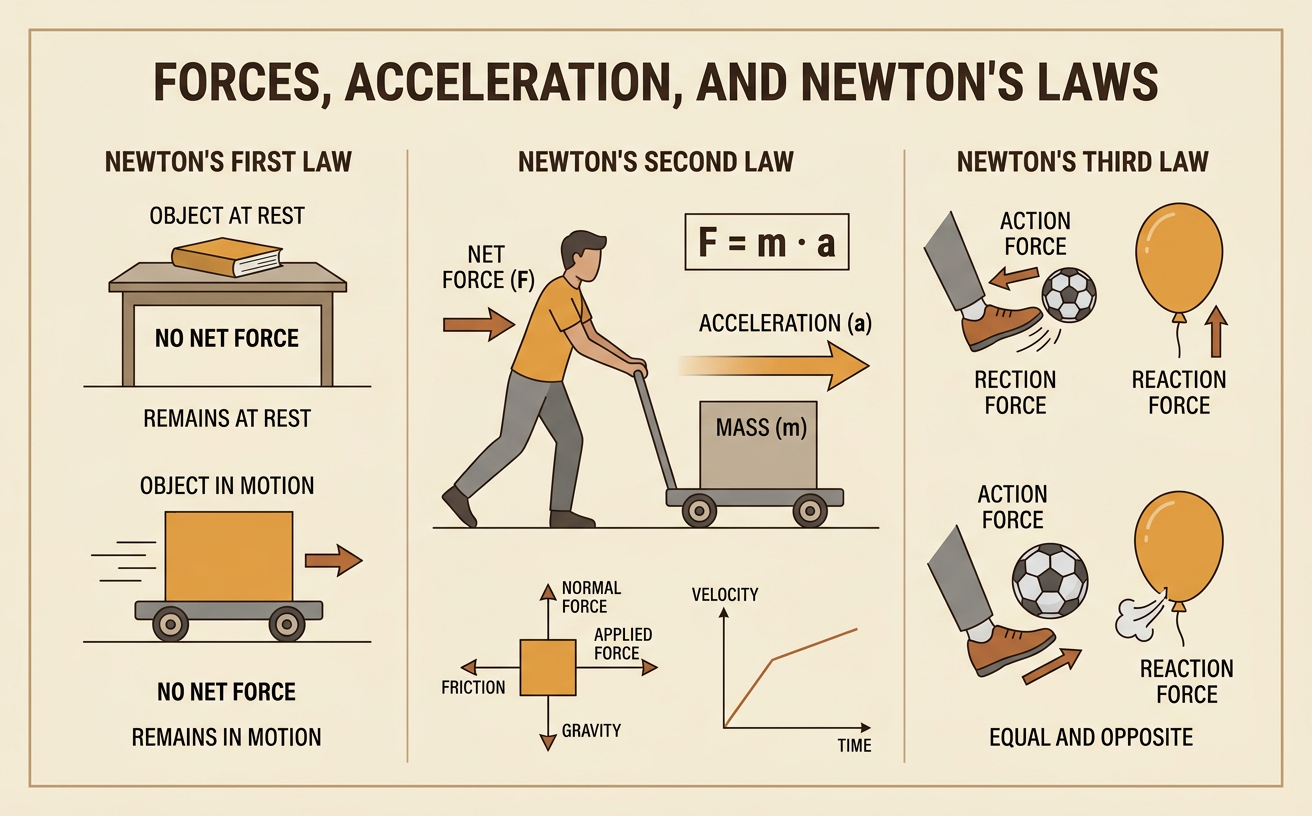
Illustrations are auto-generated and may be placeholders. They can be refreshed to match the narration.
Identifying Forces
A force is a push or pull that can change an object’s velocity. Forces are vectors, so each force has both magnitude and direction. Contact forces occur when objects touch. They include applied force, friction, normal force, tension, and air resistance. Noncontact forces, such as gravity, act across a distance. To predict motion, identify all forces acting on the object and add them as vectors. This sum is the net force. For example, suppose a person pushes a box to the right with 30 newtons while friction pulls left with 12 newtons. The horizontal net force is 18 newtons to the right. If the floor’s upward normal force balances the box’s downward weight, the vertical net force is zero. The unbalanced horizontal force causes the box to accelerate to the right.
Drawing Free-Body Diagrams
A free-body diagram isolates one object and represents each external force on it with an arrow. Draw the object as a simple dot or box. Begin every force arrow on the object, and point it in the force’s direction. Label each arrow with the force type and, when known, its magnitude. Longer arrows should represent larger forces. Do not include forces that the chosen object exerts on something else. For example, consider a crate sliding right while a person continues pushing it. The diagram includes the applied force to the right, kinetic friction to the left, the normal force upward, and weight downward. If the crate has no vertical acceleration, the normal force and weight arrows are equal. If the rightward arrow is longer than the friction arrow, the crate’s net force and acceleration point right.
Newton’s First Law
Newton’s first law states that an object remains at rest or moves with constant velocity unless a nonzero net force acts on it. This resistance to a change in motion is called inertia. Mass measures inertia, so an object with greater mass is harder to start, stop, or turn. Balanced forces produce zero net force and therefore no acceleration. Zero acceleration does not always mean zero velocity; an object can keep moving in a straight line at constant speed. For example, when a car stops suddenly, a passenger’s body tends to continue moving forward at the car’s previous velocity. A seat belt applies the unbalanced force needed to slow the passenger with the car. Without that force, the passenger would continue forward until another force changed the passenger’s motion.
Newton’s Second Law
Newton’s second law describes how net force, mass, and acceleration are related: Fnet = ma. Acceleration points in the same direction as the net force. For a constant mass, increasing the net force increases acceleration by the same factor. For a constant net force, increasing mass decreases acceleration. Consider a 2-kilogram cart. Data show that net forces of 2, 4, and 6 newtons produce accelerations of 1, 2, and 3 meters per second squared. Doubling the force from 2 to 4 newtons doubles the acceleration, while the ratio Fnet/a remains 2 kilograms. A graph of acceleration versus net force forms a straight line through the origin. Its slope is 1/m, so a more massive object produces a less steep line. This pattern supports Newton’s mathematical relationship.
Newton’s Third Law
Newton’s third law states that when one object exerts a force on a second object, the second object exerts an equal-magnitude force in the opposite direction on the first. These two forces form an interaction pair. They occur at the same time and act on different objects, so they do not cancel each other on a single free-body diagram. For example, imagine two students on low-friction skateboards pushing apart. Student A pushes Student B to the right, while Student B pushes Student A to the left with an equal force. Both students accelerate away from each other. If Student A has less mass, Student A has greater acceleration because the same force acts on a smaller mass. The equal forces do not require equal accelerations; acceleration also depends on mass according to Newton’s second law.
Solving Force Problems
To solve a force problem, first choose the object and draw its free-body diagram. Select positive and negative directions, then add the force components along each axis to find the net force. Finally, use Fnet = ma and include units in the answer. Suppose a 10-kilogram sled is pulled right with 35 newtons while friction acts left with 15 newtons. Taking right as positive gives Fnet = 35 N − 15 N = 20 N to the right. The acceleration is a = Fnet/m = 20 N/10 kg = 2 m/s² to the right. The upward normal force and downward weight balance, so there is no vertical acceleration. Check whether the result is reasonable: the acceleration points in the direction of the net force, and its units are meters per second squared.