
Forces in Pairs: Newton’s Third Law and Collision Safety
Students analyze collisions to explain how interacting objects exert equal-magnitude, opposite-direction forces and use evidence to propose a safety feature.

Illustrations are auto-generated and may be placeholders. They can be refreshed to match the narration.
Observe an Interaction
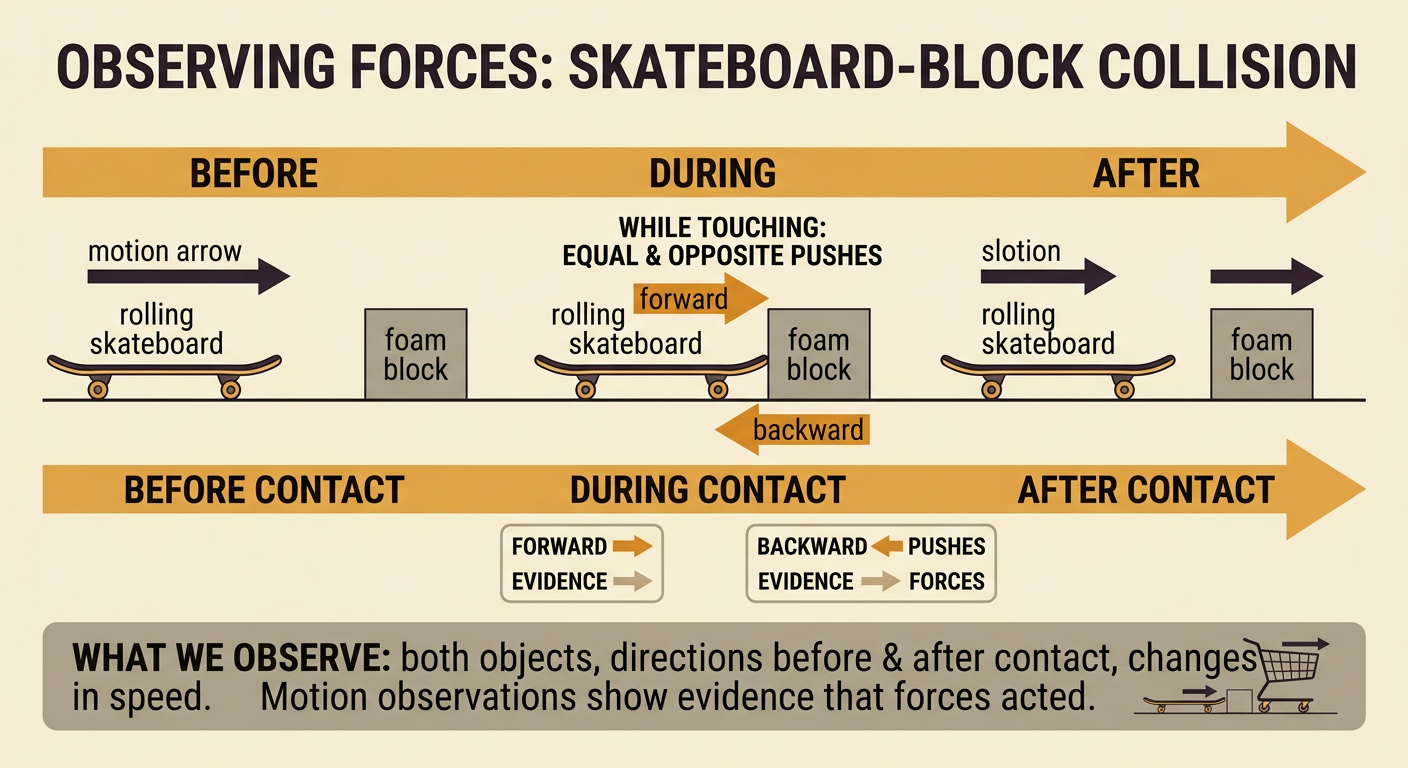
A force is a push or pull caused by an interaction between objects. Consider a rolling skateboard that bumps into a stationary foam block. During contact, the skateboard pushes the block forward. At the same time, the block pushes the skateboard backward. You might observe the block begin moving while the skateboard slows down. These changes in motion are evidence that forces acted on both objects. The interaction begins when the objects touch and ends when they separate. To describe it carefully, identify the two objects, the direction each object moves before and after contact, and any change in speed. Observations of motion do not directly measure force, but they help you recognize when an interaction occurs and what evidence should be collected.
Identify Action-Reaction Force Pairs
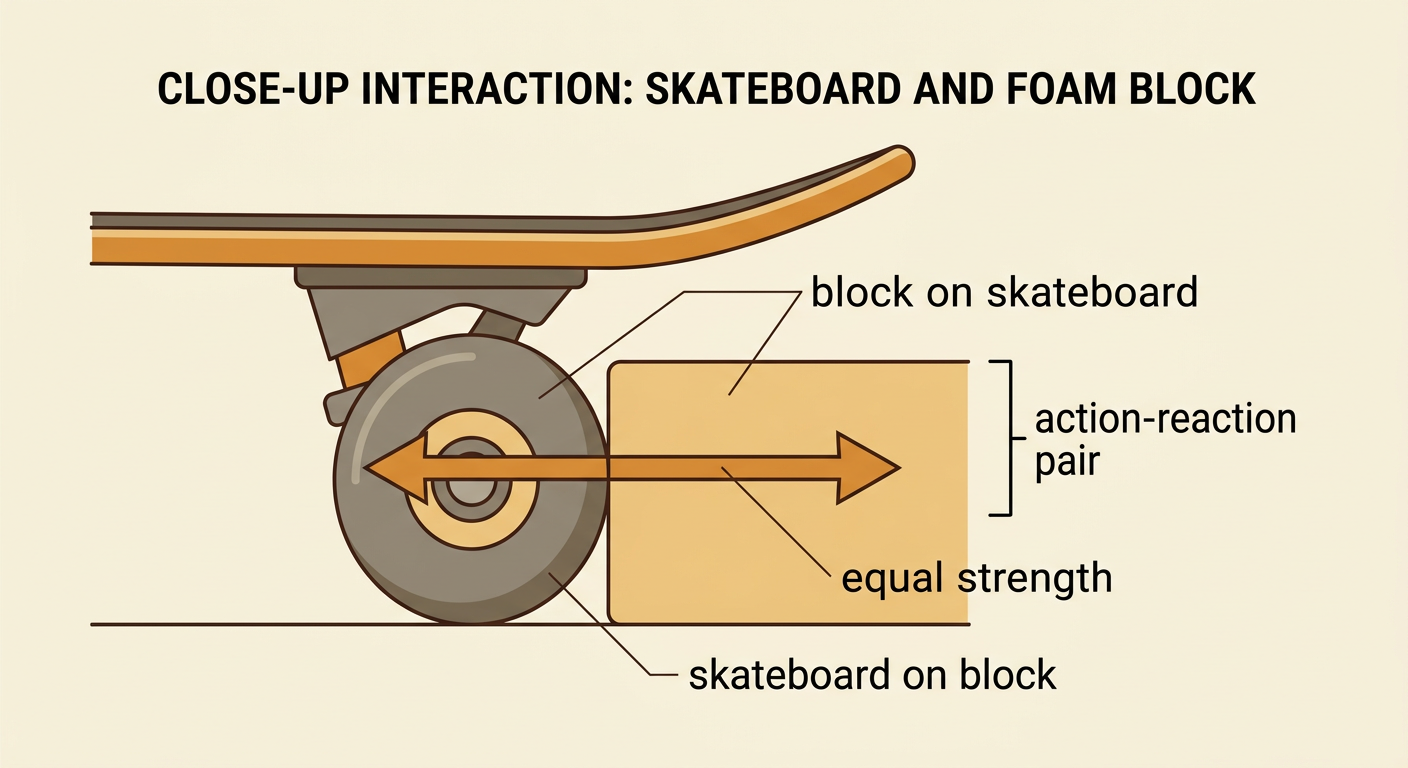
Newton’s Third Law states that when object A exerts a force on object B, object B exerts an equal-magnitude force in the opposite direction on object A. These two forces form an action-reaction pair. When a skateboard hits a foam block, the force of the skateboard on the block points forward, while the force of the block on the skateboard points backward. The forces occur at the same time and are the same type of force. They do not cancel because they act on different objects. To identify a correct pair, name both objects and reverse their order: skateboard on block and block on skateboard. The skateboard’s weight and the floor’s upward force are not this collision pair because they involve different interactions.
Model Equal and Opposite Forces
A force model uses arrows to represent forces. The arrow points in the force’s direction, and its length represents magnitude. Suppose a cart exerts a 40-newton force on another cart during a collision. Newton’s Third Law tells us that the second cart simultaneously exerts a 40-newton force in the opposite direction on the first cart. If right is positive, the forces can be written as F on cart B equals positive 40 newtons and F on cart A equals negative 40 newtons. In general, F from A on B equals the negative of F from B on A. The negative sign shows opposite direction, not a smaller force. Equal forces can produce different changes in motion when the carts have different masses.

Analyze a Collision
Imagine a 1-kilogram cart colliding with a 4-kilogram cart. A force sensor on each cart records a peak force of 60 newtons during contact, with the forces pointing in opposite directions. This evidence supports Newton’s Third Law. However, equal force does not mean equal acceleration. Using F equals ma, acceleration can be written as a equals F divided by m. The lighter cart’s acceleration magnitude is 60 divided by 1, or 60 meters per second squared. The heavier cart’s acceleration magnitude is 60 divided by 4, or 15 meters per second squared. The lighter cart therefore changes its velocity more rapidly during the collision. Sensor uncertainty and friction may affect exact measurements, so repeated trials provide stronger evidence than one trial.

Design a Collision-Safety Feature
A collision-safety feature should reduce the risk of damage even though the two colliding objects still exert equal and opposite forces on each other. One solution is a foam bumper on the front of a model cart. The foam compresses and increases the time over which the cart stops. For the same change in momentum, increasing stopping time reduces the average force. Students can compare bumper thicknesses while keeping cart mass, starting speed, and collision target the same. The measured variable could be peak force. Let p represent the peak force without foam and f represent the peak force with foam. A design goal might be f less than or equal to 0.60p. If p is 50 newtons, the acceptable force is 30 newtons or less. The design must also remain attached and fit within size limits.

Defend the Design with Evidence
A strong design argument includes a claim, evidence, reasoning, and an honest discussion of limitations. A student might claim that a two-centimeter foam bumper is the best tested option for the model cart. Evidence could include three force-sensor trials averaging 27 newtons, compared with 48 newtons for the cart without foam. A technical source may also explain that compressible materials increase stopping time. The reasoning connects these facts: a longer stopping time lowers average force while Newton’s Third Law still applies to the cart and barrier. Sensor data are direct and specific, but a small number of trials limits reliability. The technical source explains the science, but it may describe full-size vehicles rather than model carts. The student should cite both sources and recommend additional tests at different speeds.
