Forces, Mass, and Motion with Model Carts
Students test model carts to determine how net force and mass affect changes in motion, analyze their measurements, and connect the results to transportation technology.
Illustrations are auto-generated and may be placeholders. They can be refreshed to match the narration.
Observe a Cart in Motion
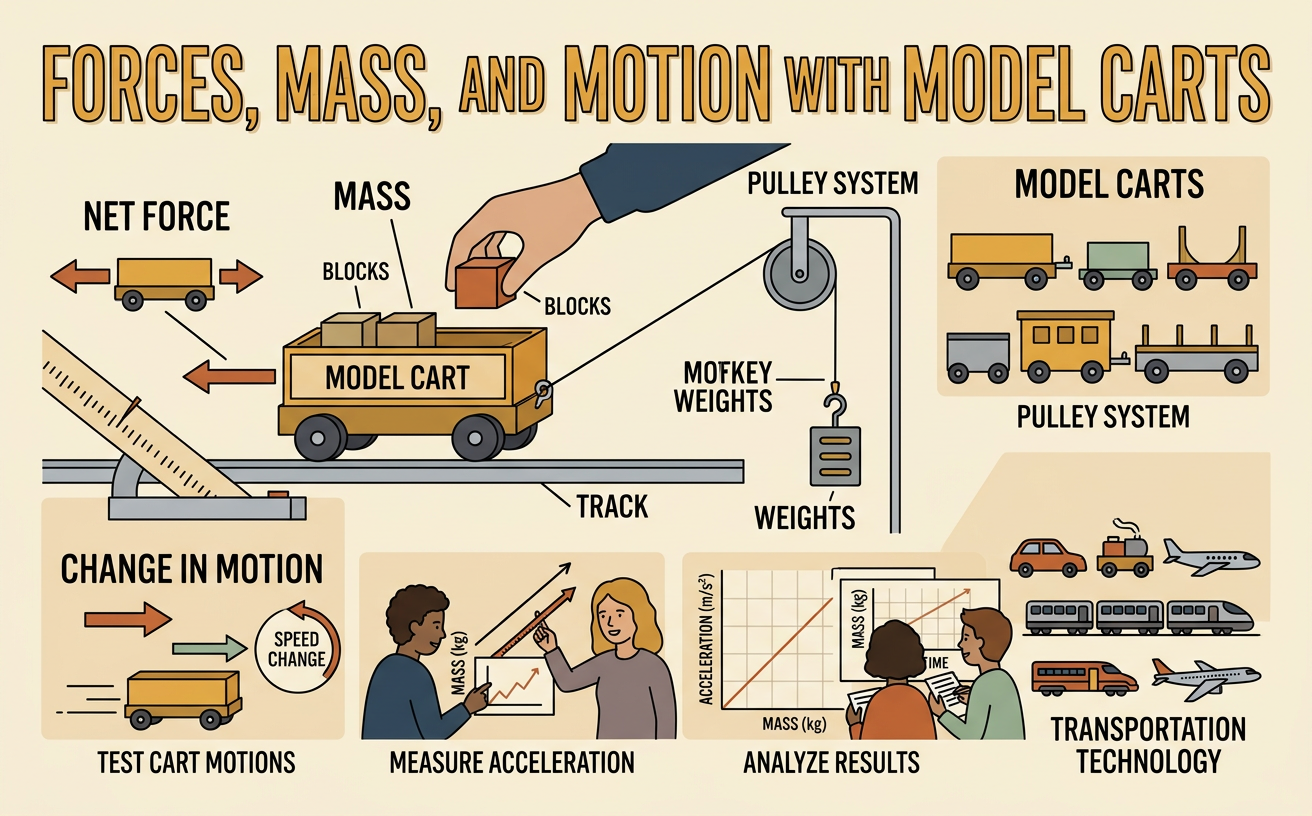
Place a model cart at rest on a level track and give it a gentle push. Watch how its position and speed change. A push or pull is a force, and a force can start, stop, speed up, slow down, or change the direction of an object. Observe the cart at equal time intervals rather than judging only by sight. For example, mark its position every half second with a motion sensor or video. Increasing spaces between positions show that the cart is speeding up. Nearly equal spaces show nearly constant speed. If the cart slows after your hand leaves it, friction and air resistance are acting against its motion. Record observations before explaining them so that your conclusions are based on evidence.

Review Force, Mass, and Net Force
Force is a push or pull measured in newtons. Mass is the amount of matter in an object and is commonly measured in grams or kilograms. Net force is the combined effect of all forces, including their directions. Forces in the same direction add, while forces in opposite directions subtract. For example, if a fan pushes a cart right with 3 newtons and friction acts left with 1 newton, the net force is 2 newtons to the right. An unbalanced net force changes the cart's motion. Balanced forces produce zero net force, so the cart does not change its velocity; it may remain still or keep moving at constant speed. With the same net force, a cart with greater mass changes speed more slowly than a lighter cart.

Plan a Fair Cart Test
A fair investigation changes one variable at a time. First, test how net force affects motion by keeping the cart's mass, track, starting position, and measurement time the same. Use two calibrated fan settings, such as 1 newton and 2 newtons, and measure each cart's change in speed after two seconds. Next, test mass by keeping the force setting the same and adding measured blocks to the cart. For example, compare a 0.5-kilogram cart with a 1.0-kilogram loaded cart under the same force. Repeat each condition at least three times. Keep the track level, release the cart without pushing it, and use the same equipment for every trial. Identify the independent variable, the measured dependent variable, and all controlled variables before beginning.

Conduct and Record Trials
Follow the planned procedure in the same order for every trial. Measure the total mass of the cart and added blocks with a balance. Set the cart at the starting line, begin the motion sensor or video timer, turn on the calibrated fan, and release the cart without an extra push. Record the starting speed and the speed after two seconds. Subtract the starting speed from the final speed to find the change in speed. For example, a cart that changes from 0.0 meter per second to 0.8 meter per second has a speed change of 0.8 meter per second. Run three trials for each force and mass condition. Stop the cart safely before it reaches the track end, and record measurements immediately with units rather than relying on memory.
Compare Data and Draw Conclusions
Organize the results in a table and calculate an average for the repeated trials. Then use rate reasoning to compare how quickly speed changed. Divide the change in speed by the elapsed time. For example, if a 1-newton trial produces a speed change of 0.5 meter per second in two seconds, the rate of change is 0.25 meter per second each second. If a 2-newton trial with the same mass produces twice the rate, the evidence supports the idea that greater net force causes a greater change in motion. Compare the mass trials in the same way. Under the same net force, the heavier cart should have a smaller rate of speed change. Graph force or mass on the horizontal axis and the measured rate on the vertical axis. Note unusual results and possible measurement errors.

Connect Physics to Transportation
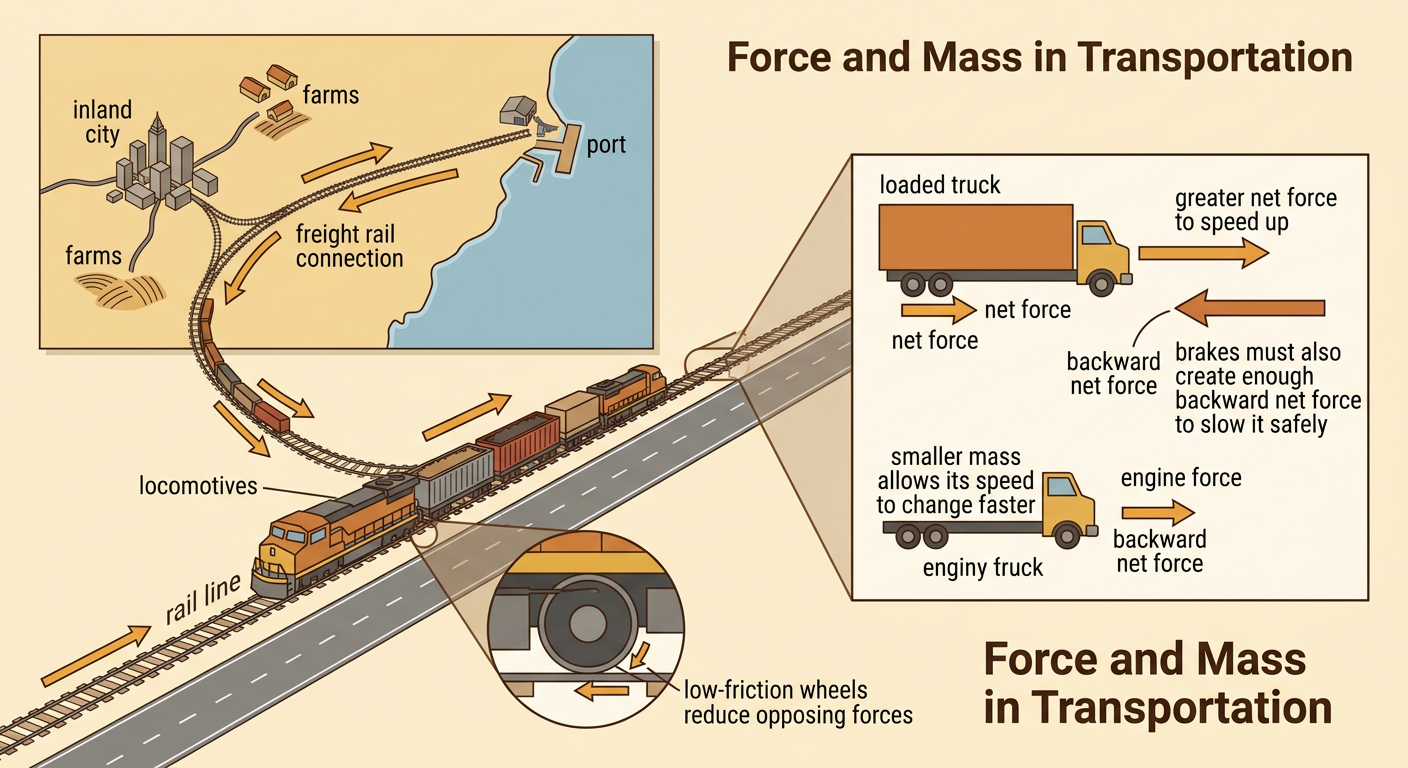
Transportation engineers apply the same relationships among force, mass, and motion. A loaded truck has more mass than an empty truck, so it needs a greater net force to speed up at the same rate. It also needs strong brakes to produce enough backward net force to slow safely. Trains use powerful locomotives because many railcars have a large combined mass, while low-friction wheels help reduce opposing forces. Improvements in engines, brakes, roads, and rail systems allow people and goods to travel farther and more reliably. For example, a faster freight rail connection can link an inland town with a distant port, changing where businesses locate and how settlements exchange products. Transportation technology therefore affects both vehicle motion and the spatial connections among farms, cities, factories, and markets.