Forces: Pushes, Pulls, and Changes in Motion
Students analyze how balanced and unbalanced forces affect an object's speed, direction, and overall motion.

Illustrations are auto-generated and may be placeholders. They can be refreshed to match the narration.
Forces as Interactions
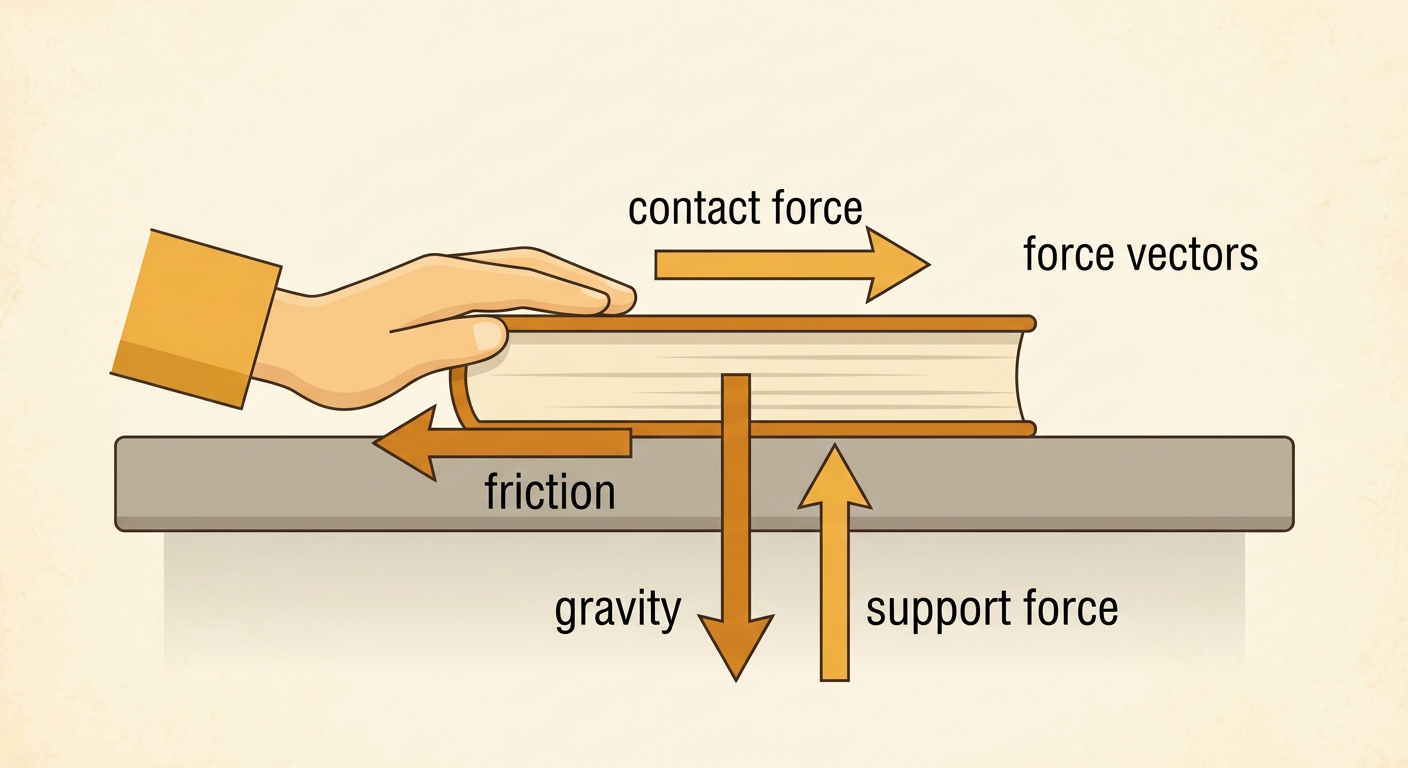
A force is a push or pull that happens when objects interact. A force can change an object’s speed, direction, or shape. Some forces require contact. For example, your hand applies a contact force when you push a book across a desk. Friction between the book and desk acts in the opposite direction. Other forces act without direct contact. Earth’s gravitational force pulls the book downward, while the desk pushes upward on the book. Forces are measured in newtons, abbreviated N. Scientists represent forces with arrows called force vectors. The arrow points in the direction of the force, and its length represents the force’s strength. Identifying every force acting on an object helps explain why its motion changes or stays the same.
Direction and Strength
A force has both direction and strength, or magnitude. In a force diagram, the arrowhead shows direction, while the arrow’s length shows relative strength. Two forces acting in the same direction combine. For example, if one student pushes a cart to the right with 20 N and another pushes to the right with 10 N, the total force in that direction is 30 N. Forces in opposite directions subtract. If a 20 N push acts to the right while a 10 N force acts to the left, the net force is 10 N to the right. Net force is the overall force after all forces are combined. The direction of the net force determines the direction in which the object’s motion changes.

Balanced Forces
Forces are balanced when they are equal in strength and opposite in direction. Balanced forces produce a net force of 0 N, so they do not change an object’s motion. An object at rest stays at rest, and a moving object continues at the same speed in the same direction. Consider a box resting on the floor. Gravity pulls downward on the box, while the floor exerts an equal support force upward. Because these vertical forces balance, the box does not move up or down. Balanced forces can also act on a moving object. If a toy car travels at a steady speed while its forward force equals the backward friction force, its velocity remains constant. Balanced forces do not mean that no forces are present; they mean the forces cancel.

Unbalanced Forces
Forces are unbalanced when they do not cancel, producing a net force greater than 0 N. An unbalanced force causes acceleration, which is any change in velocity. An object accelerates when it speeds up, slows down, or changes direction. Imagine two teams pulling a wagon in opposite directions. One team pulls right with 50 N, while the other pulls left with 30 N. The net force is 20 N to the right, so the wagon accelerates to the right. If friction later acts opposite the wagon’s motion and becomes the larger force, the wagon slows down. A turning soccer ball also accelerates because its direction changes, even if its speed remains the same. The change in motion always occurs in the direction of the net force.

Mass and Changes in Motion
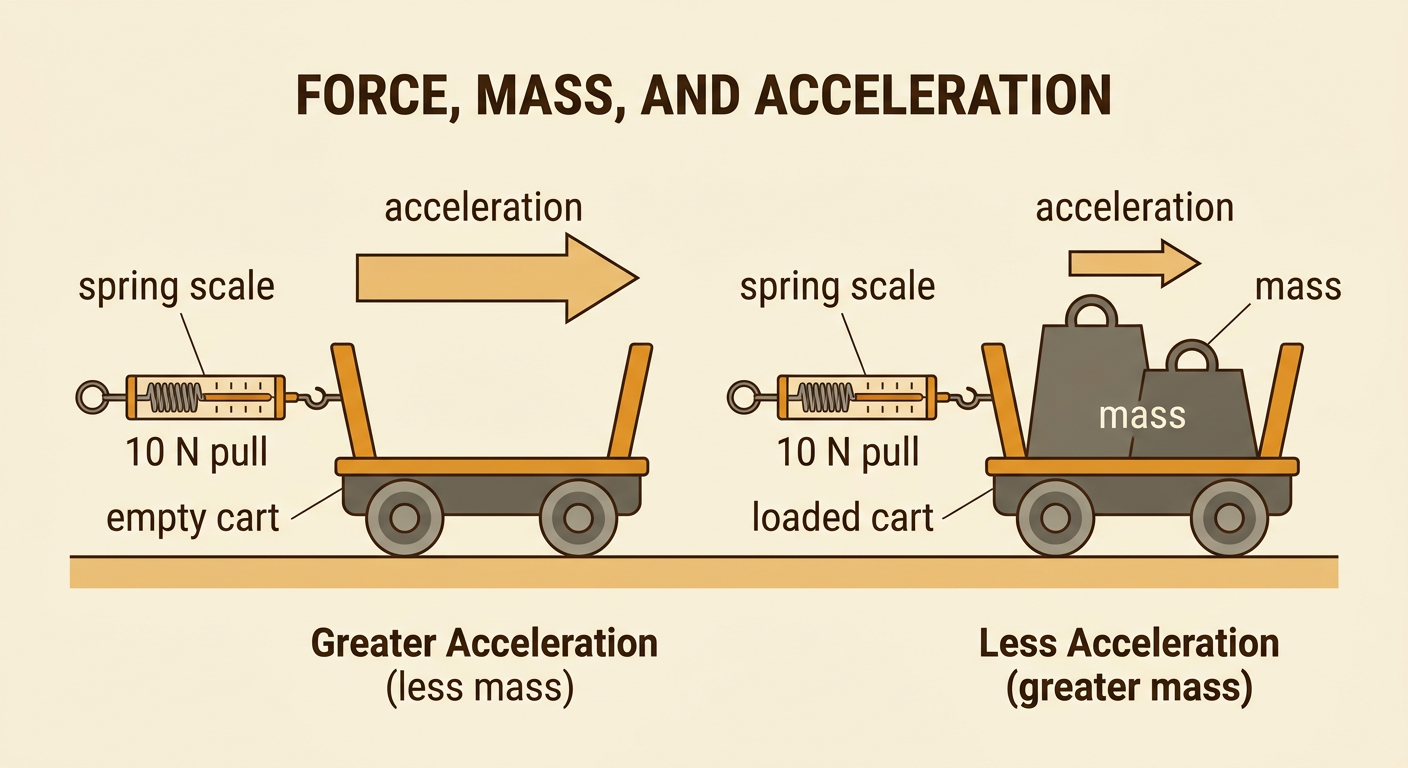
An object’s change in motion depends on both the net force and its mass. Mass is the amount of matter in an object and is measured in kilograms. With the same mass, a larger net force produces a greater acceleration. With the same net force, an object with more mass has less acceleration because it is harder to change its motion. For example, the same 10 N push makes an empty cart accelerate more than a cart loaded with books. Students can investigate this relationship using a cart, added masses, and a spring scale. Keep the pulling force at 10 N, change the cart’s total mass, and measure its acceleration each time. Repeat the trials and record the results. Only mass should change so the investigation provides a fair comparison.