
Fossil Clues to Ancient Environments
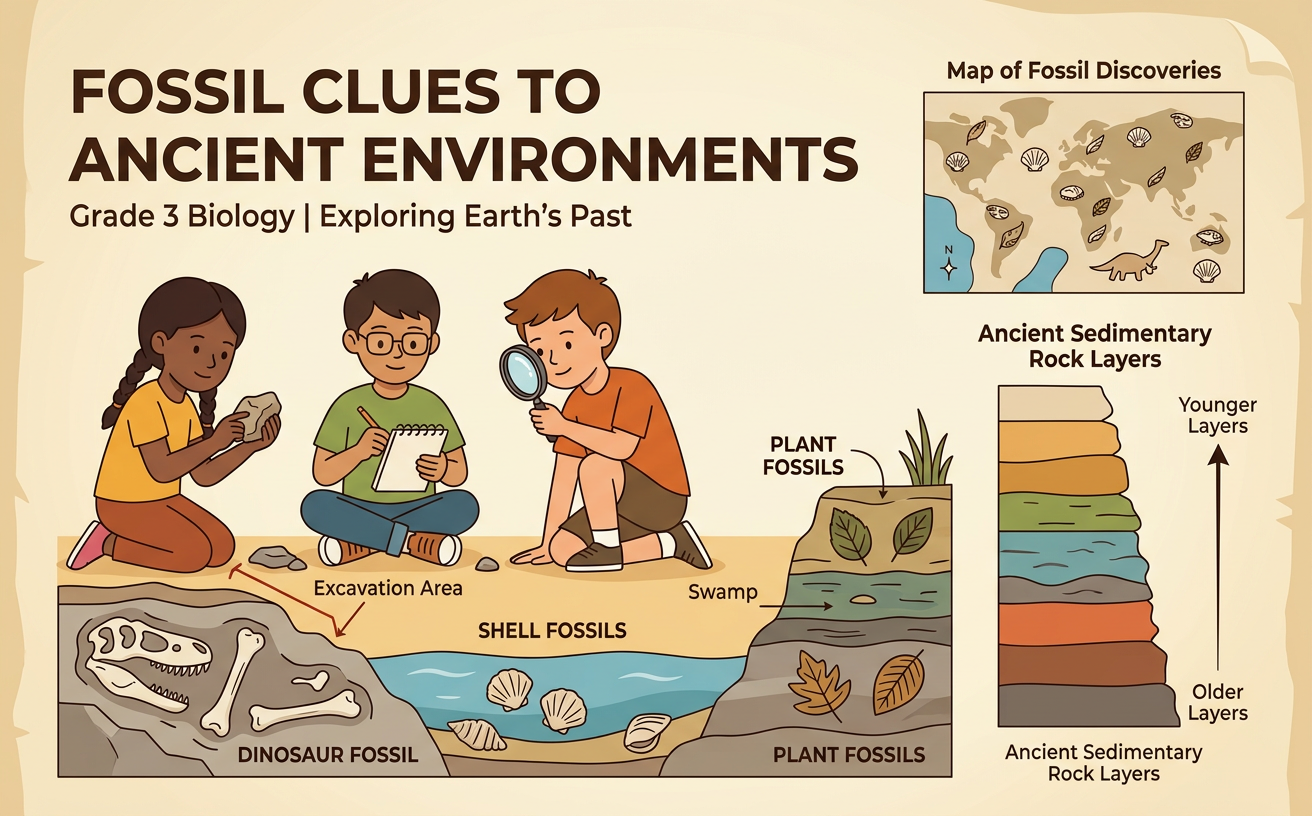
Students examine fossil evidence and use observations, maps, and simple data to explain what an area was like long ago.
Illustrations are auto-generated and may be placeholders. They can be refreshed to match the narration.
What Is a Fossil?
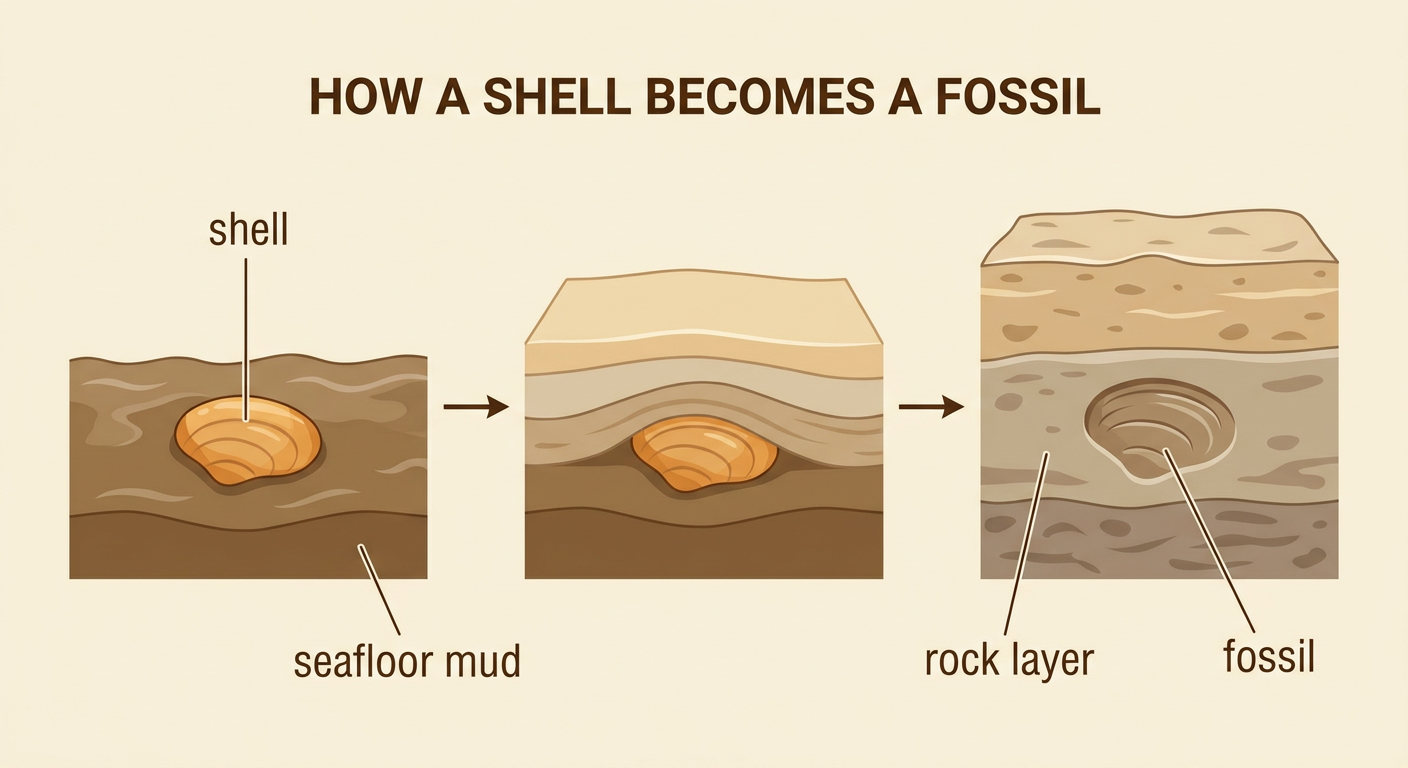
A fossil is preserved evidence of a living thing from long ago. Some fossils are body parts, such as shells, bones, or teeth. Other fossils are traces, such as footprints, burrows, or leaf impressions. Fossils usually form when an organism or its trace is quickly covered by mud, sand, or ash. Over a very long time, the sediment may harden into rock and preserve the evidence. For example, a shell buried in soft seafloor mud can leave its shape in rock. Fossils do not tell us every detail about the past, but they provide useful clues. Scientists carefully record where each fossil is found because fossils from the same rock layer may give evidence about the same ancient environment.
Observe the Fossil Clues
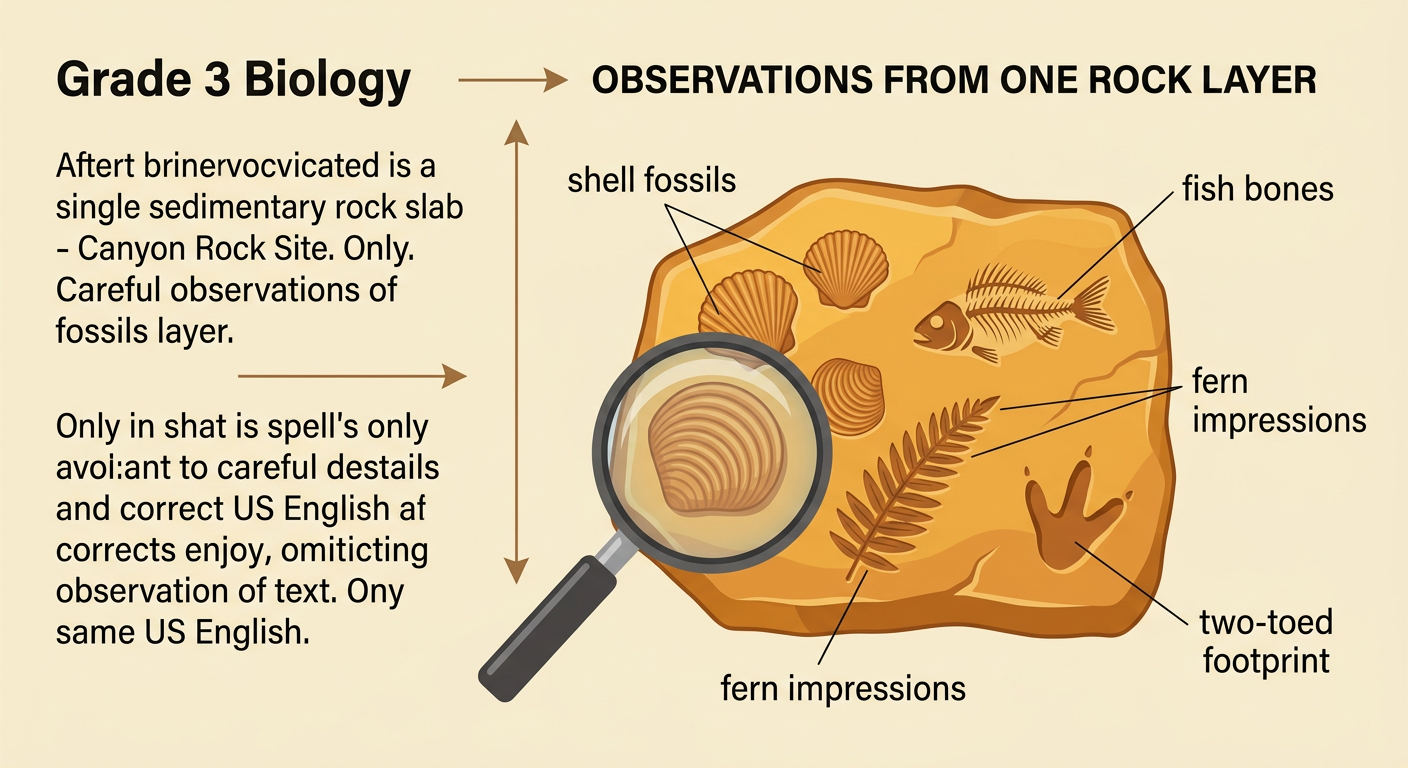
Scientists begin by making careful observations. An observation describes what can be seen or measured, not what someone guesses. Imagine that scientists examine one rock layer at Canyon Rock Site. They find curved shell fossils, fish bones, fern-leaf impressions, and a two-toed footprint. The shells have ridged surfaces, and the fish fossils include fins and small backbones. These are observations. Scientists can then ask questions: Which organisms lived in water? Which lived on land? Shells and fish are evidence of water, while ferns suggest nearby moist land. The footprint shows that an animal walked across soft ground. Because all the clues come from the same layer, they may help describe one ancient place and time.
Graph the Fossil Evidence
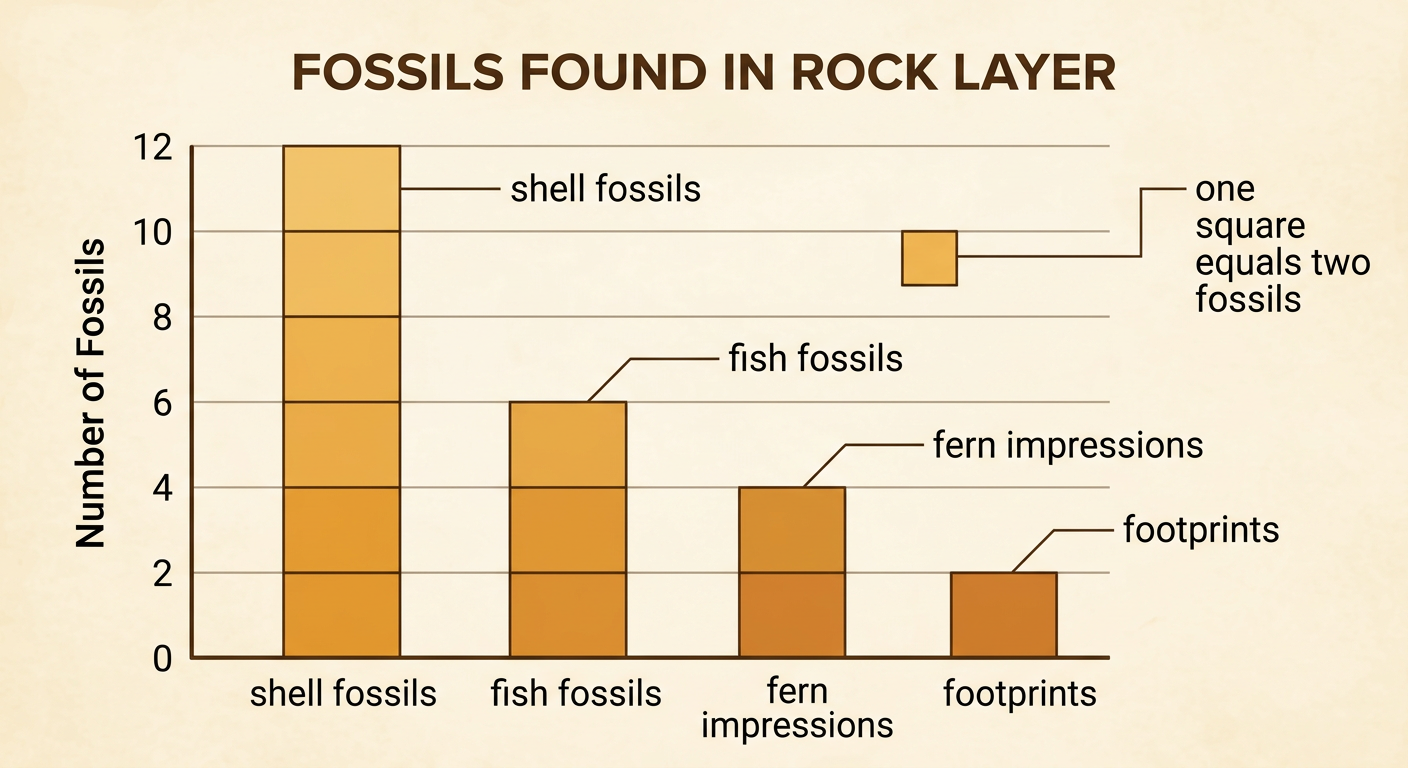
A graph helps scientists compare fossil data. At Canyon Rock Site, suppose one rock layer contains 12 shell fossils, 6 fish fossils, 4 fern impressions, and 2 footprints. A scaled bar graph can show these numbers using a scale of one square for every two fossils. The shell bar is six squares tall, the fish bar is three squares tall, the fern bar is two squares tall, and the footprint bar is one square tall. The graph shows that shells are the most common fossil. There are 6 more shells than fish fossils and 10 more shells than footprints. Many water-organism fossils provide strong evidence that water was an important part of this environment. However, the fern and footprint clues also suggest land was nearby.
Map the Ancient Environment
A map shows where fossil clues are found and how locations connect to environmental features. On a map of Canyon Rock Site, shell and fish fossils are clustered in a low central area. Fern impressions and footprints are found along the higher eastern edge. Scientists can use these locations to create a model of the ancient environment. The low area may once have been shallow water, while the higher edge may have been a muddy shoreline with plants. A map key explains each symbol, and a compass rose shows direction. This ancient map may look different from a map of the area today because rivers, lakes, shorelines, and landforms can change over long periods. Fossils help reveal environmental characteristics that are no longer visible.

Make an Evidence-Based Claim
An evidence-based claim answers a question and is supported by observations and data. For Canyon Rock Site, a student might claim, “This area was probably a shallow-water environment beside a muddy, plant-covered shore.” The evidence includes 12 shell fossils and 6 fish fossils, which show that water organisms lived there. Four fern impressions and 2 footprints provide evidence of moist land nearby. The map strengthens the claim because shells and fish are grouped in the low area, while ferns and footprints are near its edge. The reasoning connects the evidence to the claim: fish and many shell animals live in water, while ferns grow on land and animals can leave tracks in wet mud. Words such as “probably” are important because fossil evidence supports a conclusion but may not prove every detail.
