
Fossil Clues to Life Long Ago
Students examine fossil evidence to explain how organisms and environments have changed over time.

Illustrations are auto-generated and may be placeholders. They can be refreshed to match the narration.
What Is a Fossil?
A fossil is preserved evidence of an organism that lived long ago. Fossils can be body parts, such as bones, teeth, shells, or leaves. They can also be traces of activity, such as footprints, nests, or burrows. Many fossils form when an organism is quickly buried by mud or sand. Over time, more sediment piles on top and hardens into sedimentary rock. Minerals may replace or fill parts of the organism. For example, an ammonite shell buried on an ancient seafloor may leave a spiral-shaped fossil in rock. Fossil formation is rare because most organisms decay or are eaten before they can be buried. Each fossil is a clue, but scientists must study its rock layer and surroundings to understand the clue correctly.

Reading Fossil Clues
Scientists read fossils by observing their shape, size, location, and rock layer. In an undisturbed stack of sedimentary rock, lower layers usually formed before layers above them. This pattern helps scientists place fossils in a relative order from older to younger. They do not learn an exact age from position alone. Imagine that a three-toed footprint fossil is found in a lower layer, while a leaf fossil is found in a higher layer. The footprint was probably made earlier if the layers have not been folded or overturned. Scientists also compare repeated patterns across rock formations. Matching fossils found in separate places can help connect layers that formed during a similar period. Careful notes, photographs, and measurements allow other scientists to check the evidence and compare interpretations.

Organisms of the Past
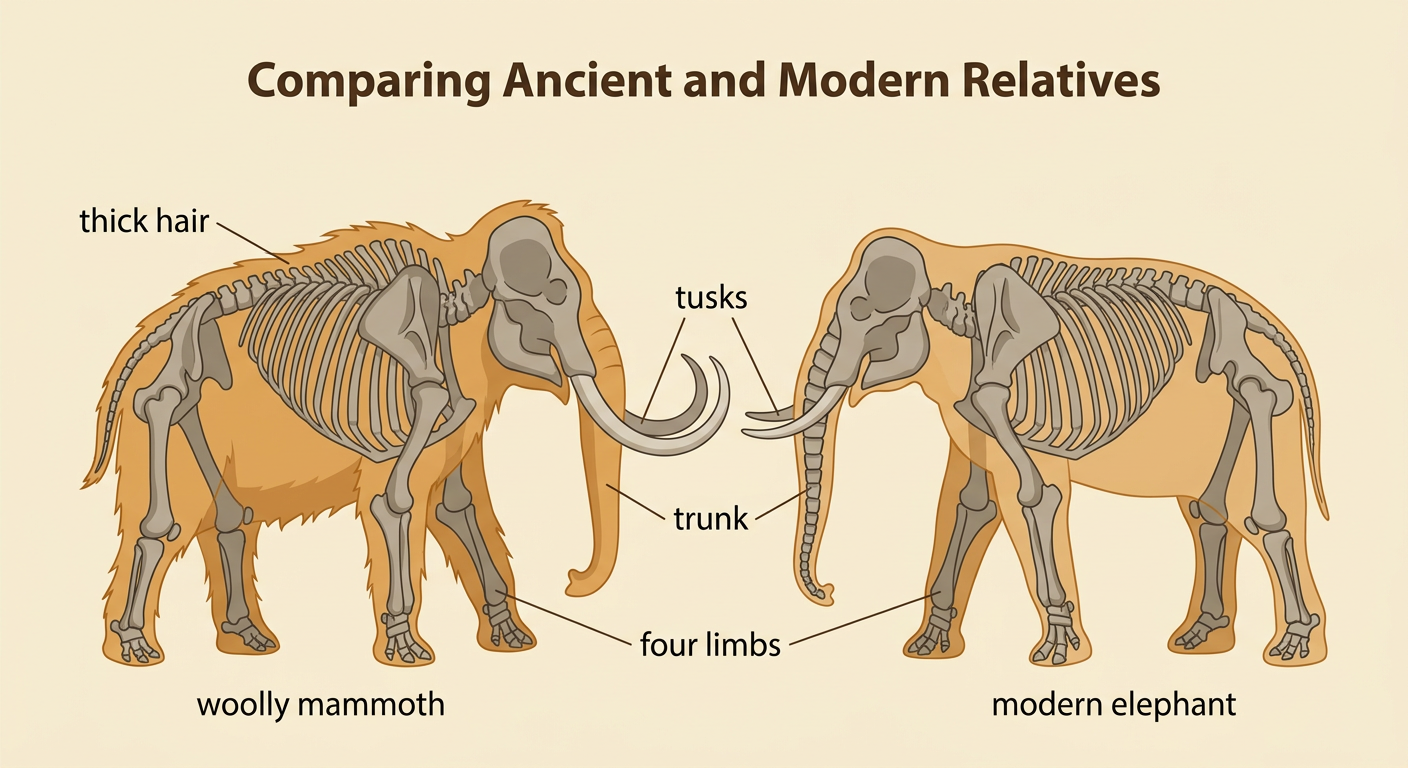
Fossils show that many organisms from the past were different from organisms living today. Some fossil organisms are extinct, which means no members of their kind are alive now. Other fossils share features with modern organisms. Scientists compare structures such as teeth, limbs, shells, and leaves to learn how living things have changed over long periods. For example, a woolly mammoth fossil has tusks and a trunk like a modern elephant, but it also shows features suited to cold conditions, including thick hair. Scientists use more than one fossil before drawing a conclusion because a single specimen may be incomplete. By comparing mammoth bones, frozen remains, cave images, and modern elephant skeletons, researchers build a stronger picture of the mammoth’s body, behavior, and way of life.
Changing Environments
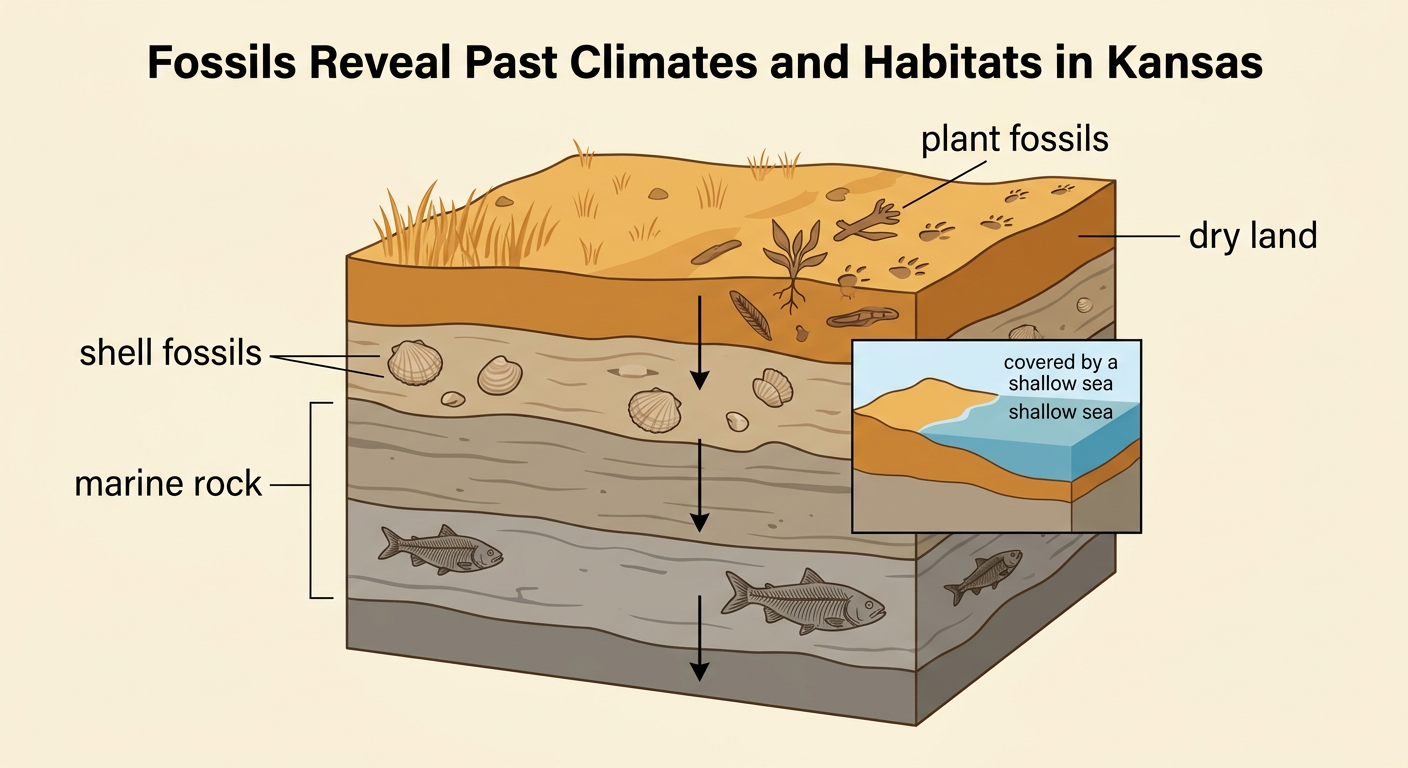
Fossils can reveal how an environment changed over time. Organisms need particular habitats, so their fossils provide clues about past water, land, and climate conditions. For example, scientists have found fossils of clams and other sea organisms in rock layers in Kansas, far from today’s ocean. These fossils, together with layers of marine sedimentary rock, show that a shallow sea once covered the area. Higher rock layers may contain land plants or tracks from land animals, suggesting that the water later disappeared and dry land formed. One fossil is not enough to explain an entire landscape. Scientists look for patterns in many fossils, rock types, and formations. They also compare maps and scientific texts to decide which explanation best fits all the available evidence.
Building an Evidence-Based Explanation
An evidence-based explanation includes a claim, evidence, and reasoning. The claim answers a question. The evidence includes relevant observations from fossils, rock layers, maps, or reliable texts. The reasoning explains how the evidence supports the claim. Suppose students claim that a location changed from a shallow sea to dry land. They could cite shell fossils in a lower marine rock layer and plant fossils in a higher layer. Their reasoning would explain that shells came from sea organisms, plants grew on land, and the lower layer formed first. Students should also integrate information from two texts and compare sources. An early scientist’s field journal may describe where a fossil was found, while a modern museum article may identify it using newer research. If sources disagree, students should note the difference and choose the explanation best supported by several pieces of evidence.
