
From Data to Scientific Explanation
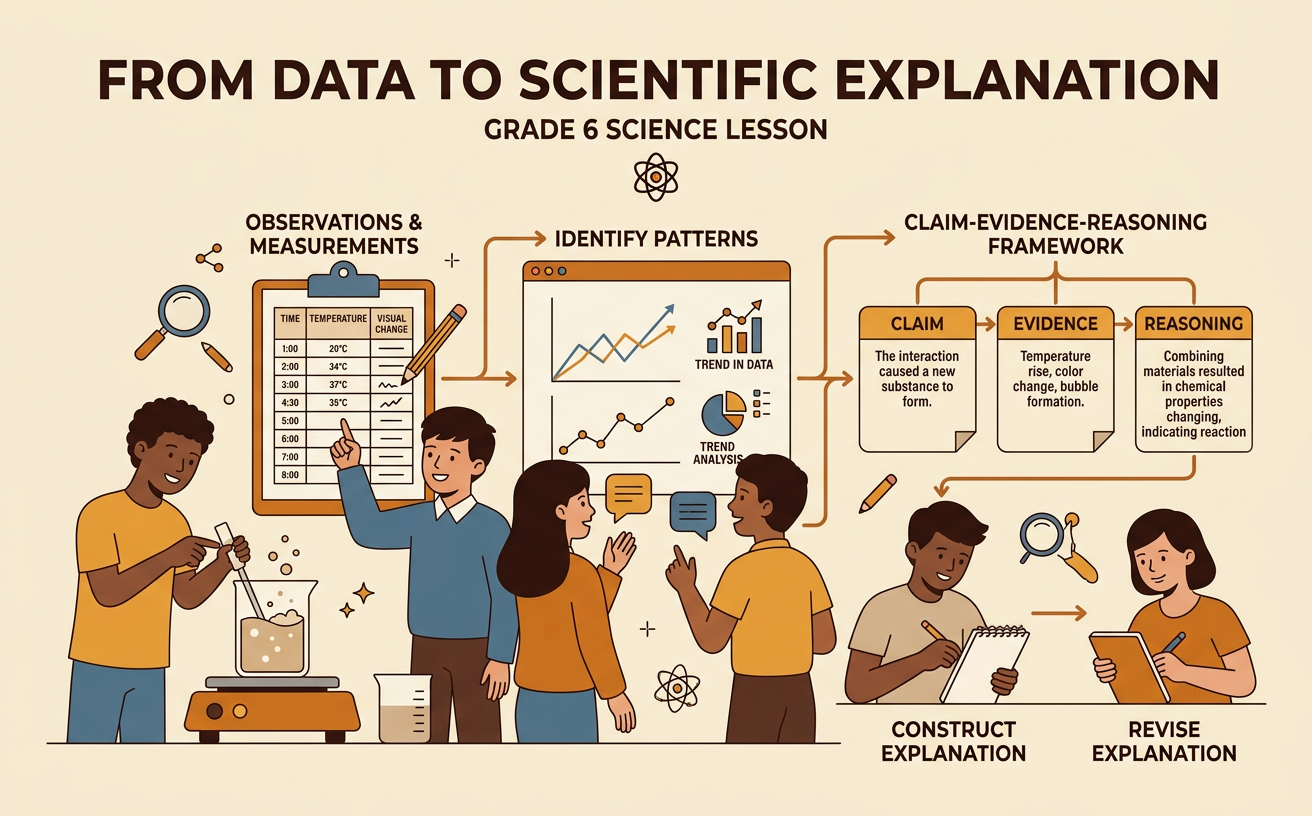
Students analyze observations and measurements from a substance-interaction investigation, identify patterns, and use claim-evidence-reasoning to construct and revise a scientific explanation.
Illustrations are auto-generated and may be placeholders. They can be refreshed to match the narration.
Scientific Inquiry as an Iterative Process
Scientific inquiry is not a straight path with a final answer after one test. Scientists ask a question, plan an investigation, collect data, analyze results, explain what happened, and then ask new questions. They may repeat or change a step when evidence is unclear. For example, students might mix baking soda and vinegar and ask whether a chemical reaction occurs. They record bubbling, temperature, and mass. If one group measures a different temperature change, the class can repeat the trial using equal amounts and the same starting temperature. Repeated trials help reveal whether a result is dependable or caused by a measurement error. Each cycle can improve the investigation and make the scientific explanation more accurate and convincing.
Observations, Measurements, and Inferences
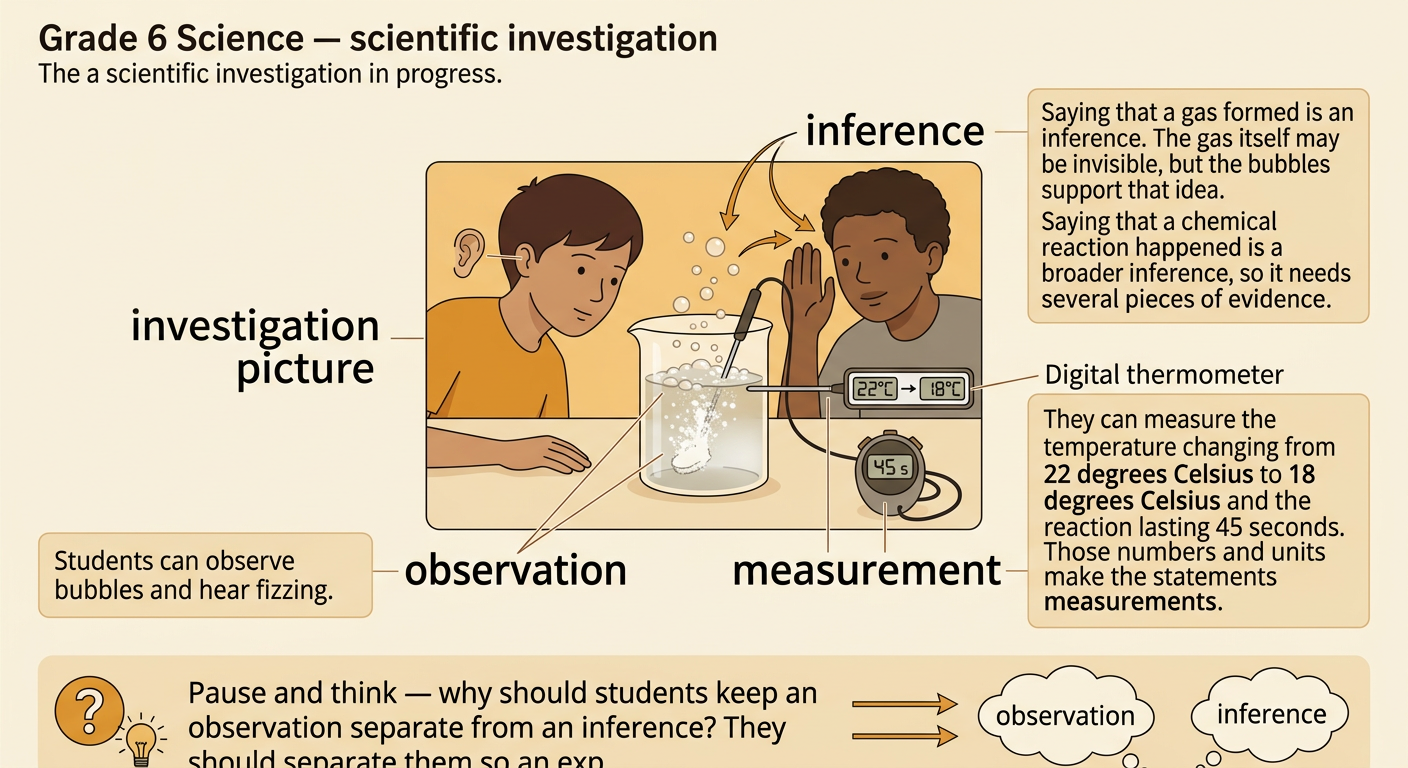
An observation is information gathered directly with the senses or tools. A measurement is an observation that includes a number and unit. An inference is a logical interpretation based on observations and prior scientific knowledge. When baking soda is added to vinegar, students might observe bubbles and hear fizzing. They might measure the temperature changing from 22 degrees Celsius to 18 degrees Celsius and record the reaction time as 45 seconds. Saying that a gas formed is an inference supported by the bubbles, while saying that a chemical reaction occurred is a broader inference that requires several pieces of evidence. Students should keep observations separate from inferences in their notes. This prevents an expected conclusion from being recorded as if it were directly seen or measured.
Finding Patterns in Data
A pattern is a repeated relationship or trend in data. Scientists organize measurements in tables and graphs so patterns are easier to see. Suppose three trials of a baking soda and vinegar investigation begin at 22 degrees Celsius and end at 18, 19, and 18 degrees Celsius. All three trials also produce bubbles, while a control trial containing baking soda and water shows no bubbling and almost no temperature change. The repeated decrease in temperature and repeated gas production form a pattern linked to mixing the two reactants. One unusual result should be checked rather than ignored. Students should compare trials, look for increases or decreases, and consider whether the same amounts, tools, and procedures were used. Consistent patterns provide stronger evidence than a single observation.

Building a Claim-Evidence-Reasoning Explanation
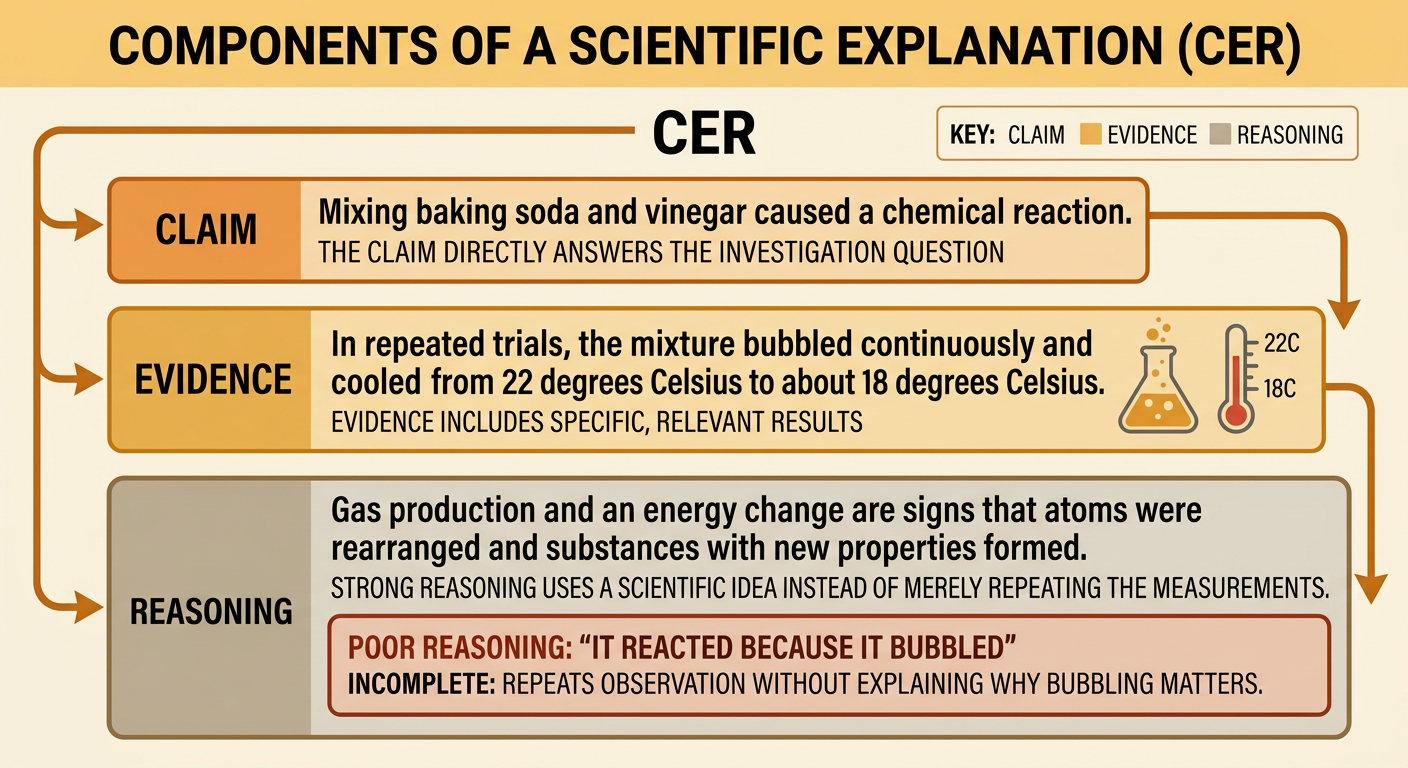
A scientific explanation can be organized as claim, evidence, and reasoning, often called CER. The claim directly answers the investigation question. For example, a claim might state, “Mixing baking soda and vinegar caused a chemical reaction.” Evidence includes specific, relevant observations and measurements, such as continuous bubbling and a temperature decrease from 22 degrees Celsius to about 18 degrees Celsius in repeated trials. Reasoning explains why the evidence supports the claim. In this case, gas production and an energy change are signs that atoms were rearranged and substances with new properties formed. Strong reasoning uses scientific ideas instead of simply repeating the evidence. A good CER explanation also avoids unsupported statements and identifies limitations, such as not directly identifying every product formed.
Revising Explanations with New Evidence
Scientific explanations should change when new, reliable evidence becomes available. Imagine that an open-container trial shows a lower final mass. Students might first claim that matter disappeared during the reaction. A later trial in a sealed bag shows that the total mass stays the same, even though the bag inflates. This new evidence indicates that gas escaped from the open container but remained inside the sealed system. Students should revise the explanation to state that a chemical reaction produced gas while the total amount of matter was conserved in a closed system. They should also describe strengths and limitations. Repeated temperature measurements and a sealed setup strengthen the evidence, but bubbles and temperature change alone do not identify all products. Revision does not mean the first effort failed; it means the explanation now fits more of the evidence.
