From Foraging to Farming: The Neolithic Revolution
Students examine evidence to explain how domestication and agriculture changed human settlement, population, work, and social organization.
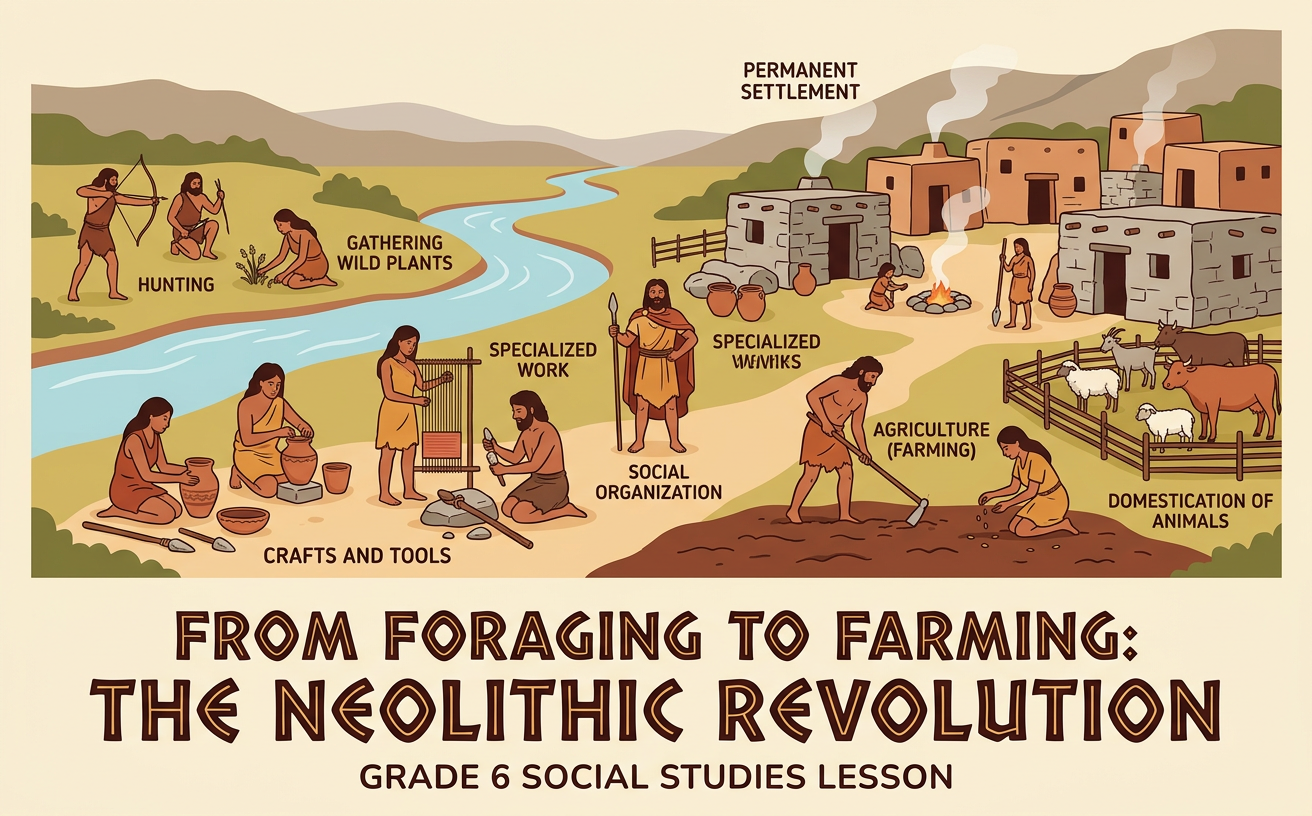
Illustrations are auto-generated and may be placeholders. They can be refreshed to match the narration.
Life as Hunters and Gatherers
Before agriculture, people obtained food by hunting animals, fishing, and gathering wild plants. Many groups moved during the year as resources became available in different places. For example, a community might gather berries in summer, fish during a seasonal salmon run, and hunt herd animals in winter. These seasonal movements required detailed knowledge of plants, animals, weather, and landscapes. Group sizes were often limited by the amount of food and water nearby. When resources became scarce, people moved, traded, or divided into smaller groups. However, not all foragers traveled constantly. In resource-rich areas, some built camps used for long periods. Foraging societies also made tools, created art, cared for children, and shared knowledge. Their ways of life were complex adaptations to local ecosystems.

Domesticating Plants and Animals
Domestication occurred when people repeatedly selected and raised plants or animals with useful traits. Over many generations, these species changed genetically and became different from their wild ancestors. In Southwest Asia, for example, farmers saved seeds from wheat plants whose seed heads stayed attached to the stalk. This made harvesting easier, and the trait became more common in later crops. People also managed sheep, goats, pigs, and cattle for meat, milk, hides, or labor. Domestication developed independently in several regions: rice was cultivated in East Asia, maize in Mesoamerica, and potatoes in the Andes. It was a gradual process rather than a single invention. As people increased the availability of selected foods, these resources could support larger human populations, although crop failure and animal disease created new risks.

Why Permanent Settlements Grew
Farming encouraged many communities to remain near fields, water sources, and stored food. Crops required planting, weeding, harvesting, and protection over several months. Grain could also be dried and stored, helping people survive seasons when fresh food was scarce. Greater resource availability often supported population growth. More children could be raised in one place, and larger groups could work together to dig irrigation channels or build houses. At Çatalhöyük in present-day Turkey, thousands of people lived in closely packed mud-brick homes while growing crops and raising animals. Permanent settlement did not guarantee an easy life. Crowded villages could experience disease, waste problems, conflict, or shortages after droughts. Settlement growth therefore resulted from both opportunities and challenges connected to local resources, food production, and cooperation.

Reading Archaeological Evidence
Archaeologists use physical remains to investigate how ancient people lived. They record where each object is found because location and soil layer provide important context. Charred grain may show that people stored or cooked crops. A stone sickle with a polished edge can suggest repeated harvesting. Animal bones offer additional evidence: a large number of young male sheep bones, combined with older female bones, may indicate that people managed breeding herds. No single artifact proves that farming occurred. Researchers compare several kinds of evidence, use scientific dating, and consider other explanations. For example, wild grain seeds near a hearth might have been gathered rather than cultivated. Students analyzing a source should identify the evidence precisely, such as the artifact, layer, date, or pattern, and then explain how that evidence supports an interpretation.

Changes in Work and Society
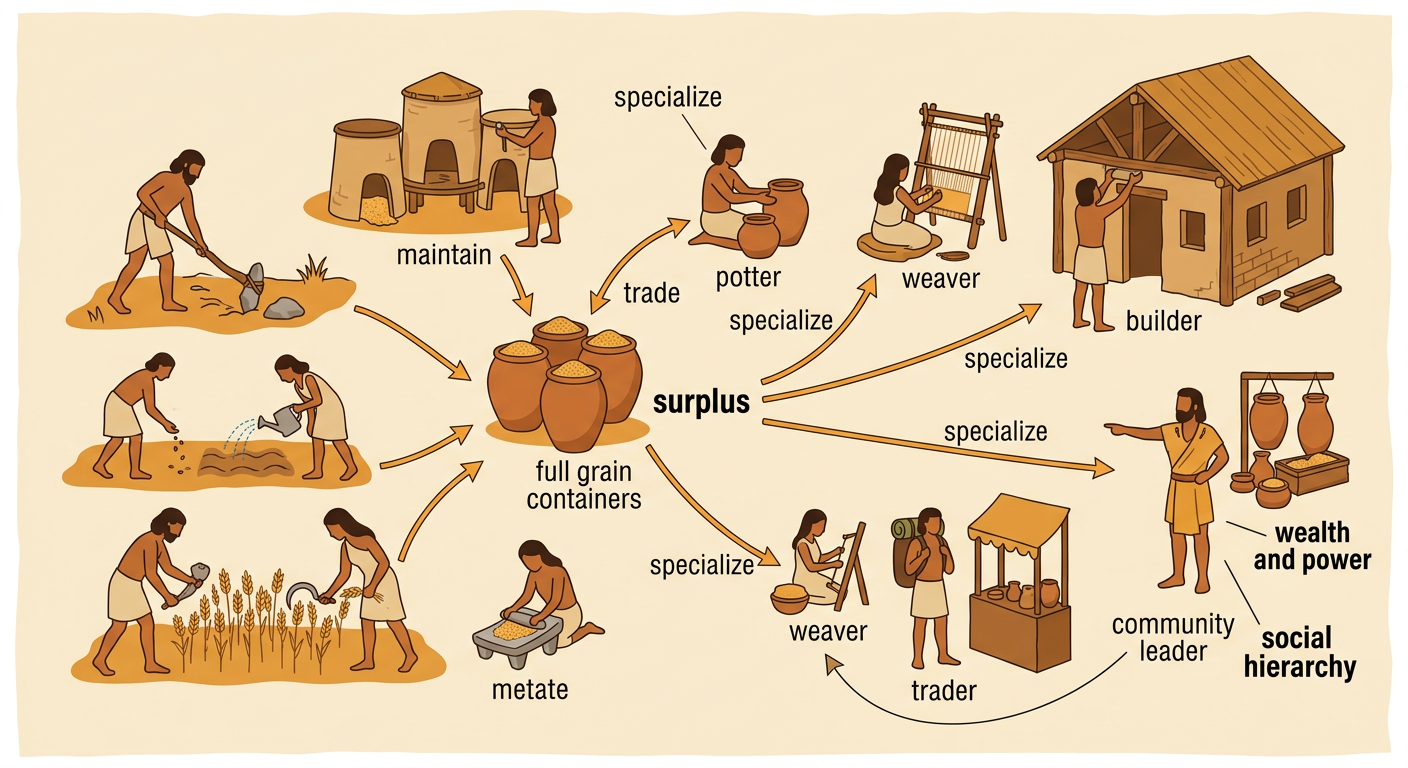
Agriculture changed work rather than simply reducing it. Farmers spent time clearing land, planting, watering, harvesting, grinding grain, tending animals, and maintaining storage areas. When farms produced a surplus, some people could devote more time to pottery, weaving, toolmaking, trade, construction, or leadership. A village potter, for example, could exchange storage jars for grain produced by farmers. Surplus food and valuable goods could also be controlled unequally, contributing in some places to differences in wealth and power. Larger settlements needed ways to organize shared tasks, settle disputes, and distribute resources. Family roles may also have changed, although artifacts rarely reveal exactly who performed every task. Communities still depended on cooperation, shared knowledge, and exchange. The effects varied by place, so archaeologists avoid assuming that every early farming society developed the same jobs or social hierarchy.
Evaluating Change and Continuity
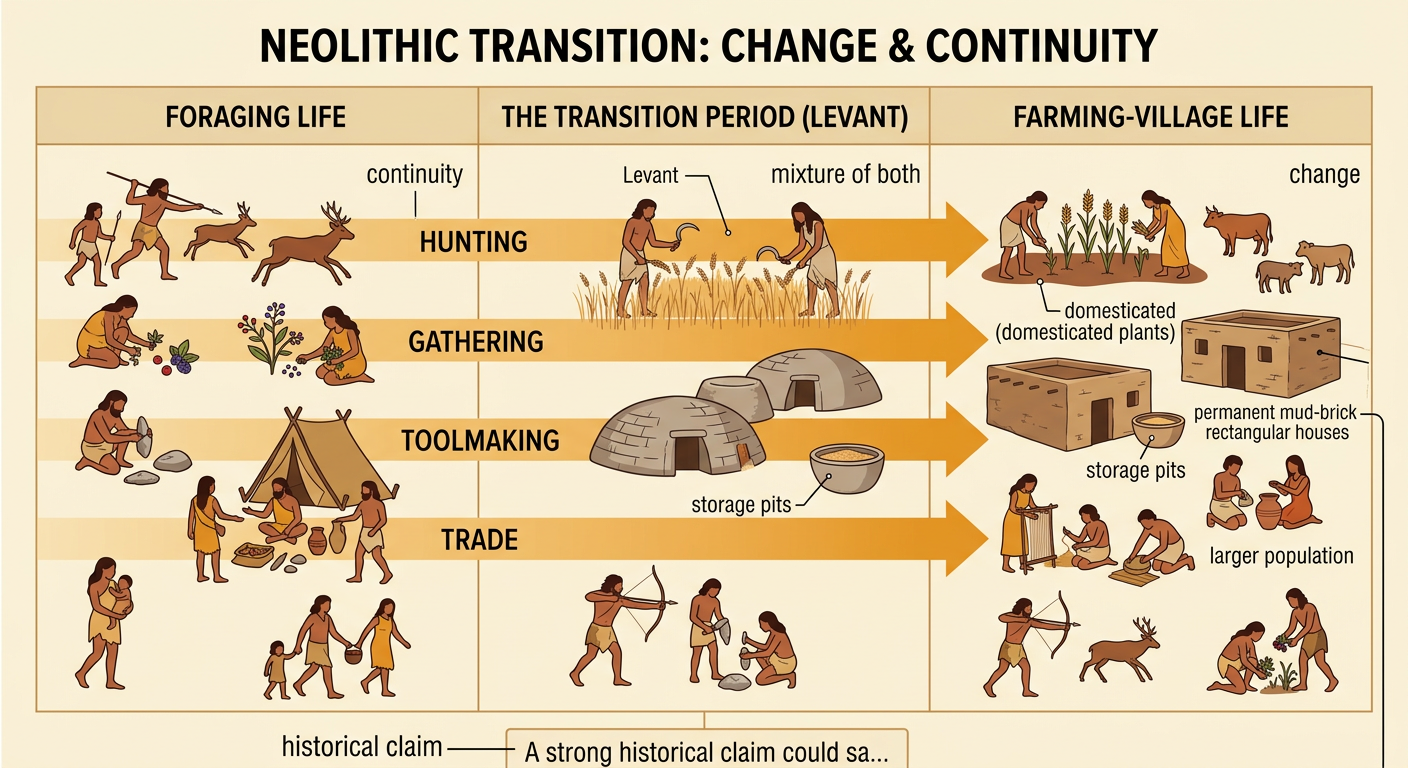
The Neolithic Revolution was a long transition, not a sudden worldwide event. To evaluate it, historians classify developments as change, continuity, or a mixture of both. Farming and permanent villages were major changes because they altered food production, population size, work, and settlement. Yet people continued hunting, gathering wild plants, trading, making tools, caring for families, and adapting to seasonal conditions. In the Levant, some communities harvested wild grain and lived in long-term settlements before fully domesticated crops became common. Later farmers still collected wild foods and hunted animals. This evidence shows that foraging and farming overlapped. A strong historical claim might state that agriculture increased reliance on domesticated food while older practices continued. The claim should cite specific evidence, such as plant remains, animal bones, tools, house foundations, storage pits, or settlement population estimates.