
From Natural Resources to Synthetic Materials
Students trace how natural resources are chemically processed into synthetic materials and evaluate the benefits and environmental impacts of those materials.

Illustrations are auto-generated and may be placeholders. They can be refreshed to match the narration.
Natural and Synthetic Materials
Natural materials come from plants, animals, rocks, minerals, or other parts of Earth. Wood, cotton, wool, clay, and metals are examples. Synthetic materials are made through human-controlled chemical processes. Their starting substances usually come from natural resources, but chemical reactions give the final materials new structures and properties. For example, cotton fibers grow around the seeds of cotton plants. Polyester fibers, however, are produced by reacting chemical substances usually obtained from petroleum or natural gas. Both cotton and polyester can be woven into fabric, but polyester usually dries faster and resists wrinkling. A material is not synthetic simply because it has been cut or shaped. Shaping wood into a chair does not change wood into a synthetic material. The key question is whether chemical processing created a material with a new chemical structure.

Tracing a Material to Its Source
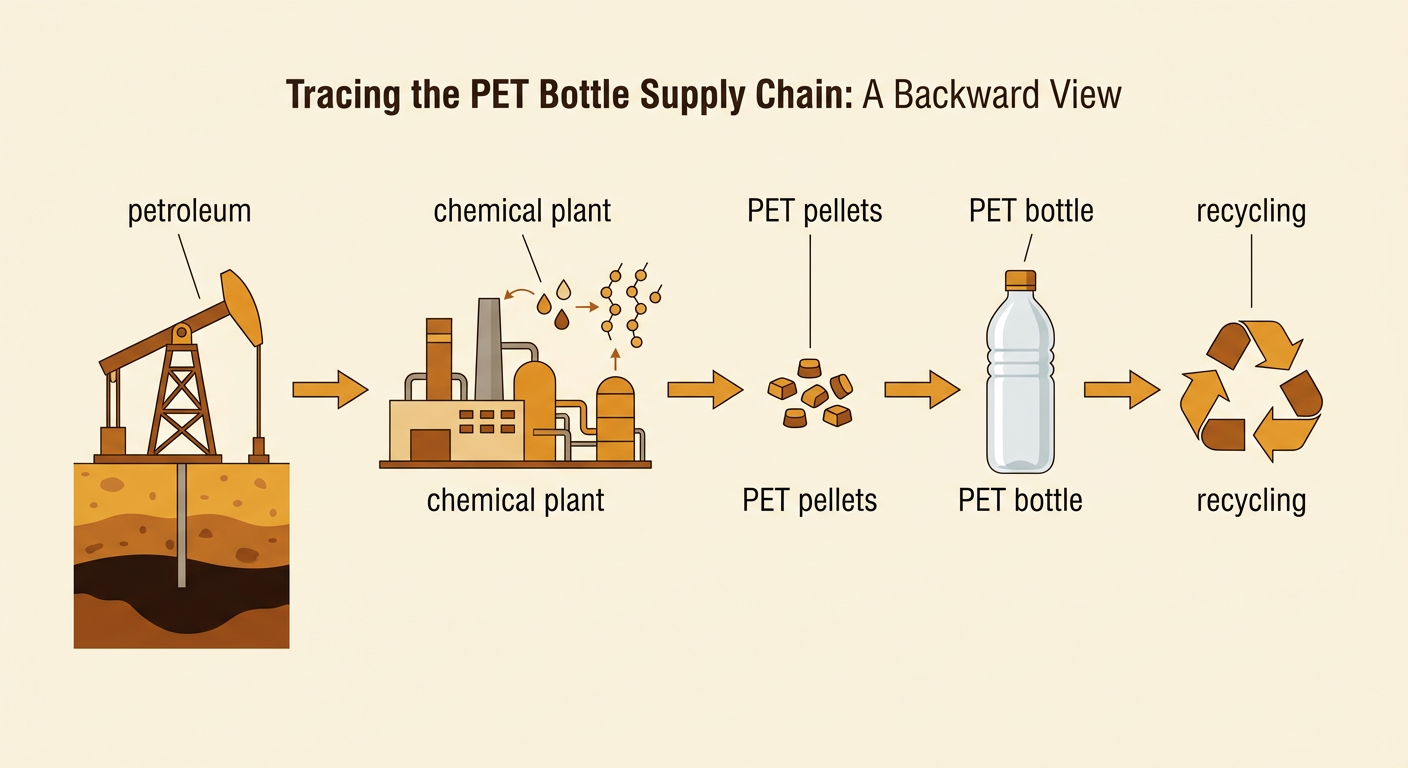
A material can be traced backward through a supply chain to the natural resources used to make it. Consider a clear polyethylene terephthalate, or PET, beverage bottle. The bottle begins with petroleum or natural gas extracted from Earth. At a refinery and chemical plant, these resources are separated and converted into smaller chemical substances. Manufacturers react ethylene glycol with terephthalic acid to form long PET polymer chains. The PET is cooled into small pellets, heated again, and molded into bottles. After use, a bottle may be collected, sorted, cleaned, and recycled into new plastic products. Tracing each step reveals that an object in a store is connected to resource extraction, energy use, transportation, manufacturing, and waste management. A complete trace identifies both the original natural resource and the major processing steps.
How Chemical Processing Changes Materials
Chemical processing rearranges atoms by breaking existing chemical bonds and forming new ones. This differs from a physical change, such as melting or cutting, which does not create a different chemical substance. Polyethylene provides an example. Manufacturers can obtain ethylene molecules from petroleum or natural gas feedstocks. Each ethylene molecule is a small unit called a monomer. During polymerization, many ethylene monomers join through new chemical bonds to form long polyethylene chains. The product has properties that individual ethylene molecules do not have. Depending on how the chains are arranged and processed, polyethylene can be flexible enough for bags or rigid enough for containers. Heating polyethylene to mold it is mainly a physical change, but producing polyethylene from ethylene is a chemical change. Its new molecular structure helps explain its strength, flexibility, and resistance to water.

Benefits of Synthetic Materials
Synthetic materials can be designed to have specific properties, including strength, flexibility, low mass, water resistance, or resistance to chemical damage. These properties can improve safety, health, transportation, and communication. Polycarbonate safety goggles are a concrete example. Polycarbonate is a transparent synthetic polymer that can withstand impacts better than ordinary glass of similar thickness. It protects a student’s eyes while remaining lightweight and easy to shape. Synthetic materials can also reduce costs because factories can produce large quantities with consistent properties. Nylon ropes resist rot, synthetic insulation slows heat transfer, and some medical plastics can be made sterile and used once to prevent infection. However, no material is best for every purpose. Designers must compare performance, cost, expected lifetime, resource use, and disposal options. A useful benefit should be evaluated across the material’s entire life cycle, not only during use.

Environmental and Social Impacts
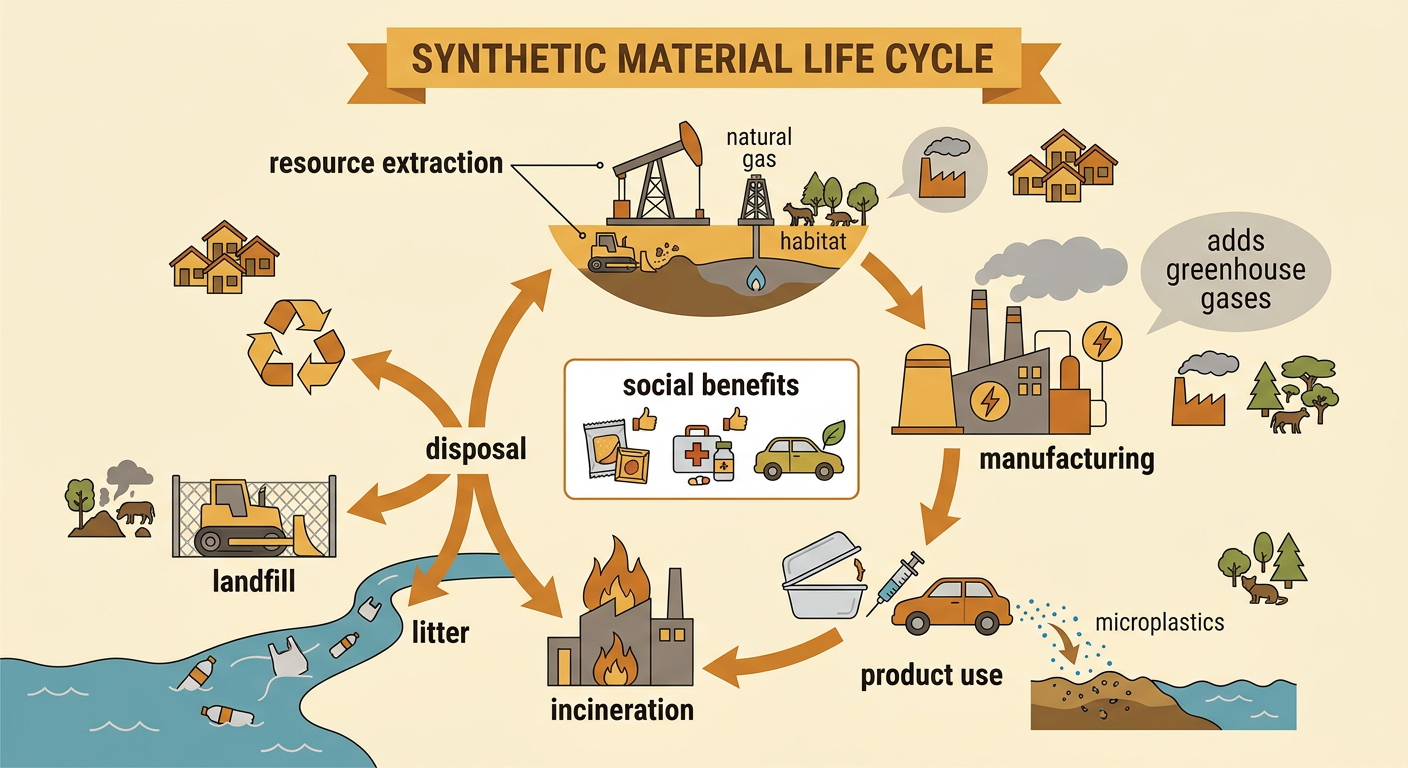
Synthetic materials can create impacts during resource extraction, manufacturing, use, and disposal. Extracting petroleum and natural gas can disturb habitats and may release pollutants. Chemical plants use energy, and energy production can add greenhouse gases to the atmosphere. During use, some plastic products break into tiny pieces called microplastics, which can enter soil and water. At the end of a product’s life, plastic may be recycled, burned, placed in a landfill, or released as litter. Each choice has different effects. Communities near extraction sites, factories, highways, or waste facilities may experience more noise, traffic, or pollution than communities that receive most of the product’s benefits. On the other hand, synthetic materials can preserve food, provide clean medical supplies, and make vehicles lighter. A fair evaluation considers environmental effects, social benefits, and how risks and benefits are distributed among groups.
Evidence-Based Material Choice
An evidence-based material choice includes a claim, supporting evidence, reasoning, and a response to a counterclaim. Suppose a school must choose between reusable stainless-steel forks and disposable polypropylene forks. A claim might state that reusable forks are the better long-term choice when they are used many times. Evidence should come from trustworthy science sources and may include data about raw materials, manufacturing energy, washing, durability, waste, and recycling. Students should cite the source’s author or organization, title, date, and the exact fact used. Reasoning must explain how the evidence supports the claim. A counterclaim might argue that disposable forks use no dishwashing water and are convenient during emergencies. A strong response acknowledges that benefit, then compares it with the repeated waste and resource use of single-use items. The final choice may depend on local electricity, water, recycling access, sanitation needs, and the expected number of uses.
