
From One Organism to the Biosphere: Ecological Levels
Students describe and explain how an organism belongs to a species and how organisms are organized into populations, communities, ecosystems, and the biosphere.
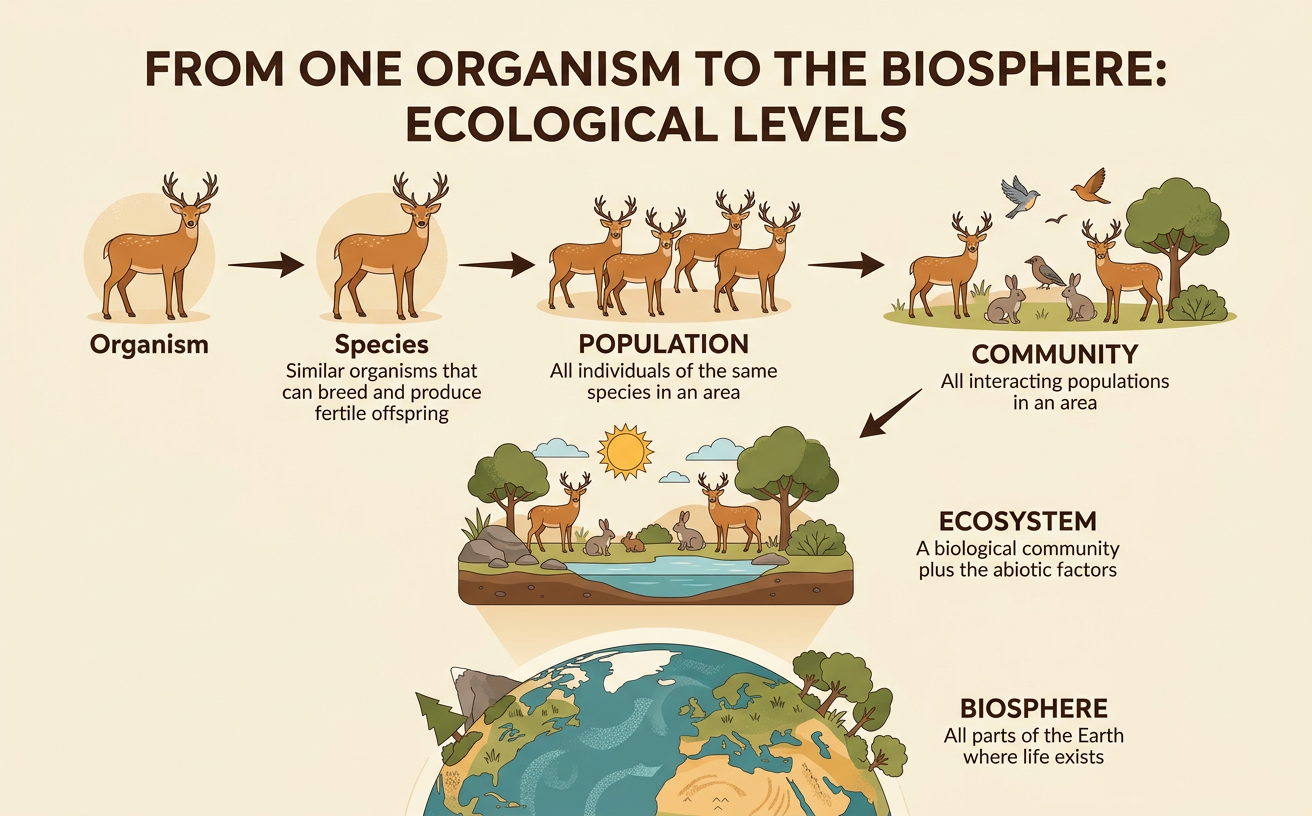
Illustrations are auto-generated and may be placeholders. They can be refreshed to match the narration.
The Hierarchy of Ecological Organization
Ecologists study life at several levels, from one living individual to all life on Earth. An organism is one individual living thing. Organisms that share important traits and can reproduce with one another belong to the same species. Members of one species living in the same area at the same time form a population. All the populations living and interacting in an area make up a community. A community plus nonliving parts of its surroundings forms an ecosystem. Together, all of Earth’s ecosystems make up the biosphere. For example, one frog is an organism. All frogs of its species in a pond are a population. The frogs, fish, plants, insects, and microbes form a community. When water, sunlight, air, and soil are included, the pond is an ecosystem.
Organism: One Living Individual
An organism is one individual living thing that carries out the processes needed for life. It uses energy, grows, responds to its surroundings, and has structures that help it survive. An organism may be a large animal, a tiny bacterium, a plant, a fungus, or another form of life. One red oak tree in a forest is an organism. Its roots take in water and minerals, its leaves capture sunlight, and its trunk supports its branches. The tree also interacts with its surroundings. It competes with nearby plants for light, provides shelter for squirrels and insects, and exchanges gases with the air. Although an organism can be studied by itself, it is always connected to other organisms and to nonliving parts of its environment.
Species and Population
A species is a group of organisms that share inherited characteristics and can reproduce with one another under natural conditions, producing offspring that can also reproduce. A population is more specific: it includes members of the same species living in the same area at the same time. For example, all monarch butterflies belong to the species Danaus plexippus. The monarch butterflies living in one meadow during the summer form a local population. Monarchs in a distant meadow are the same species, but they belong to a different local population. Population members may compete for food or space, find mates, and be affected by the same weather or predators. Population size can change when organisms are born, die, enter the area, or leave it. Therefore, species describes biological membership, while population also includes place and time.
Community and Ecosystem
A community includes all the populations of different species living and interacting in one area. In a pond community, populations of frogs, fish, algae, cattails, insects, bacteria, and fungi may affect one another. Fish may eat insect larvae, frogs may compete for prey, and fungi and bacteria may break down dead material. An ecosystem includes this entire living community plus nonliving factors such as water, sunlight, temperature, air, rocks, and soil. These nonliving factors influence which organisms can survive. For example, the amount of sunlight affects algae growth, and the water temperature affects fish activity. Matter and energy move between the living and nonliving parts of the ecosystem. A community contains only living populations, but an ecosystem includes both biotic factors, which are living or once living, and abiotic factors, which are nonliving.
Biosphere: All of Earth's Ecosystems
The biosphere is the broadest level of ecological organization. It includes every place on Earth where life exists and all of the planet’s ecosystems. The biosphere extends through parts of the land, water, and atmosphere. It includes deserts, forests, grasslands, lakes, rivers, oceans, wetlands, and icy polar regions. These ecosystems are different, but they are connected by moving water, air, organisms, nutrients, and energy. For example, water evaporates from the ocean, moves through the atmosphere, and falls as rain over a forest. Migrating birds may carry seeds or nutrients between distant ecosystems. Energy from the Sun supports most ecosystems by powering photosynthesis. The biosphere does not include all of Earth’s interior or all of outer space. It includes the thin global zone in which organisms live and interact with their environments.
Putting the Levels in Order
The ecological levels can be arranged from the narrowest focus to the broadest: organism, population, community, ecosystem, and biosphere. Species is an important classification that connects organisms of the same kind, but it is not defined by one location. To identify a level, ask what is included. One living individual is an organism. Individuals of the same species in one place and time form a population. All populations in that place form a community. Add nonliving factors to get an ecosystem. Combine every ecosystem on Earth to get the biosphere. For example, one sea otter is an organism. Sea otters along one section of coast are a population. Otters, kelp, fish, and other populations form a community. Add seawater, sunlight, rocks, and temperature to describe the kelp forest ecosystem. That ecosystem is one part of the biosphere.