
From Senses to Responses: How Animals React
Students model how an animal detects a stimulus through its senses, processes the information in its brain, and produces a response.

Illustrations are auto-generated and may be placeholders. They can be refreshed to match the narration.
What Is a Stimulus?
A stimulus is a change inside or outside an animal that can be detected. Light, sound, temperature, odor, pressure, hunger, and thirst can all be stimuli. A stimulus does not automatically cause the same response in every animal. The response depends on the animal, the situation, and how its brain interprets the information. For example, the sudden crack of a branch is a sound stimulus. A deer may lift its head, turn its ears toward the sound, and run away if it senses danger. A woodpecker might continue feeding because the sound is not important to it. Scientists identify the stimulus first and then observe the animal’s response. This helps them explain the relationship between an environmental change and an animal’s behavior.

The Five Senses as Receptors
Animals use sensory receptors to detect stimuli. Receptors are specialized cells that respond to particular kinds of information. In the familiar five senses, receptors in the eyes detect light, receptors in the ears detect sound, receptors in the nose detect airborne chemicals, receptors on the tongue detect chemicals in food, and receptors in the skin detect touch, pressure, and temperature. Sense organs change information from the environment into nerve signals. Different animals have senses suited to their needs. For example, an owl’s large eyes gather light in dim conditions, helping the owl detect a moving mouse at night. Some animals also have sensory abilities beyond the familiar five, such as detecting Earth’s magnetic field. In every case, receptors begin the process of collecting information.

From Sense Organ to Brain
After a sensory receptor detects a stimulus, it changes the information into an electrical nerve signal. Sensory nerves carry the signal toward the brain, often through the spinal cord. The brain receives the signal, connects it with other information and past experiences, and decides what it may mean. Suppose a dog hears the sound of a can opener. Receptors in the inner ear detect vibrations caused by the sound. Sensory nerves carry signals to the brain. The dog’s brain may connect that pattern of sound with previous experiences of being fed. The brain then prepares a response, such as turning toward the kitchen. This process happens quickly, but it still follows an organized pathway from the sense organ to the nervous system.

How the Body Responds
Once the brain processes sensory information, it can send signals through motor nerves to parts of the body. Muscles may contract to produce movement, and glands may release substances such as saliva or sweat. Some responses are voluntary, meaning the animal makes a conscious choice. Others are automatic and happen without careful thought. For example, when a rabbit sees a hawk’s shadow, its brain may identify possible danger. Motor nerves carry signals to the rabbit’s leg muscles. Those muscles contract, causing the rabbit to sprint toward shelter. At the same time, its heart rate may increase automatically so that more oxygen reaches its working muscles. A response can therefore include both visible behavior and changes occurring inside the body.

Comparing Response-Time Data
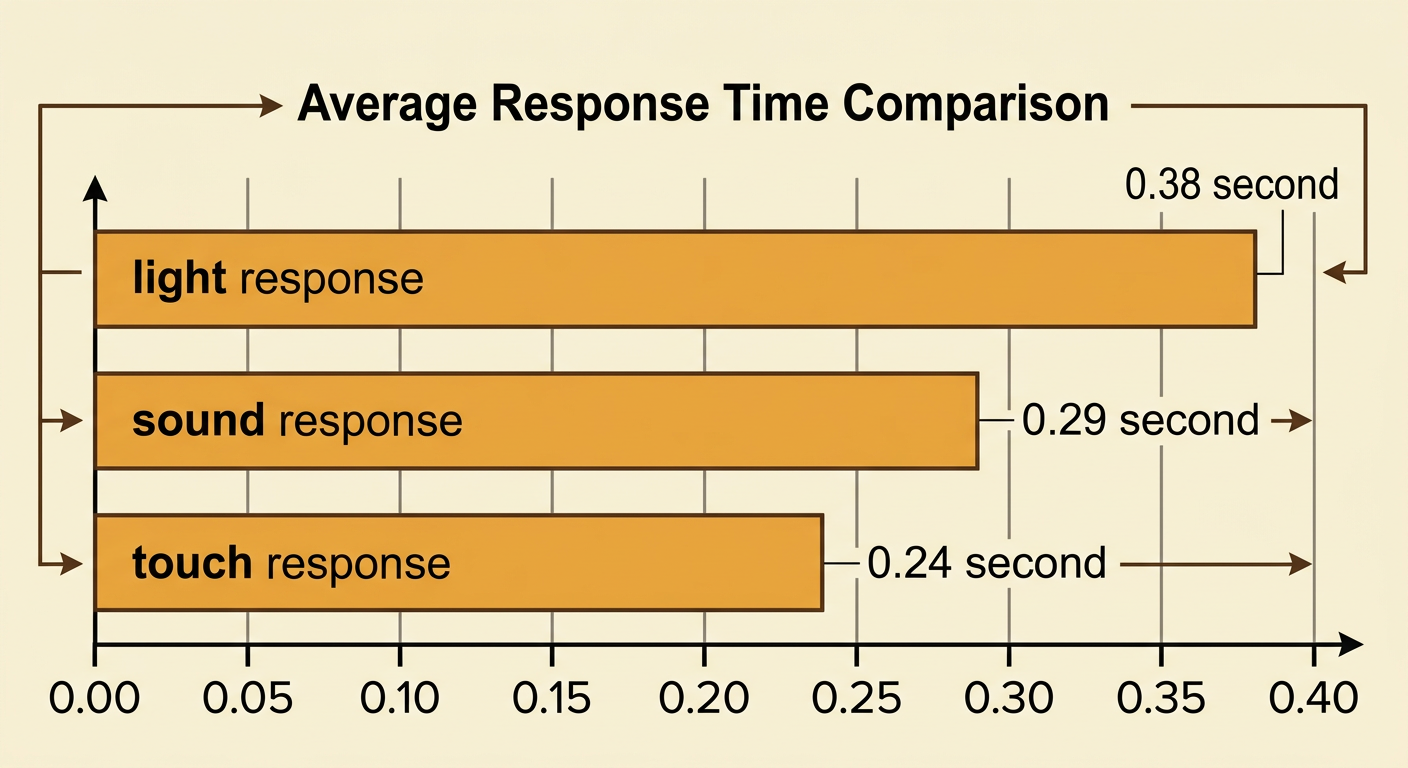
Response time is the amount of time between a stimulus and a response. Scientists can record response times in seconds and use decimals to compare the results. Imagine that a student model gives these average times: 0.38 second for a light, 0.29 second for a sound, and 0.24 second for a touch signal. A smaller number means a faster response. In this data set, the touch response is fastest. To compare touch and light, subtract 0.24 from 0.38. The difference is 0.14 second. The sound response is 0.09 second faster than the light response because 0.38 minus 0.29 equals 0.09. Scientists repeat trials because attention, practice, and measurement error can affect results. These classroom data model response time but do not measure brain processing alone.
Model the Stimulus-Response Pathway
A scientific model can show the main parts of a stimulus-response pathway. Begin with a stimulus, then add the sensory receptor that detects it. Use arrows to show sensory signals traveling to the brain, information being processed, motor signals leaving the brain, and an action by muscles or glands. For example, a lizard may detect the moving shadow of a bird with receptors in its eyes. Its brain processes the information, and signals travel to its leg muscles, causing it to hide under a rock. To support the model, gather relevant facts from several reliable sources, such as a science book, a museum website, and an animal expert. Compare the sources and record which facts each one supports. Remember that a model simplifies a complex nervous system and may not show every nerve or brain region.
