From Stimulus to Response: How Animals Sense Their Environment
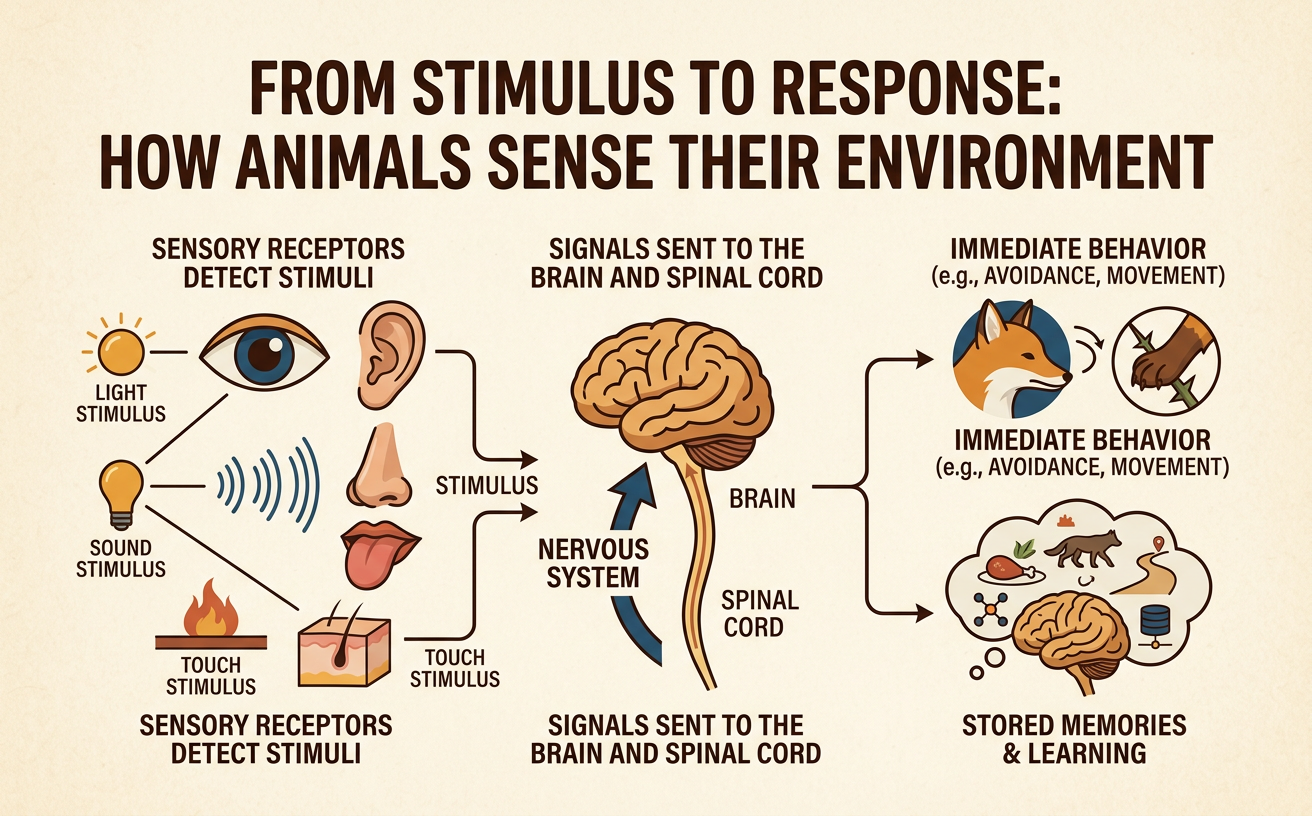
Students trace how sensory receptors detect stimuli, send signals to the brain, and produce immediate behaviors or stored memories.
Illustrations are auto-generated and may be placeholders. They can be refreshed to match the narration.
What Is a Stimulus?
A stimulus is a change inside or outside an animal that can be detected. Light, sound, temperature, pressure, odors, and chemicals are external stimuli. Hunger, thirst, and changes in body temperature are internal stimuli. A response is an action or body change caused by detecting a stimulus. For example, a deer may hear a snapping branch, lift its head, turn its ears, and run away. The sound is the stimulus; lifting its head and running are responses. Responses can help animals find food, avoid danger, communicate, or keep stable internal conditions. The same stimulus does not always produce the same response. A deer may ignore a familiar sound but flee from an unfamiliar one. Its response can be influenced by biology, past experience, surroundings, and the behavior of other animals.

Sensory Receptors Detect Change
Sensory receptors are specialized cells or nerve endings that detect particular kinds of stimuli. Receptors in the eyes detect light, receptors in the ears detect sound vibrations and head movement, and receptors in the nose and tongue detect chemicals. Receptors in the skin can detect touch, pressure, temperature, and possible tissue damage. When a receptor detects an appropriate stimulus, it converts the stimulus into a signal that the nervous system can carry. This conversion is called sensory transduction. For example, touching a cold metal railing activates temperature receptors in the skin. Those receptors do not send cold metal to the brain; they produce nerve signals containing information about the temperature change. A receptor responds best to certain stimuli, so light receptors cannot directly detect sound and sound receptors cannot directly detect light.

Signals Travel to the Brain
After sensory receptors detect a stimulus, sensory neurons carry information toward the central nervous system, which includes the brain and spinal cord. A nerve signal travels electrically along a neuron. At most junctions between neurons, called synapses, chemical messengers help pass the signal to the next cell. The brain receives and processes patterns of signals, compares them with other information, and may form a perception of what is happening. For example, sound vibrations from a ringing bicycle bell activate receptor cells in the inner ear. Sensory neurons carry signals through the auditory nerve to areas of the brain that process sound. The brain may identify the sound as a warning and send signals through motor neurons to the muscles. The rider then turns the handlebars or applies the brakes.

Immediate Responses and Stored Memories
Some sensory information produces an immediate response. In a withdrawal reflex, touching a dangerously hot surface activates receptors in the skin. Sensory neurons carry signals to the spinal cord, where other neurons quickly activate motor neurons. The muscles pull the hand away, while signals also travel to the brain so the person becomes aware of pain and heat. Other responses involve more brain processing and may be guided by memory. The brain can store parts of an experience by changing connections among neurons, although not every experience becomes a lasting memory. Later, a similar stimulus may bring back information and affect behavior. A person who remembers being burned may use an oven mitt before touching a hot pan. Biological reflexes, thoughts, learned habits, family practices, and safety rules can all influence how a person responds.

Reaction-Time Data Investigation
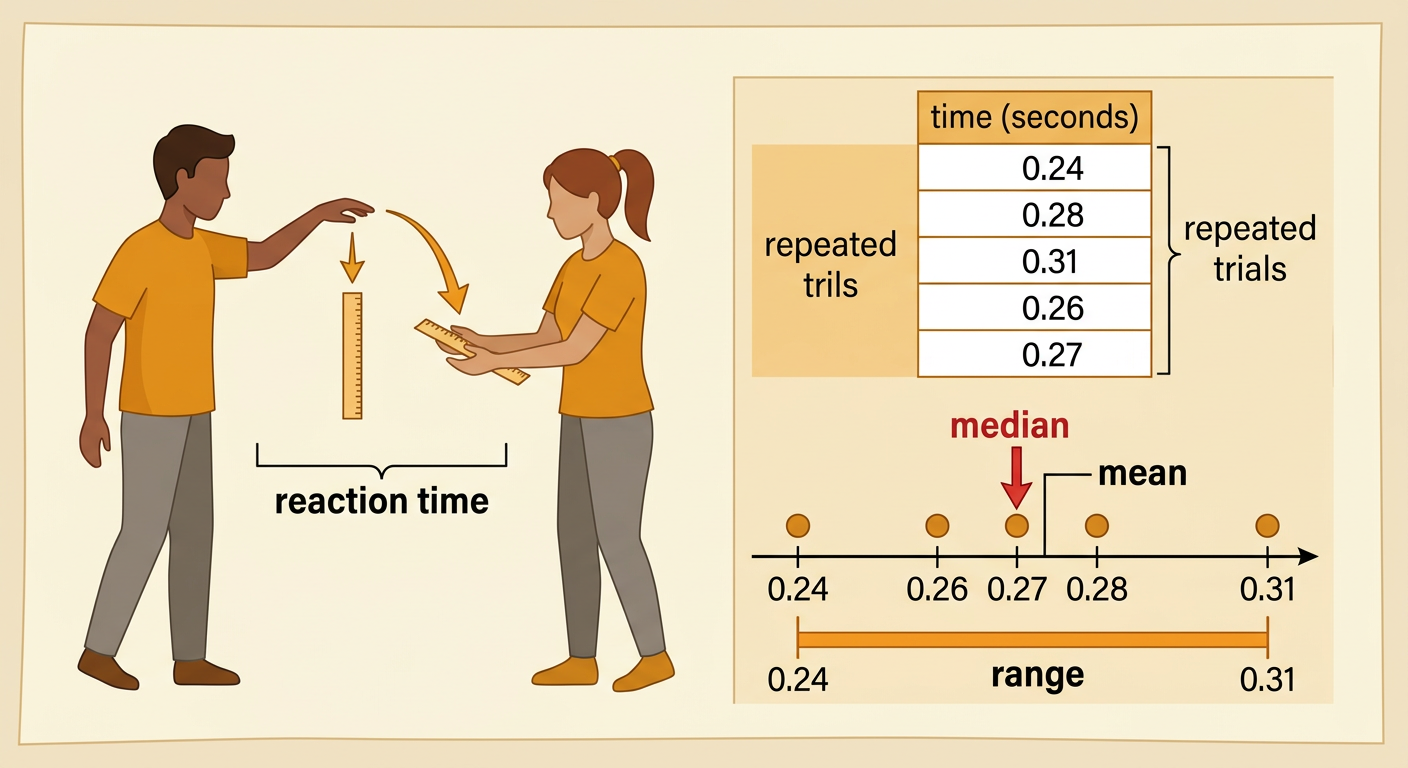
Reaction time is the time between the start of a stimulus and a measured response. To investigate it, one student can drop a ruler without warning while a partner catches it. The catch distance can be converted to time, or a digital timer can measure time directly. Suppose five trials give 0.24, 0.28, 0.31, 0.26, and 0.27 seconds. In order, the values are 0.24, 0.26, 0.27, 0.28, and 0.31, so the median is 0.27 second. The mean is 0.272 second, and the range is 0.07 second. Repeated trials reveal variation and give a better summary than one trial. Students should keep the same hand position, stimulus, device, and procedure. They can compare results, but reaction time should not be used to label a person’s intelligence or overall ability.
Explain a Stimulus-Response Pathway
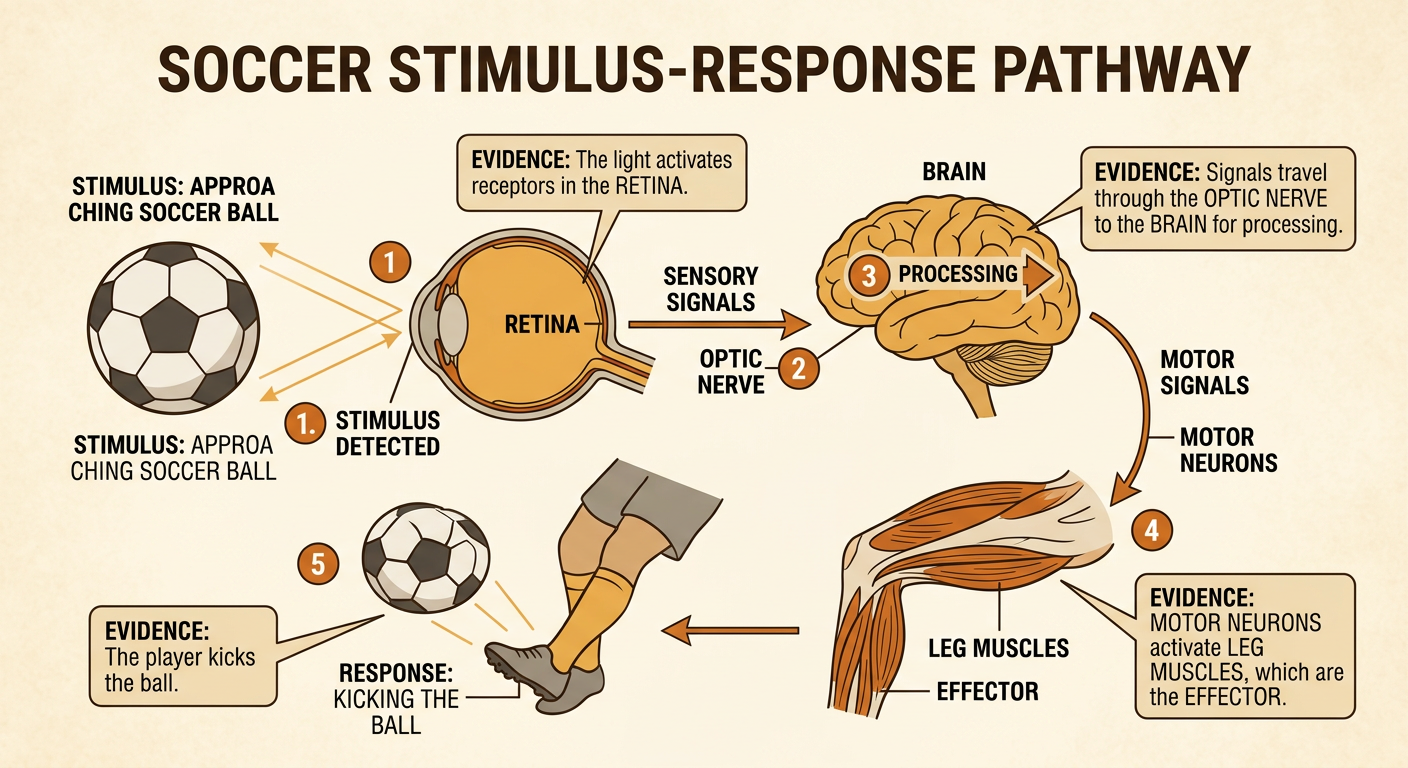
A strong explanation traces the complete pathway and supports each step with evidence. Begin by naming the stimulus and the receptor that detects it. Then describe sensory signals traveling to the central nervous system, processing by the brain or spinal cord, motor signals traveling to an effector, and the resulting response. An effector is a muscle or gland that carries out a response. For example, when a soccer player sees a ball approaching, light reflected from the ball activates receptors in the retina. Sensory signals travel through the optic nerve to the brain. The brain uses the ball’s motion and the player’s experience to select an action, then motor neurons activate leg muscles to kick. When using a scientific text, cite the specific sentence, paragraph, figure, or data that supports each claim. Also consider biological abilities, thoughts, learned behavior, and cultural rules of the sport.