Gas Laws and the Kinetic Molecular Theory
Students use particle models and mathematical relationships to explain and predict how pressure, volume, temperature, and amount affect the behavior of gases.
Illustrations are auto-generated and may be placeholders. They can be refreshed to match the narration.
Kinetic Molecular Theory
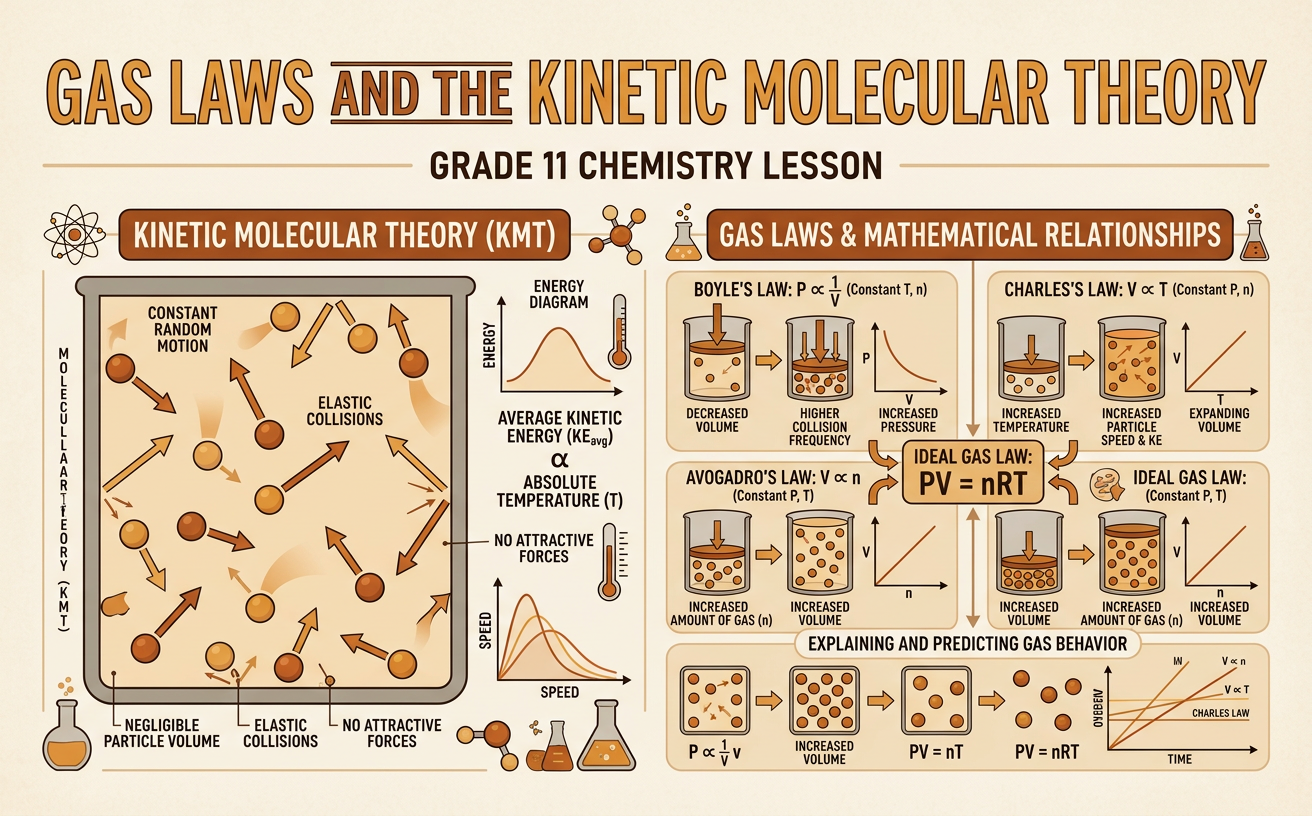
The kinetic molecular theory explains gas behavior by modeling a gas as tiny particles in constant, random motion. The particles are far apart, so their individual volumes are negligible compared with the container’s volume. In an ideal gas, particles do not attract or repel one another, and their collisions with each other and the container walls are perfectly elastic, meaning total kinetic energy is conserved. A gas particle’s average kinetic energy depends only on absolute temperature in kelvins. When a sealed container is heated from 250 K to 500 K, the particles’ average kinetic energy doubles. They move faster and strike the walls more often and with greater force. Particle diagrams are models: they do not show particles to scale, but they help connect invisible molecular motion to measurable properties such as temperature and pressure.

Pressure, Volume, and Temperature
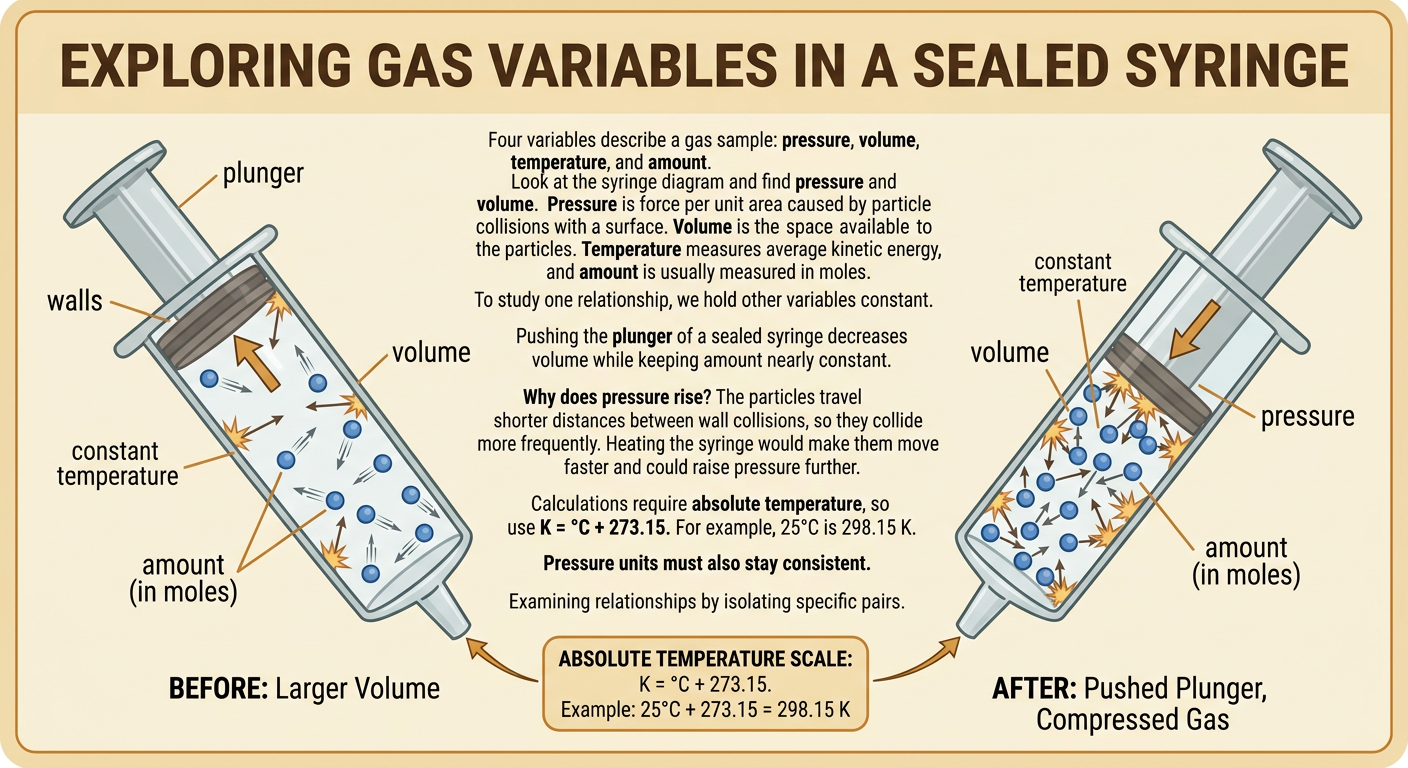
Four variables describe a gas sample: pressure, volume, temperature, and amount. Pressure is the force per unit area produced when gas particles collide with a surface. Volume is the space available to the particles, temperature measures their average kinetic energy, and amount is commonly measured in moles. To investigate one relationship, scientists hold other variables constant. For example, pushing in the plunger of a sealed syringe decreases the gas volume while keeping the amount nearly constant. The particles then travel a shorter distance between wall collisions, so collisions occur more frequently and pressure rises. If the syringe is also heated, faster particle motion can increase pressure further. Gas-law calculations must use an absolute temperature scale, so temperatures are converted to kelvins with K = °C + 273.15. Pressure units must also remain consistent throughout a calculation.
Boyle’s, Charles’s, and Gay-Lussac’s Laws
The simple gas laws describe pairs of variables when amount and one other condition remain constant. Boyle’s law states that pressure and volume are inversely related at constant temperature: P1V1 = P2V2. If a gas at 100 kPa occupies 2.0 L and is compressed to 1.0 L, its pressure becomes 200 kPa. Charles’s law states that volume is directly proportional to kelvin temperature at constant pressure: V1/T1 = V2/T2. A balloon that occupies 3.0 L at 300 K would occupy 4.0 L at 400 K if pressure stayed constant. Gay-Lussac’s law states that pressure is directly proportional to kelvin temperature at constant volume: P1/T1 = P2/T2. Heating a rigid tank from 300 K to 450 K raises its pressure by a factor of 1.5. Each law applies only when its stated variables are held constant.

The Combined and Ideal Gas Laws
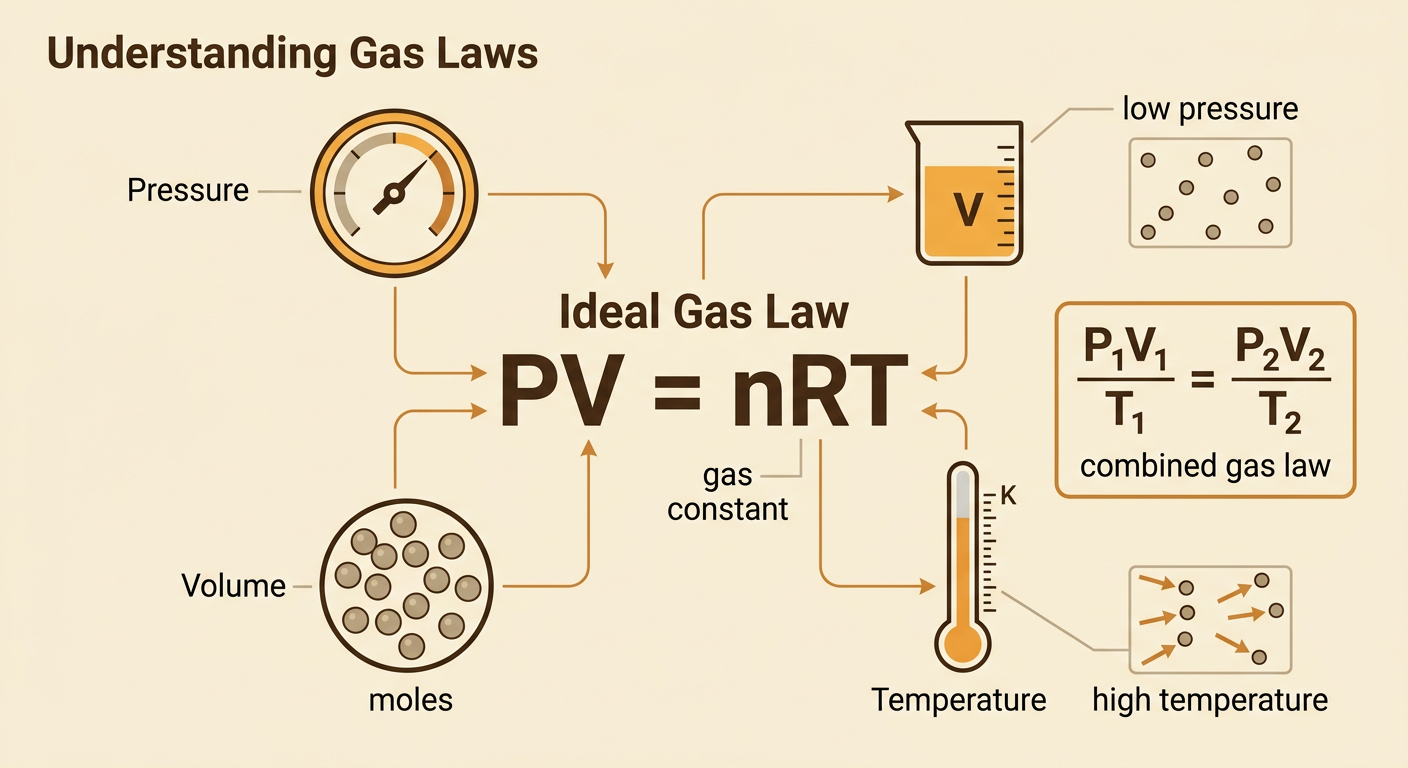
The combined gas law, P1V1/T1 = P2V2/T2, relates pressure, volume, and temperature for a fixed amount of gas. It is useful when a sample changes from one set of conditions to another. If the amount can also vary, the ideal gas law, PV = nRT, relates all four variables. In this equation, n is the amount in moles and R is a constant chosen to match the pressure and volume units. For example, one mole of an ideal gas at 273.15 K and 1.00 atm has a predicted volume of about 22.4 L when R = 0.08206 L·atm/(mol·K). Before solving, convert temperature to kelvins, select consistent units, identify the unknown, and rearrange the equation. These equations model energy-related particle behavior, but their predictions are most accurate for gases at low pressure and high temperature.
Interpreting Gas-Law Graphs and Data
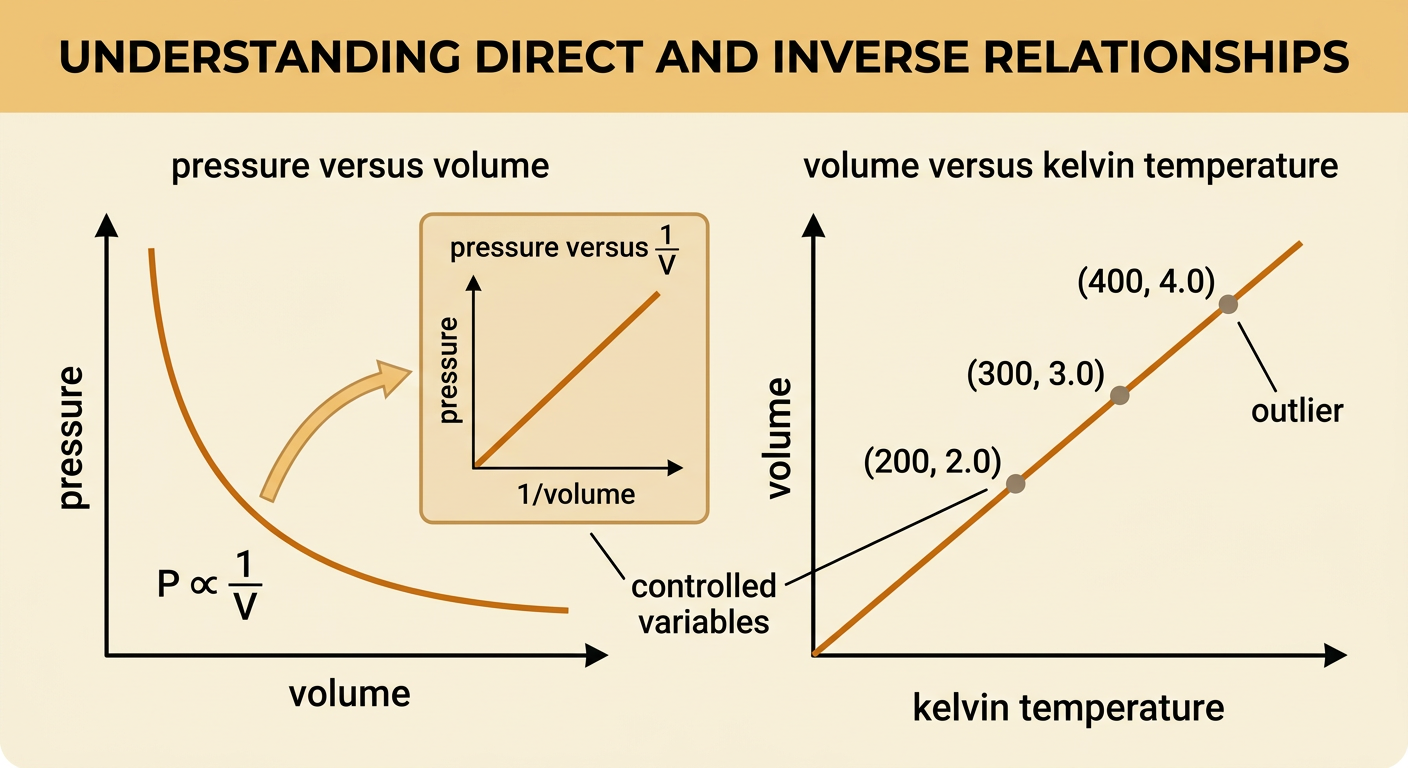
Graphs reveal whether gas variables are directly or inversely related. At constant temperature, a pressure-versus-volume graph forms a downward curve because Boyle’s law gives P = k/V. Plotting pressure against 1/V instead produces a straight line. At constant pressure, volume plotted against kelvin temperature forms a straight line through the origin for an ideal gas because V = kT. A Celsius-temperature graph does not pass through the origin and extrapolates toward zero volume near −273.15°C. Suppose data show volumes of 2.0, 3.0, and 4.0 L at 200, 300, and 400 K. The constant ratio V/T supports the claim that volume is directly proportional to kelvin temperature. When evaluating data, students should identify controlled variables, inspect units, compare patterns with equations, and note uncertainty or outliers before making an evidence-based conclusion.
Real-World Gas-Law Applications
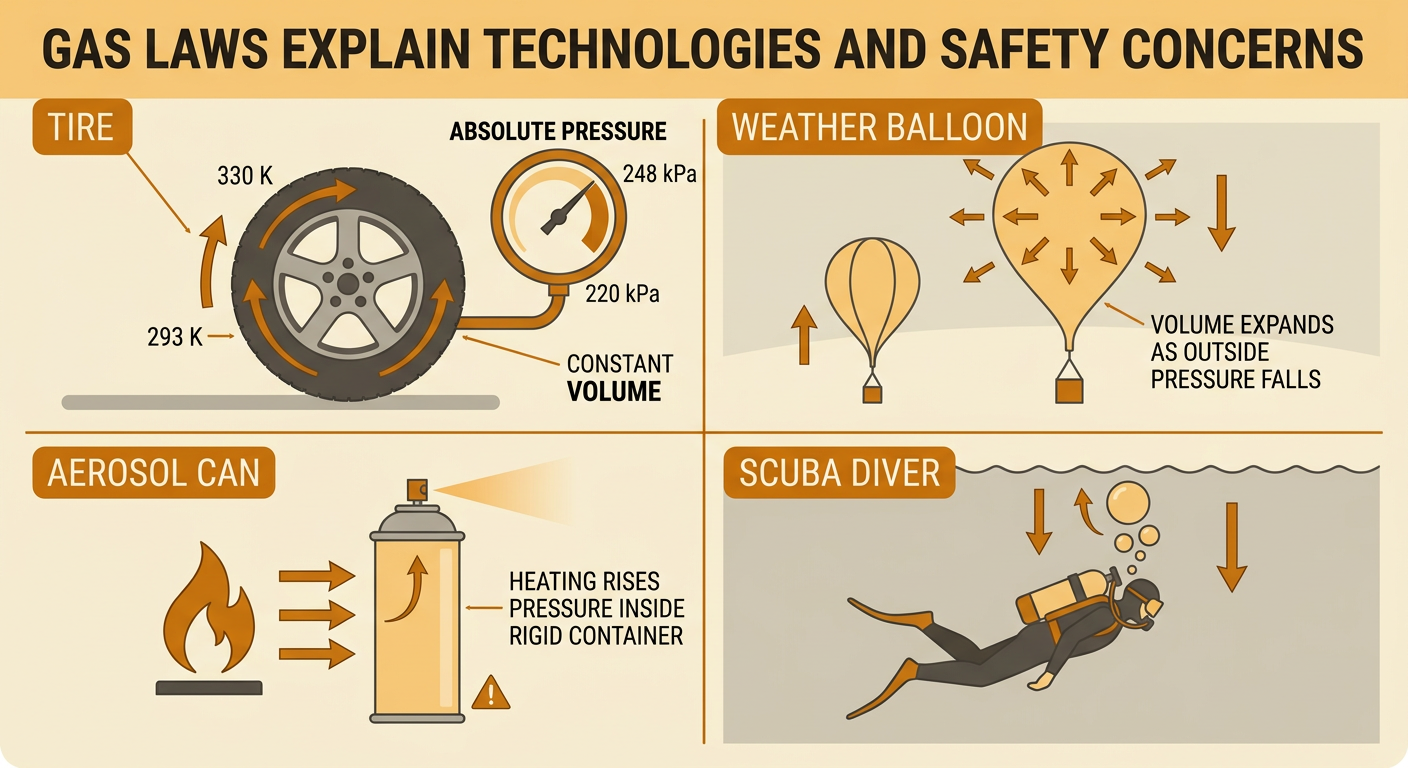
Gas laws explain many everyday technologies and safety concerns. A car tire has nearly constant volume, so its pressure changes with kelvin temperature according to Gay-Lussac’s law. If its absolute pressure is 220 kPa at 293 K and the air warms to 330 K, the predicted pressure is about 248 kPa because P2 = 220 × 330/293. This evidence supports the claim that tire pressure should be checked when tires are cool. Weather balloons illustrate Charles’s and Boyle’s laws: as a balloon rises, outside pressure falls, allowing the gas to expand, while changing temperature also affects its volume. Pressurized aerosol cans carry warnings because heating raises the pressure in their rigid containers. Scuba divers must also consider pressure changes because gases compress at depth and expand during ascent. In every application, a useful prediction depends on identifying which variables change and which remain approximately constant.