
Generating Equivalent Expressions with the Distributive Property
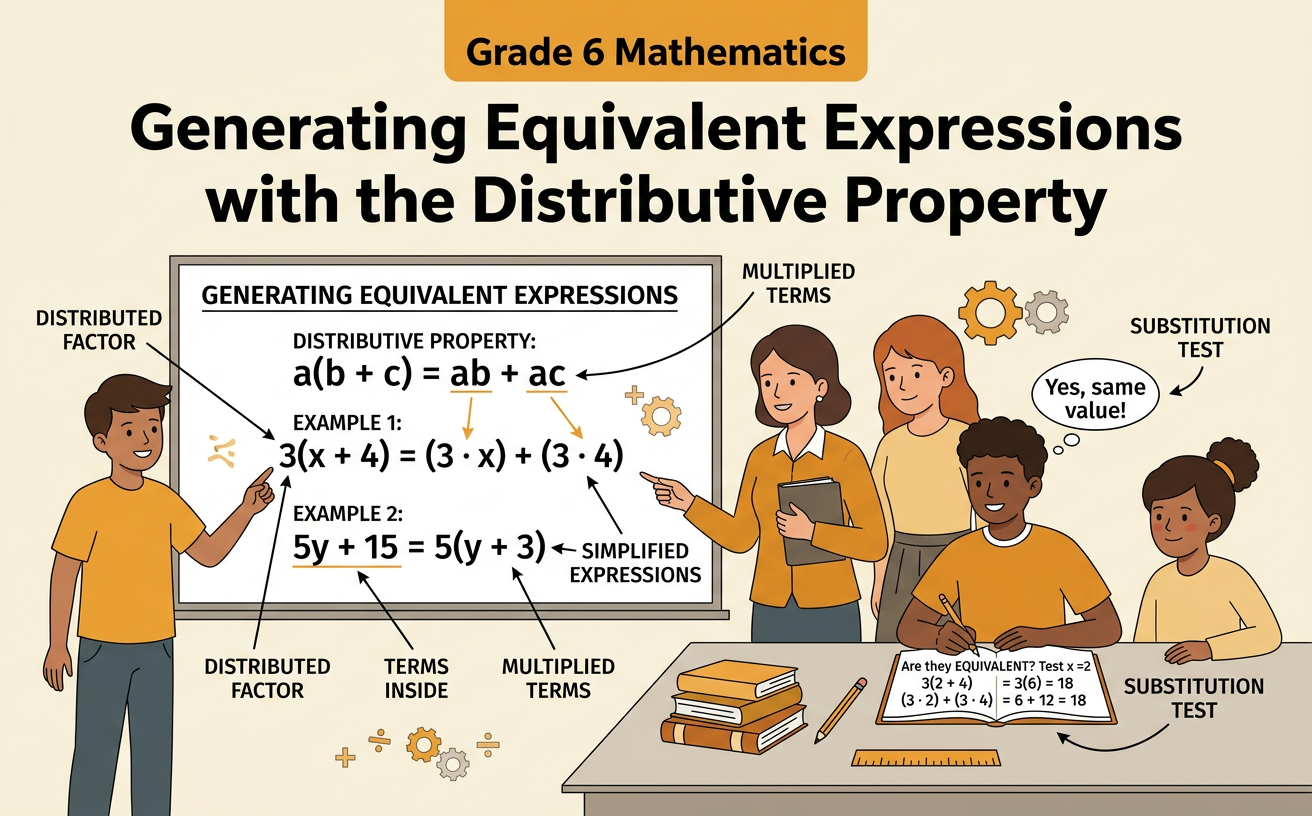
Students use the distributive property to rewrite algebraic expressions and verify that different forms are equivalent.
Illustrations are auto-generated and may be placeholders. They can be refreshed to match the narration.
Reviewing Expressions and Terms
An algebraic expression is a mathematical phrase made of numbers, variables, and operation symbols. A variable is a letter that represents a number. Terms are parts of an expression separated by addition or subtraction signs. In 4x + 7, the terms are 4x and 7. The number 4 is the coefficient because it multiplies x, and 7 is a constant because it has no variable. In 3a + 2a + 5, the terms 3a and 2a are like terms because they have the same variable. They can be combined to make 5a, so 3a + 2a + 5 is equivalent to 5a + 5. Equivalent expressions may look different, but they have the same value whenever the same number is used for the variable.

Modeling the Distributive Property
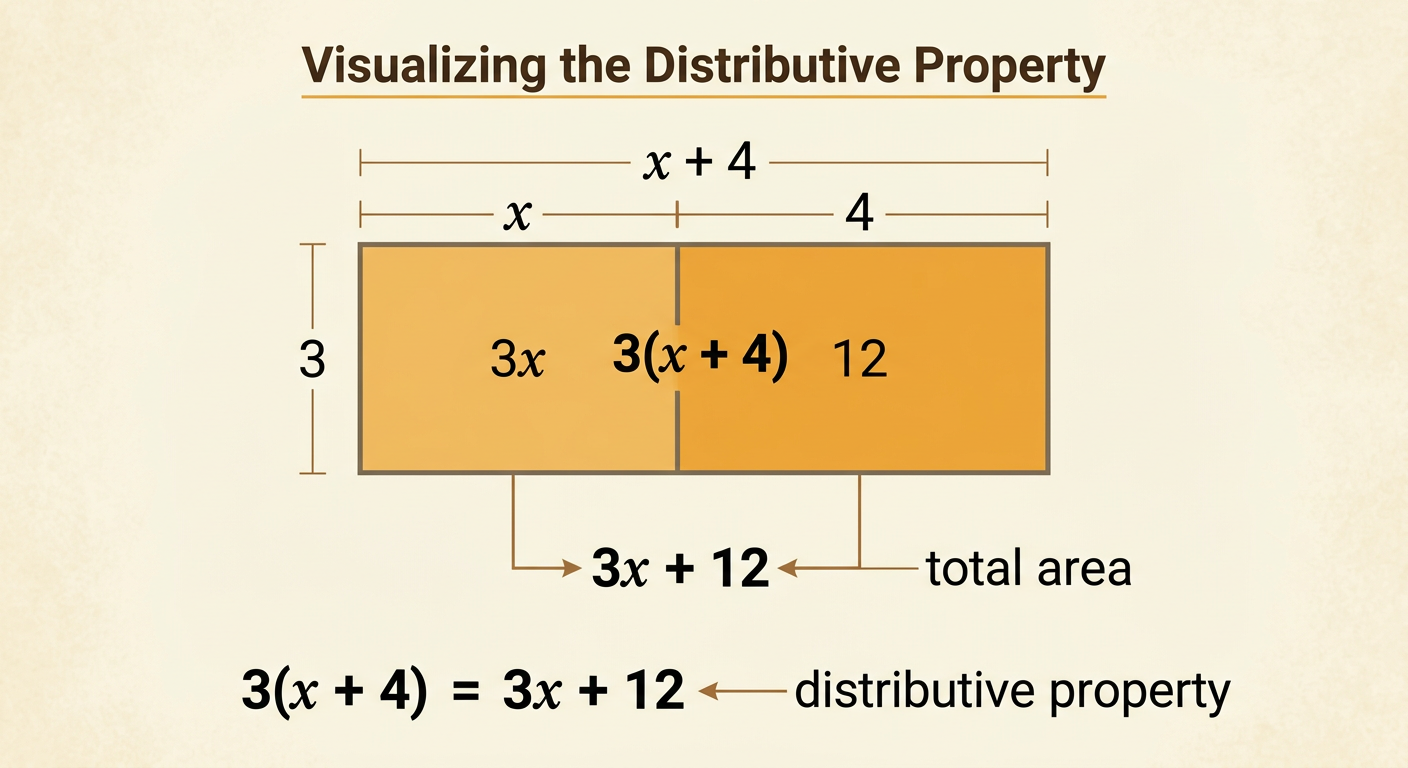
The distributive property explains how multiplication works with a sum or difference. Consider 3(x + 4). This means that 3 multiplies the entire quantity x + 4. An area model can show the multiplication. Draw a rectangle with a height of 3 and divide its width into sections of x and 4. The first section has area 3 times x, or 3x. The second section has area 3 times 4, or 12. The total area is 3x + 12. Therefore, 3(x + 4) = 3x + 12. The factor outside the parentheses must multiply every term inside the parentheses. This model demonstrates the rule a(b + c) = ab + ac. The same idea works with subtraction: a(b − c) = ab − ac.
Rewriting Expressions
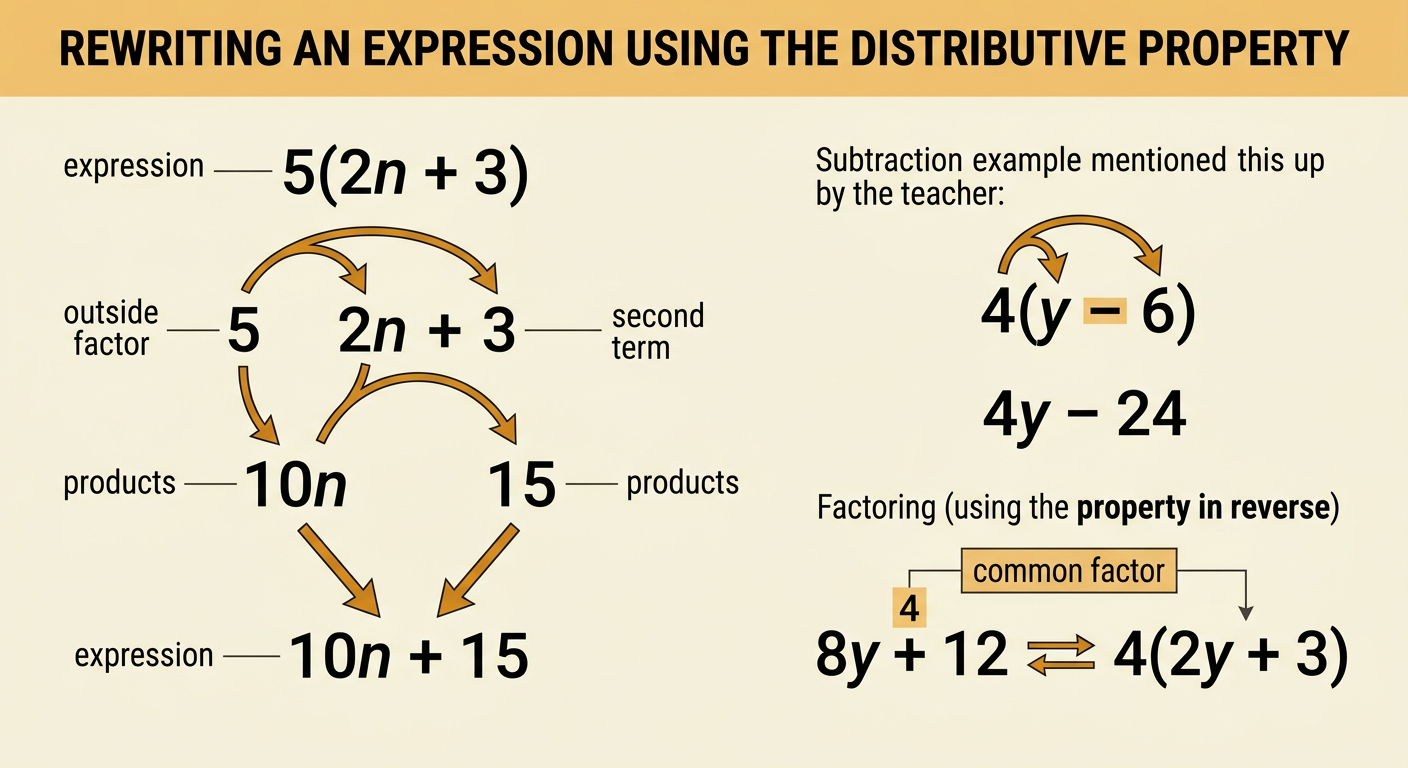
To rewrite an expression using the distributive property, multiply the factor outside the parentheses by each term inside. For example, rewrite 5(2n + 3). First multiply 5 by 2n to get 10n. Then multiply 5 by 3 to get 15. The expanded expression is 10n + 15, so 5(2n + 3) = 10n + 15. Keep each operation sign when distributing. For example, 4(y − 6) becomes 4y − 24. The property can also be used in reverse by finding a common factor. In 8y + 12, both terms have a factor of 4. Factoring out 4 gives 4(2y + 3). Expanding and factoring create different forms of the same expression without changing its value.
Checking for Equivalence
Two expressions are equivalent if they have the same value for every allowed value of the variable. You can check your rewriting by substituting the same number into both expressions. Compare 2(3m + 5) and 6m + 10 using m = 4. The first expression is 2(3 × 4 + 5) = 2(17) = 34. The second is 6 × 4 + 10 = 24 + 10 = 34. Their matching values support the claim that they are equivalent. The distributive property proves the match for every value because 2 times 3m is 6m and 2 times 5 is 10. Substitution can quickly reveal an error, but testing only a few values does not prove equivalence by itself. Use properties of operations for the proof.

Independent Practice and Exit Check
Practice rewriting each expression, making sure the outside factor multiplies every term. First, expand 6(x + 2). The products are 6x and 12, so the equivalent expression is 6x + 12. Next, expand 3(4p − 5). The result is 12p − 15. Then factor 10y + 25 by finding a common factor. Since both terms are divisible by 5, an equivalent factored form is 5(2y + 5). For an exit check, decide whether 7(a + 3) and 7a + 3 are equivalent. They are not, because 7 must also multiply 3. The correct expansion is 7a + 21. Before finishing, verify one answer by substituting a number for the variable and comparing both forms.
