
Genetic Detectives: Cracking the Inheritance Case
Students solve a fictional family-trait mystery by analyzing a pedigree, modeling allele inheritance, calculating conditional probabilities, and debating how genetic information should be used responsibly.
Illustrations are auto-generated and may be placeholders. They can be refreshed to match the narration.
Mystery Trait Case File
The Rivera family is investigating Trait Q, a fictional inherited condition caused by a simplified single-gene model. Maya has Trait Q, but both of her parents do not show it. Her brother Leo is also unaffected. Family records indicate that Maya’s maternal grandfather had the trait. Your task is to determine the most likely inheritance pattern, identify possible family genotypes, and predict future outcomes. Begin by asking what evidence would help: Is the allele dominant or recessive? Is the gene located on an autosome or a sex chromosome? Could two unaffected parents have an affected child? Treat the pedigree, chromosome model, and family statements as different sources of evidence. Like genetic detectives, you must compare these sources and distinguish what the data prove from what they only suggest.
DNA, Chromosomes, and Alleles
Genes are segments of DNA located at specific positions on chromosomes. Most human body cells contain two copies of each autosome, one inherited from each biological parent. Therefore, an individual usually has two alleles for a gene on an autosome. In this case, Q represents an allele that produces the typical phenotype, while q represents a recessive allele associated with Trait Q. A person with qq shows the trait. People with QQ or Qq do not show it under this simplified model, although a Qq person is a carrier who can transmit q. For example, Maya must have inherited one q allele from her mother and one from her father. DNA replication and chromosome separation during meiosis allow each egg or sperm to receive one allele, which can then be passed to an offspring at fertilization.
Pedigree Pattern Hunt
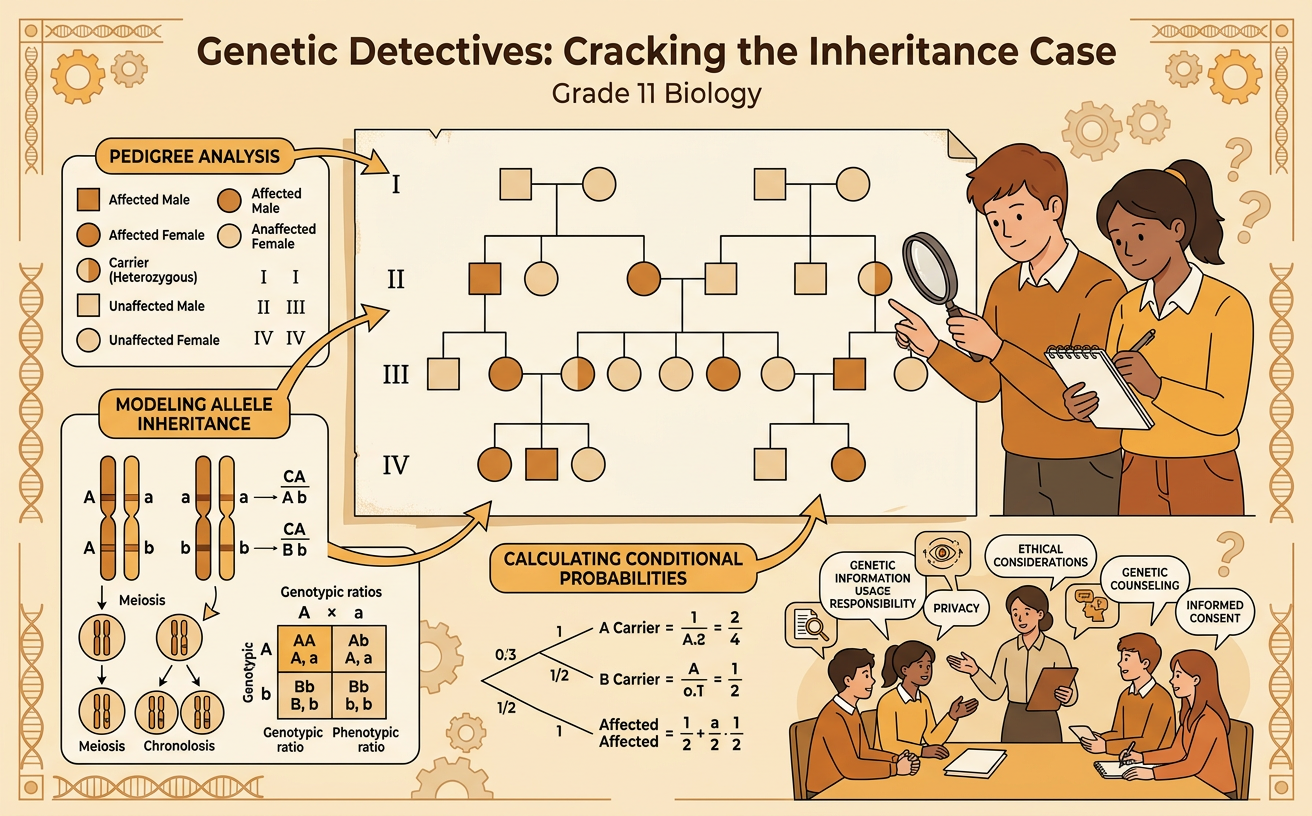
A pedigree uses standardized symbols to organize family-trait evidence across generations. Squares represent males, circles represent females, shaded symbols represent people with the trait, and horizontal and vertical lines show family relationships. In the Rivera pedigree, Maya is shaded, while both parents are unshaded. Under the single-gene model, this pattern supports autosomal recessive inheritance because two unaffected carriers can have an affected child. Maya’s genotype is qq, so each parent must have contributed q and is therefore most likely Qq. Leo is unaffected, meaning his genotype could be QQ or Qq; the pedigree alone cannot identify which one. The affected maternal grandfather also fits the pattern because he could have transmitted q to Maya’s mother. However, a small pedigree may match more than one explanation, so genetic testing or additional family data would strengthen the conclusion.
Probability Prediction Challenge
Conditional probability measures the chance of an outcome after relevant information is known. If Maya’s parents are Qq and Qq, their possible offspring genotypes are QQ, Qq, Qq, and qq. Before considering phenotype, Leo has a one-half probability of being Qq. Once we know that Leo is unaffected, the qq outcome is excluded. Among the three unaffected outcomes, two are Qq, so P(Leo is Qq given that he is unaffected) equals 2/3. Suppose Leo’s future partner is confirmed to be Qq. If Leo is a carrier, their chance of having a child with qq is 1/4. The combined probability is 2/3 multiplied by 1/4, or 1/6. This prediction describes risk for each pregnancy, not a guaranteed pattern across several children. Previous births do not change the allele probabilities for the next independent pregnancy.
Genetic Privacy Verdict
Genetic information can help people make medical and family-planning decisions, but it can also reveal sensitive information about relatives who did not choose testing. Imagine that Leo considers sharing his carrier result with a physician, a future partner, an employer, and an insurance company. A physician may use the result to recommend counseling, while a partner may consider it relevant to shared reproductive decisions. Leo may oppose employer access because genetic risk does not determine his current ability to work. Relatives may want either warning or privacy because one person’s result can suggest their genotypes. In a responsible verdict, identify who should receive the information, what consent is required, and how records should be protected. Support the decision with scientific evidence and civic principles such as autonomy, fairness, informed consent, and prevention of discrimination. Also consider how each stakeholder’s interests shape their position.