
Geographic Foundations of Europe and the Americas
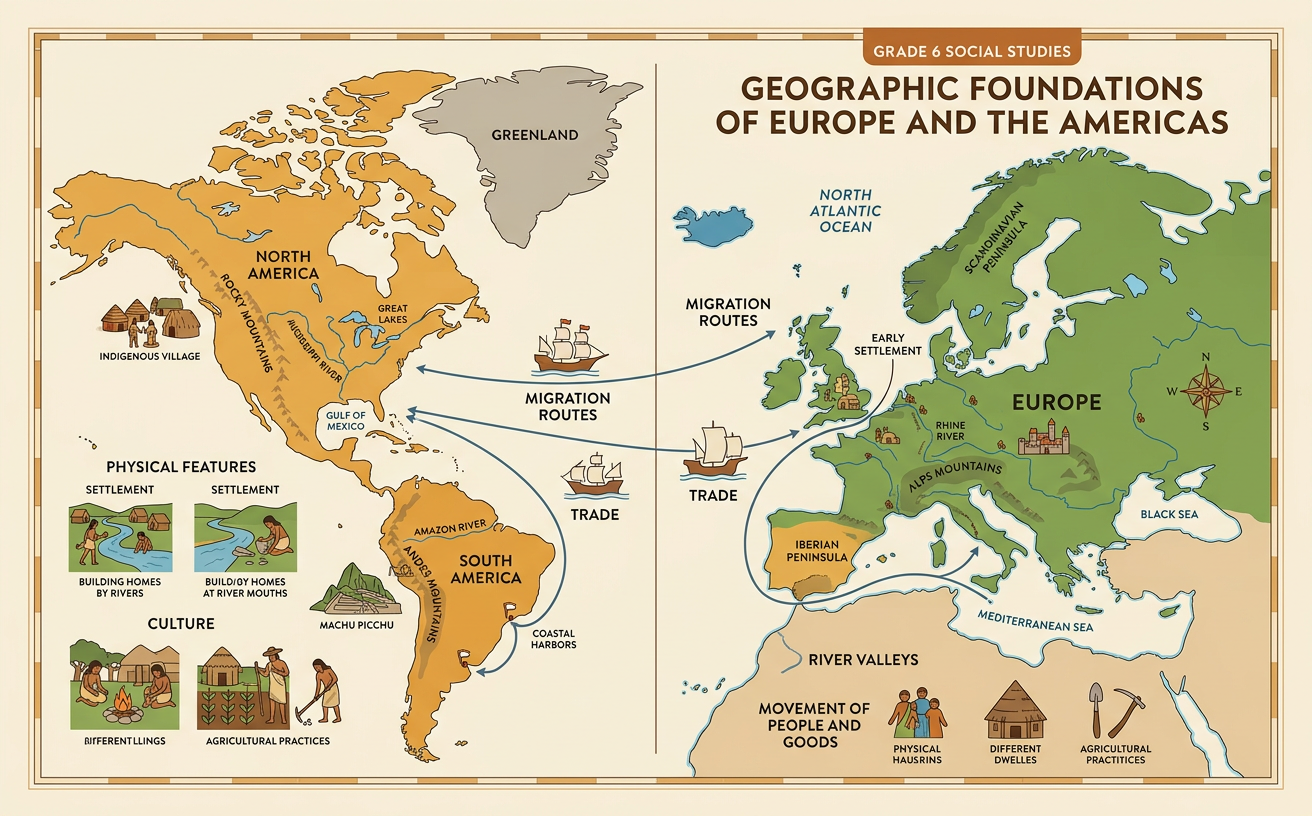
Students use maps and geographic concepts to locate Europe and the Americas and explain how physical features influenced settlement, movement, and culture.
Illustrations are auto-generated and may be placeholders. They can be refreshed to match the narration.
Locating Two Major World Regions
Europe and the Americas are large regions made up of many countries and physical environments. Europe lies west of Asia and north of Africa. The Americas include North America, Central America, the Caribbean, and South America. Students can use the Equator and Prime Meridian to describe relative location. For example, Brazil is mostly south of the Equator and west of the Prime Meridian, while France is north of the Equator and east of the Prime Meridian. Maps also show political boundaries, which divide countries, and physical features, such as mountains and rivers. Comparing political and physical maps helps students understand that national borders do not always follow natural features. A mountain range may cross several countries, while one river may form part of a border.

Mountains, Plains, and Settlement
Landforms affect where people settle and how they travel. Europe contains the Alps, a high mountain range that crosses several countries. The Americas include the Rocky Mountains, Appalachian Mountains, Andes Mountains, and broad plains. Mountain regions can make travel difficult, but they may also provide minerals, water, and protection. Plains usually offer level land that is useful for farming and transportation. For example, the fertile Great Plains of North America became an important area for growing wheat and raising livestock. In South America, many communities developed in high valleys of the Andes because the valleys provided water and farmland. When studying settlement patterns, students should ask whether a location offered food, fresh water, transportation routes, and protection from danger.
Rivers and Seas as Transportation Routes
Bodies of water connect communities and support agriculture, trade, and migration. Important European waterways include the Mediterranean Sea, Rhine River, Danube River, and Atlantic Ocean. In the Americas, major waterways include the Mississippi River, Amazon River, Caribbean Sea, and Great Lakes. Before railroads and highways, moving goods by water was often easier than carrying them across land. For example, merchants used the Mediterranean Sea to exchange olive oil, grain, pottery, and other goods among European, African, and Asian ports. The Mississippi River later became a major route for moving farm products through the center of North America. Rivers can also create fertile soil when flooding leaves behind sediment, although floods may damage homes and crops.
Climate, Resources, and Human Choices
Climate describes long-term patterns of temperature and precipitation. Europe and the Americas contain climates ranging from Arctic cold to tropical heat. Climate affects crops, clothing, housing, and economic activities. For example, the Mediterranean climate of southern Europe has warm, dry summers and mild, rainy winters, making it suitable for olives and grapes. Tropical areas of Central and South America can support crops such as cacao, bananas, and coffee. Natural resources also influence human choices. Forests provide lumber, rivers supply water and energy, and mineral deposits encourage mining. However, using resources can create challenges. Cutting too many trees may cause soil erosion, while mining may pollute water. Geography creates opportunities, but societies decide how resources will be used and protected.