Geometric Proofs with Lines and Angles
Students construct logical arguments using definitions, diagrams, and established angle relationships to prove geometric statements.
Illustrations are auto-generated and may be placeholders. They can be refreshed to match the narration.
Claims and Evidence
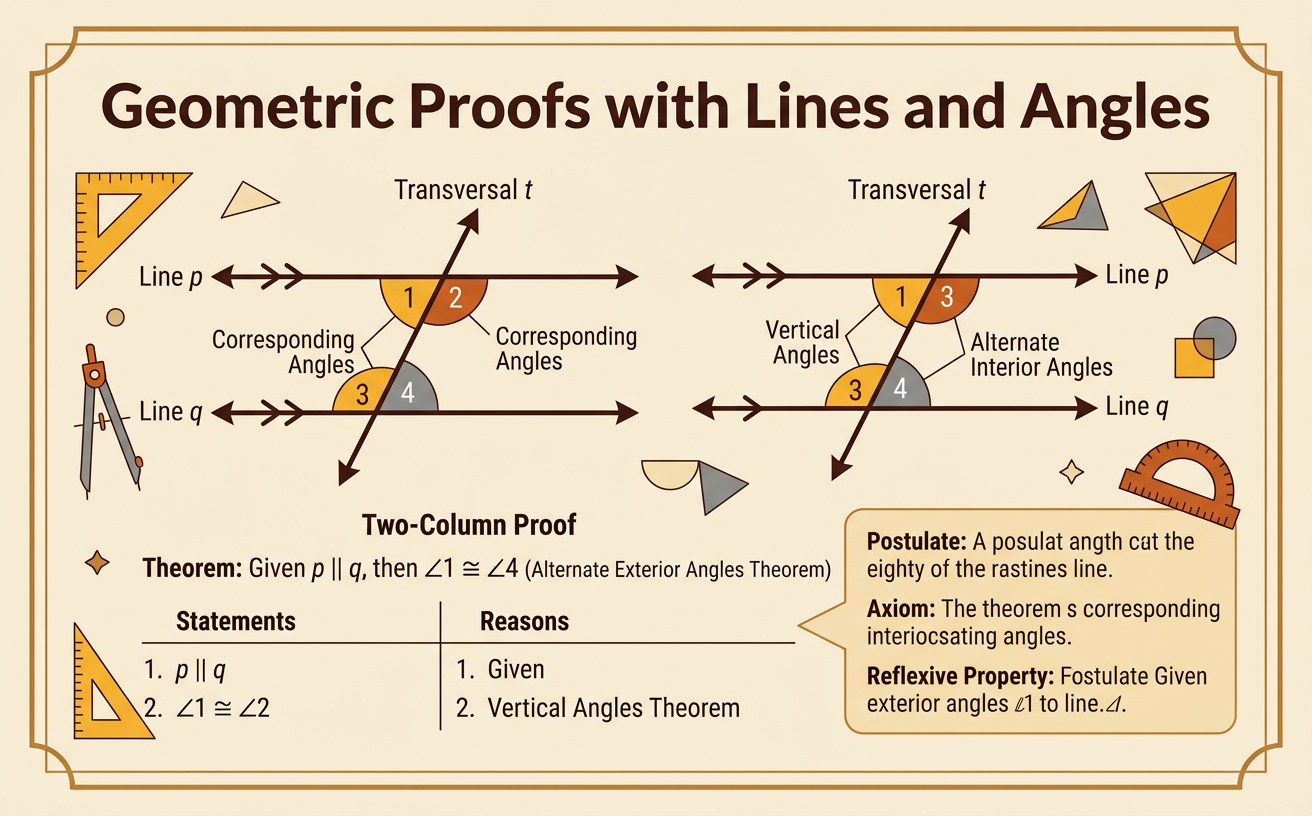
A geometric proof begins with a claim, a statement that must be shown true. Evidence includes given facts, definitions, marked diagrams, and previously proved theorems. Each step must have a reason that connects it to earlier information. For example, suppose lines AC and BD intersect at E, and the claim is that angle AEB is congruent to angle CED. Angle AEB and angle BEC form a linear pair, so their measures add to 180 degrees. Angles BEC and CED also form a linear pair, so their measures add to 180 degrees. Because both sums contain the measure of angle BEC, subtracting that measure shows that angles AEB and CED have equal measures. Therefore, the vertical angles are congruent. The diagram suggests this relationship, but the stated angle facts provide the proof.

Definitions and Given Information
Definitions explain exactly what geometric terms mean, while given information supplies facts that may be used without proof. A perpendicular bisector of a segment is a line, ray, or segment that passes through the segment’s midpoint at a right angle. Suppose line l is the perpendicular bisector of segment AB, and point P lies on line l. Let M be the intersection of line l and AB. From the definition, AM is congruent to MB, and angles PMA and PMB are right angles. Segment PM is shared by triangles PMA and PMB. The triangles are congruent by SAS, so PA is congruent to PB by corresponding parts of congruent triangles. This proves that any point on a perpendicular bisector is equidistant from the segment’s endpoints. Every fact used comes from the given information, a definition, or a theorem.

Angle Relationships
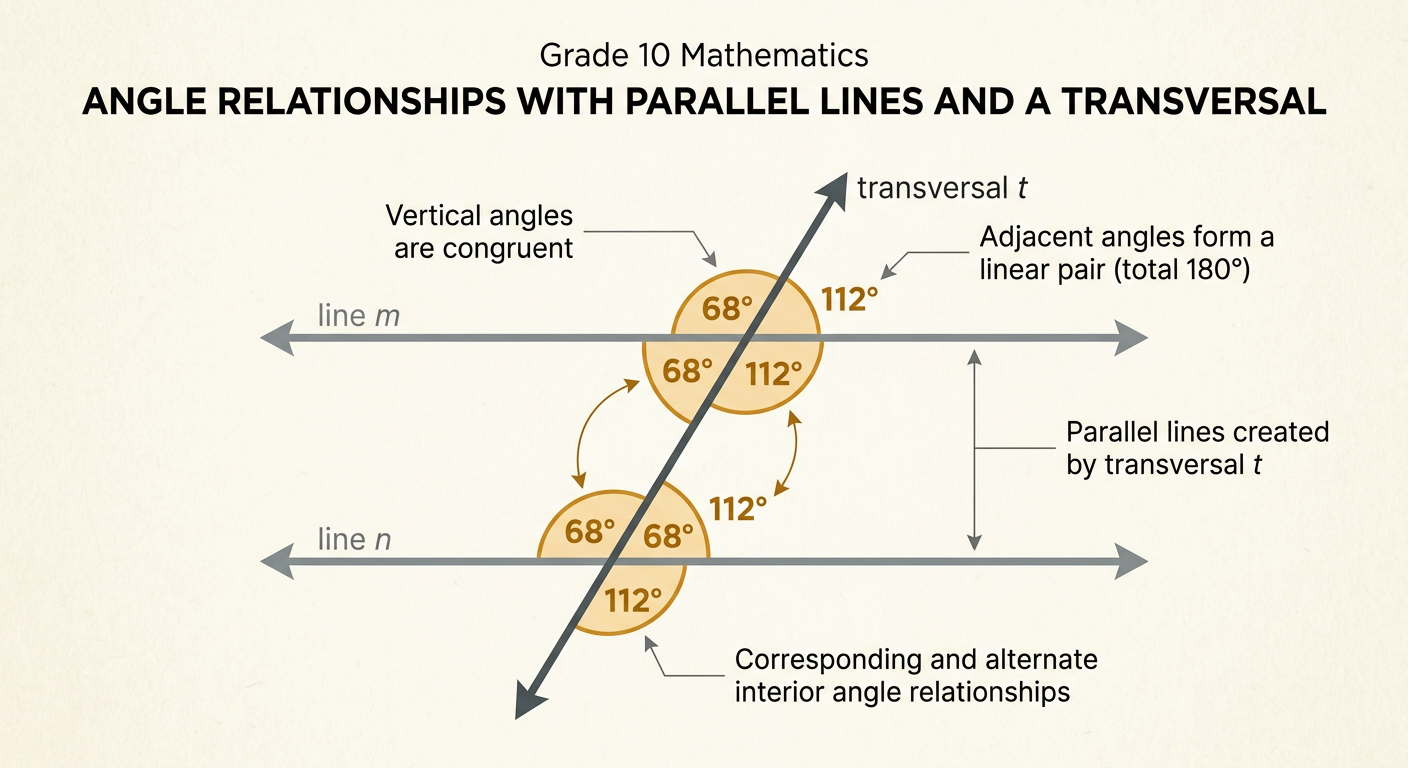
Recognizing angle relationships helps identify which theorem can justify a proof step. Vertical angles are opposite angles formed by intersecting lines, and they are congruent. A linear pair consists of adjacent angles whose noncommon sides form a straight line, so their measures total 180 degrees. When a transversal crosses two parallel lines, corresponding angles and alternate interior angles are congruent, while same-side interior angles are supplementary. For example, let parallel lines m and n be crossed by transversal t. If one interior angle measures 68 degrees, its alternate interior angle also measures 68 degrees. The adjacent interior angle forms a linear pair with the 68-degree angle, so it measures 112 degrees. Its same-side interior partner also measures 112 degrees. These conclusions depend on m and n being parallel; without that given or proved fact, the parallel-line angle theorems cannot be applied.
Two-Column and Paragraph Proofs
A two-column proof separates statements from the reasons that justify them. A paragraph proof presents the same logic in connected sentences. Both formats must begin with the given information and end with the required conclusion. For example, suppose lines m and n are parallel, transversal t crosses them, and angles 1 and 2 are alternate interior angles. In a two-column proof, write “m is parallel to n” with the reason “Given.” Next write “angles 1 and 2 are congruent” with the reason “Alternate Interior Angles Theorem.” A paragraph proof states: Because m and n are parallel and t is a transversal, angles 1 and 2 are alternate interior angles. By the Alternate Interior Angles Theorem, angle 1 is congruent to angle 2. The organization differs, but the mathematical argument is identical. Neither format may omit the condition that the lines are parallel.
Checking Logical Steps
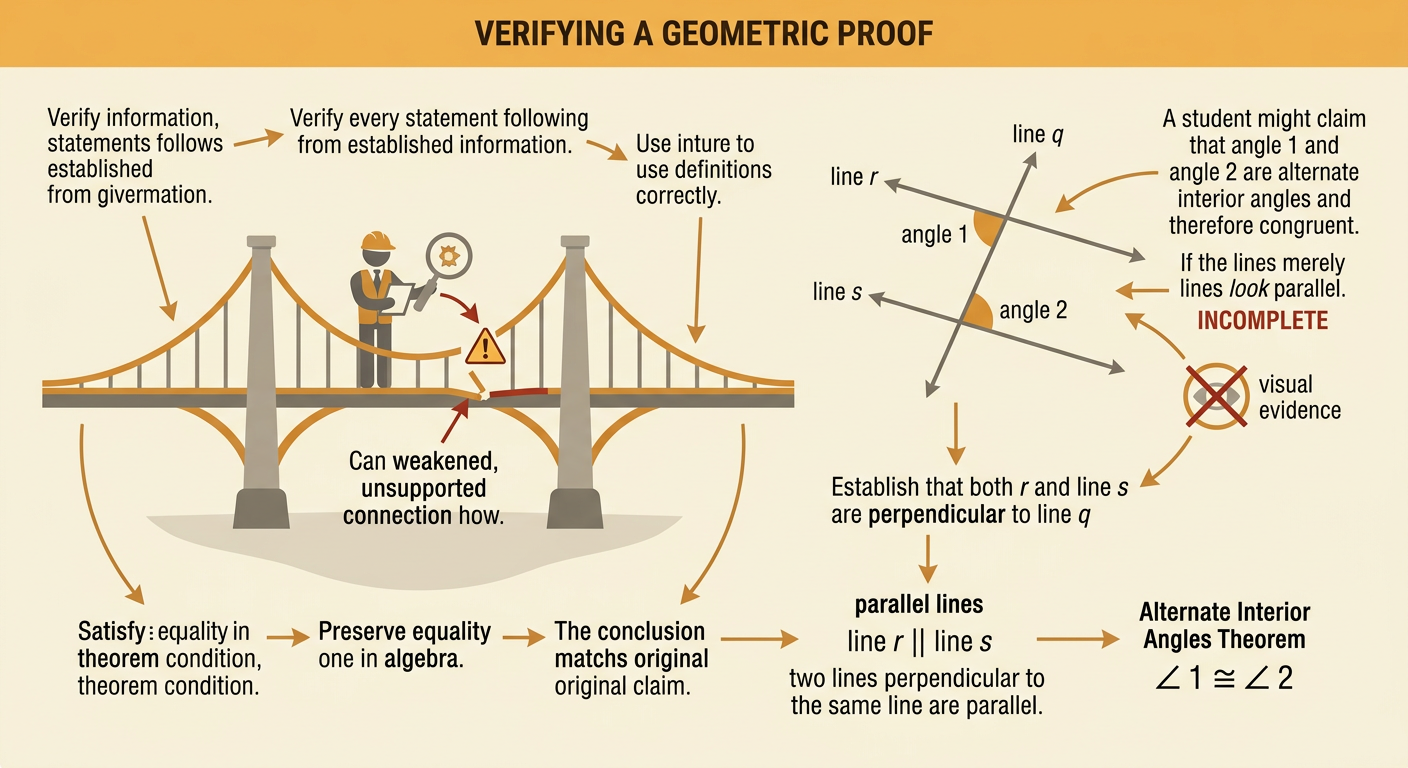
Checking a proof means verifying that every statement follows from known information and that no hidden assumption comes from the picture. Confirm that definitions are used correctly, theorem conditions are satisfied, and algebraic operations preserve equality. Also check that the conclusion matches the original claim. For example, a student sees two lines cut by a transversal and writes, “Angles 1 and 2 are alternate interior angles, so they are congruent.” This reasoning is incomplete unless the two lines are given or proved parallel. A diagram may make lines look parallel without establishing that fact. To repair the proof, add a valid fact such as both lines being perpendicular to the same line; in a plane, that proves the lines are parallel. The Alternate Interior Angles Theorem can then justify that angles 1 and 2 are congruent. Good proof checking separates visual appearance from established evidence.