
Goods and Services in Our Community
Students distinguish goods from services and identify how community workers use tools to meet people's needs.

Illustrations are auto-generated and may be placeholders. They can be refreshed to match the narration.
What Are Goods?
Goods are things that people make, grow, or sell. We can see and touch goods. People consume goods when they buy or use them. A farmer grows apples, and a grocery store sells them. A family buys the apples to eat. The apples are goods. Books, shoes, toys, bread, and pencils are also goods. Some goods meet needs. For example, a warm coat helps a person stay warm. Other goods meet wants, such as a new toy. Look around your classroom. Which objects are goods? Talk with a partner about who may have made each object and how people use it.

What Are Services?
A service is work that someone does for another person. A service is an action, so it is not an object that you can carry home. A barber provides a service by cutting hair. A bus driver provides a service by taking people to places they need to go. Teachers teach, doctors care for patients, and firefighters respond to fires and other emergencies. People consume services when they receive or use this work. Sometimes a service uses goods. For example, a barber uses scissors, but the haircut is the service. With a partner, name a service your family has used. Explain what the worker did to help.

Community Workers and Their Tools
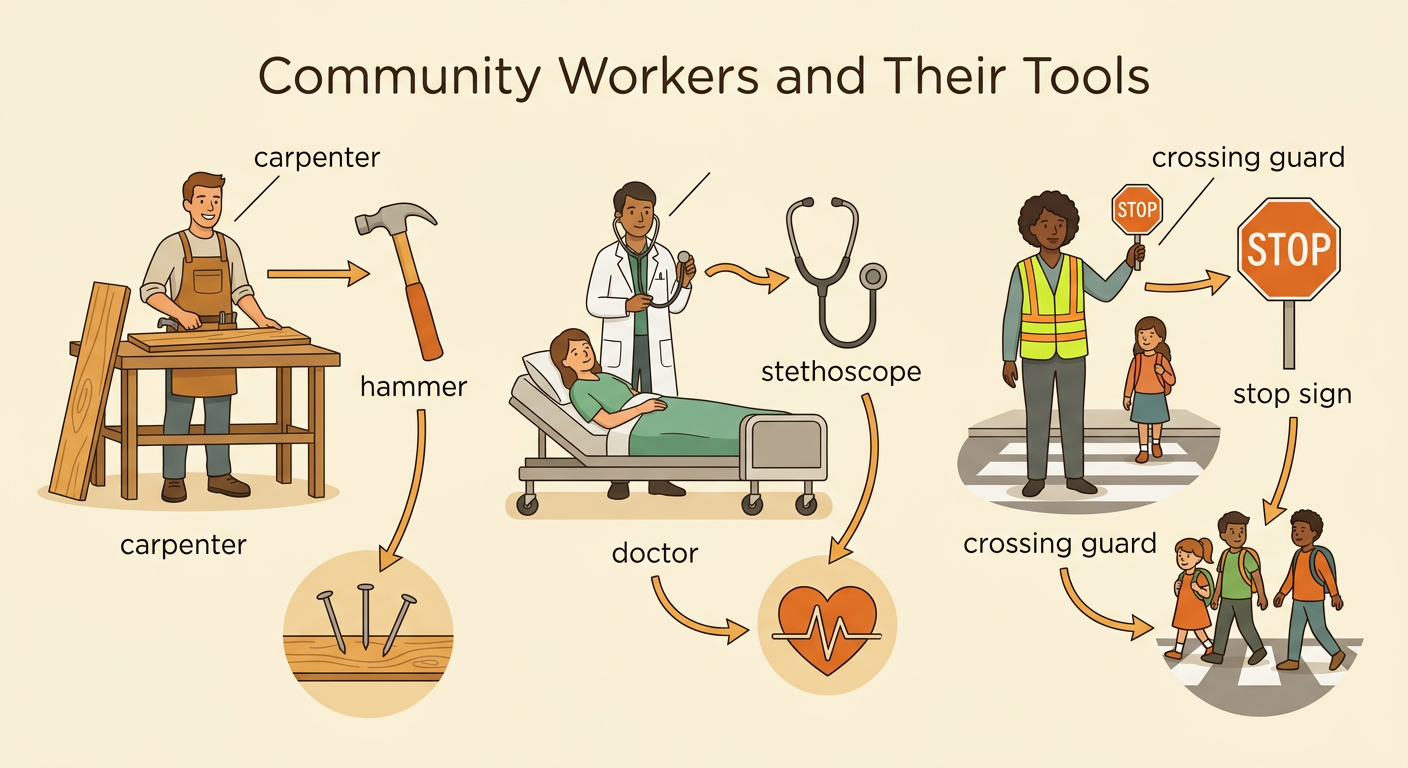
Community workers use tools to do their jobs and solve problems. A tool is an object that helps someone complete a task. A carpenter uses a hammer to join pieces of wood with nails. A doctor uses a stethoscope to listen to a heartbeat. A crossing guard uses a stop sign to help children cross a street safely. The hammer, stethoscope, and stop sign are goods. The helpful work done with them is a service. Workers choose tools that fit the problem. Ask questions such as, “What job must be done?” and “Which tool could help?” Observe each tool’s shape and use. Then talk with classmates about why one tool may work better than another.
Sort Goods and Services
We can sort examples into goods and services. First ask, “Is it a thing I can touch?” If yes, it is probably a good. A loaf of bread, a backpack, and a bicycle are goods. Next ask, “Is it work someone does for another person?” If yes, it is a service. Baking bread for customers, teaching a class, and repairing a bicycle are services. Be careful: a worker may use goods while providing a service. A bicycle mechanic uses tools, but the repair work is the service. Take turns with a partner. Name one example, listen to your partner’s idea, and decide where it belongs. Give a reason for your choice.

Choose What the Community Needs
Communities need goods and services to solve problems and help people. Imagine that children need a safe place to cross a busy street near school. Ask questions: “What makes crossing hard?” and “Who could help?” Observe the street and gather information. The community may need a crossing guard’s service. The guard may need goods such as a bright vest, a stop sign, and painted crosswalk lines. Think about other community needs. If people need fresh food, a grocery store can provide goods. If a pipe leaks, a plumber can provide a repair service and use tools. Work with classmates to choose one community problem. Name a helpful good, service, worker, or tool, and explain your choice.
