
Government and Culture in Ancient Greece and Rome
Students examine how ancient Greek and Roman governments, social structures, and cultural achievements influenced later societies in Europe and the Americas.
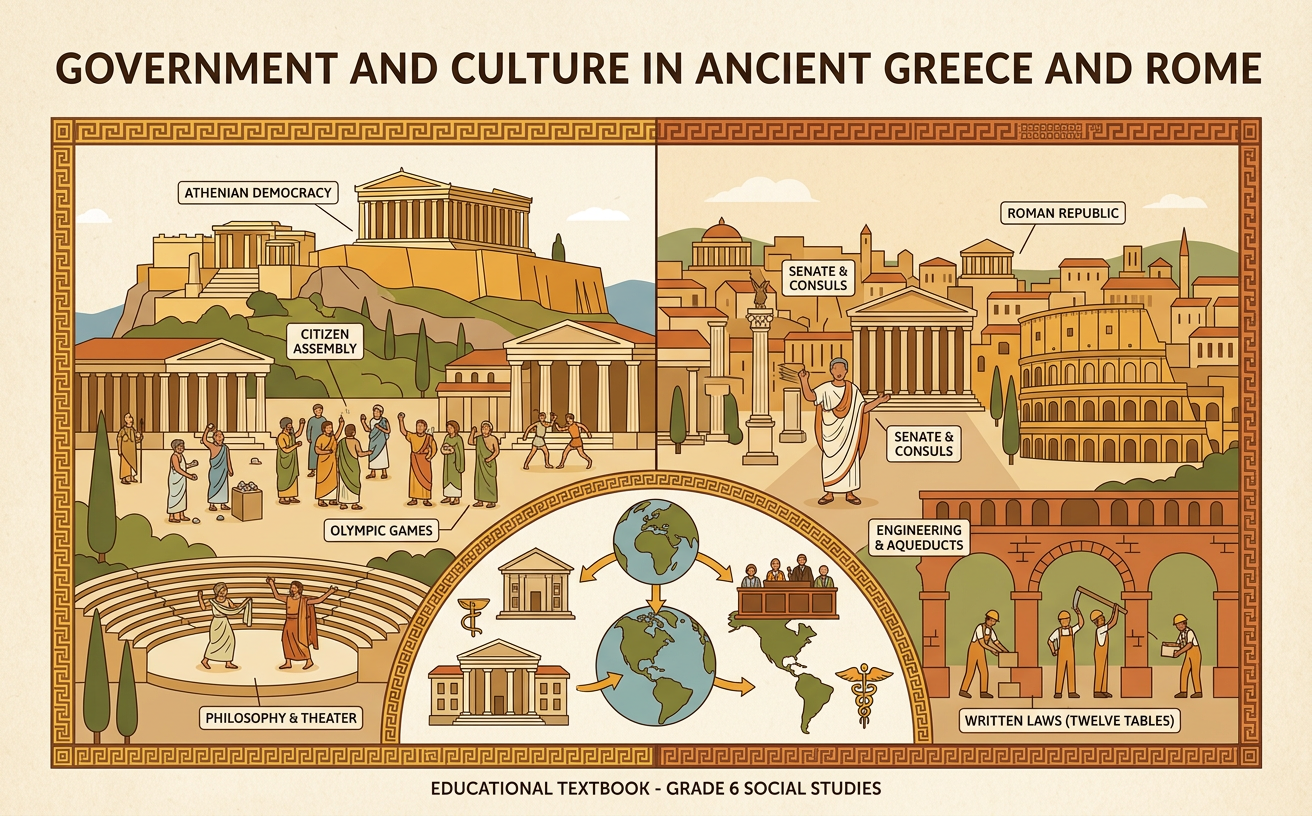
Illustrations are auto-generated and may be placeholders. They can be refreshed to match the narration.
Greek City-States and the Mediterranean
Ancient Greece developed around mountains, islands, and the Mediterranean and Aegean Seas. Mountains separated communities, so Greece did not first develop as one united country. Instead, independent city-states formed, including Athens and Sparta. Each city-state had its own laws, government, and military. Sea travel allowed Greeks to trade and establish colonies around the Mediterranean. For example, Greek merchants exchanged olive oil and pottery for grain, timber, and metals. Geography also shaped political life because citizens often felt stronger loyalty to their city-state than to Greece as a whole. Athens became known for public debate and learning, while Sparta emphasized military discipline. These differences sometimes caused conflict, but the city-states also cooperated when facing a shared threat, such as an invasion by the Persian Empire.
Athenian Democracy and Its Limits
Athens developed a form of direct democracy in which eligible citizens voted on laws and important decisions themselves. Citizens could speak in the assembly, serve on juries, and hold public office. This system introduced the influential idea that citizens should participate in government. However, Athenian democracy was limited. Only free adult men born to Athenian families were citizens. Women, enslaved people, and foreigners could not vote. For example, an Athenian craftsman who was a male citizen might vote on whether to go to war, while a woman managing the same household had no formal political voice. Modern representative democracies differ because citizens elect officials to make many decisions. Comparing the systems shows both the importance of Athens and the ways democratic participation has expanded over time.
The Roman Republic and Rule of Law
Before becoming an empire, Rome was a republic. Roman citizens elected some leaders, and government power was divided among assemblies, magistrates, and the Senate. Two consuls led the government and army, but each could limit the other’s actions. This arrangement helped prevent one person from gaining complete control. Rome also developed written laws, including the Twelve Tables. Publicly displaying laws made it harder for officials to change rules secretly. For example, a citizen involved in a property dispute could refer to a known legal rule rather than depend only on a powerful person’s opinion. Roman government was not fully equal, because wealthy families held great influence and many residents lacked citizenship. Even so, ideas about checks on power, civic duty, and written law influenced later governments.
Roman Expansion, Achievement, and Decline
Rome expanded through military conquest, alliances, roads, and trade. At its height, the Roman Empire controlled lands around the Mediterranean and parts of Europe, North Africa, and Southwest Asia. Roman engineers built roads, bridges, aqueducts, and public buildings. For example, aqueducts carried fresh water into crowded cities, supporting baths, fountains, and households. Roman law and the Latin language also spread widely. Over time, the empire faced political instability, economic problems, invasions, and the difficulty of defending a vast territory. In 476 CE, the western part of the empire collapsed, although the eastern Byzantine Empire continued for centuries. Rome’s influence remained visible in European languages, legal traditions, architecture, and government. Later societies adapted Roman ideas rather than simply copying them.