
Gravity and Electrostatic Forces
Students compare gravitational and electrostatic interactions and use inverse-square relationships to predict force strength.
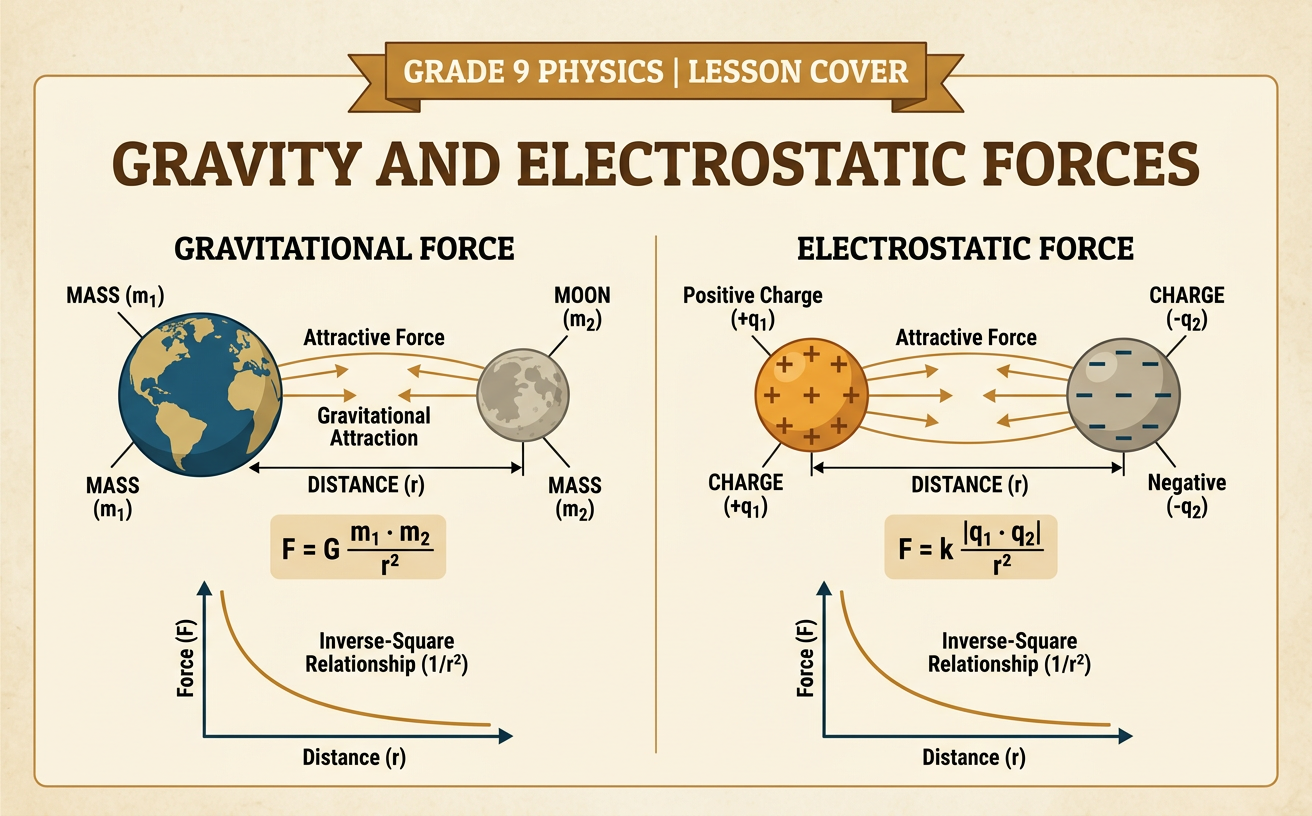
Illustrations are auto-generated and may be placeholders. They can be refreshed to match the narration.
Universal Gravitation
Every object with mass attracts every other object with mass. Newton’s law of universal gravitation represents this interaction as Fg = G(m1m2)/r². In this equation, Fg is the gravitational force, m1 and m2 are the two masses, r is the distance between their centers, and G is the universal gravitational constant. The force acts along an imaginary line connecting the objects’ centers. Each object experiences a force of equal strength in the opposite direction. For example, Earth pulls a student downward, while the student pulls Earth upward with an equally strong force. Earth’s acceleration is unnoticeably small because its mass is enormous. For spherical objects such as planets, the distance is measured from center to center, not from surface to surface.
Mass and Distance
Newton’s gravitational equation shows how mass and distance affect force. Gravitational force is directly proportional to each mass. If one mass doubles while everything else remains unchanged, the force doubles. If both masses double, the force becomes four times as strong. Distance has an inverse-square relationship with force because r is squared in the denominator. If the center-to-center distance doubles, the force becomes 1/2², or one-fourth, as strong. If the distance triples, the force becomes 1/3², or one-ninth, as strong. For example, suppose two satellites experience a gravitational force of 36 newtons at distance r. At distance 2r, with the same masses, they experience only 9 newtons. These comparisons allow predictions without calculating with G.
Electric Charge
Electrostatic force acts between objects with electric charge. Charge can be positive or negative and is measured in coulombs. Unlike gravity, which is always attractive, electrostatic interactions can attract or repel. Opposite charges attract, while charges with the same sign repel. The forces on the two objects are equal in strength and opposite in direction. For example, rubbing a balloon on hair can transfer electrons from the hair to the balloon. The balloon becomes negatively charged, and the hair is left positively charged. The opposite charges attract, causing strands of hair to move toward the balloon. In ordinary matter, positive and negative charges often balance, making the object electrically neutral. However, even a small imbalance of charge can produce a noticeable electrostatic force.
Coulomb’s Law
Coulomb’s law calculates the electrostatic force between two charged objects: Fe = k|q1q2|/r². Here, q1 and q2 are the charges in coulombs, r is the center-to-center distance in meters, and k is Coulomb’s constant, approximately 8.99 × 10⁹ N·m²/C². Absolute value gives the force magnitude, while the charge signs determine its direction. Consider charges of +2.0 microcoulombs and −3.0 microcoulombs separated by 0.50 meter. Substitution gives Fe = (8.99 × 10⁹)(2.0 × 10⁻⁶)(3.0 × 10⁻⁶)/(0.50)², or about 0.22 newton. Because the charges have opposite signs, the force is attractive. Doubling their separation would reduce this force to about 0.055 newton.
Comparing the Two Forces
Universal gravitation and Coulomb’s law have similar mathematical forms. Both forces depend on the product of two object properties and decrease with the square of center-to-center distance. Therefore, moving either pair from r to 3r reduces its force to one-ninth. The key differences involve what causes the forces and how they act. Gravity depends on mass and is always attractive. Electrostatic force depends on charge and can attract or repel. Electrostatic interactions between individual particles are usually far stronger than gravitational interactions. For example, the electrostatic attraction between a proton and an electron is about 2 × 10³⁹ times their gravitational attraction. Gravity still dominates the motion of planets because large objects contain enormous mass and are usually close to electrically neutral, so most positive and negative charge effects cancel.