
Gravity and Orbital Motion
Students explain gravity as an attractive force and use evidence to relate gravitational strength to the masses and separation of objects.
Illustrations are auto-generated and may be placeholders. They can be refreshed to match the narration.
Gravity as an Attractive Force
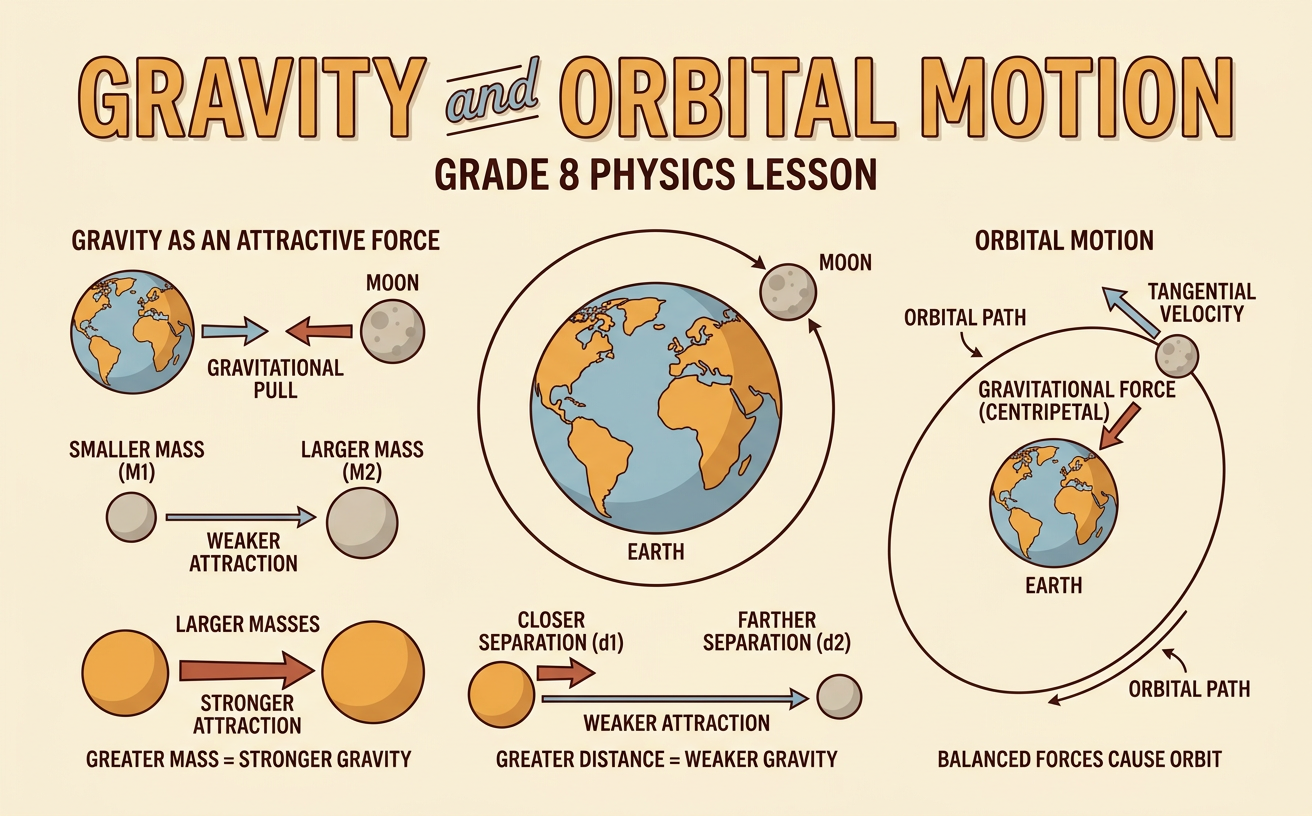
Gravity is an attractive force between any two objects that have mass. Attractive means that each object is pulled toward the other, not pushed away. The two gravitational forces are equal in strength and point in opposite directions. For example, when a ball is released, Earth’s gravity pulls the ball toward Earth’s center. At the same time, the ball pulls Earth toward itself. Earth’s motion is too small to notice because Earth has much more mass. Repeated observations of dropped objects provide evidence that gravity near Earth’s surface acts downward, toward Earth’s center. The motion of moons, planets, and artificial satellites provides additional evidence that gravity attracts objects across space, even when they are not touching.
Mass and Gravitational Strength
The strength of a gravitational interaction depends on the masses of both interacting objects. At the same separation, increasing either mass increases the gravitational force. If one object’s mass doubles while the other mass stays the same, the force doubles. If both masses double, the force becomes four times as great because the force depends on the product of the two masses. For example, imagine equal-size spacecraft placed the same distance from two planets. The spacecraft near the more massive planet experiences a stronger gravitational force. Scientists support this relationship with measurements of falling objects, satellite paths, and the motions of moons and planets. Although every object with mass produces gravity, the attraction between classroom objects is usually too weak to notice without sensitive equipment.
Distance and Gravity
Gravitational force also depends on the separation between objects. Separation is measured from the center of one object to the center of the other. As this center-to-center distance increases, gravitational force decreases. For two unchanged masses, doubling the distance makes the force one-fourth as strong. This pattern is called an inverse-square relationship. For example, a spacecraft moving far from Earth experiences less gravitational attraction from Earth than it did closer to the planet. Gravity does not suddenly stop, however; it continues across great distances while becoming weaker. Scientists find evidence for this relationship by comparing satellite orbits at different distances and by measuring how spacecraft change speed as they approach or move away from planets.
Weight Versus Mass
Mass and weight describe different properties. Mass is the amount of matter in an object and is measured in kilograms. An object’s mass stays the same when the object moves to a different location. Weight is the gravitational force acting on that mass and is measured in newtons. Weight can be calculated with W = mg, where m is mass and g is the local gravitational field strength. For example, a 50-kilogram student weighs about 490 newtons on Earth because Earth’s g is about 9.8 newtons per kilogram. On the Moon, the same student still has a mass of 50 kilograms but weighs only about 80 newtons because the Moon’s g is about 1.6 newtons per kilogram. The Moon’s smaller mass produces a weaker gravitational pull at its surface.
Gravity in Orbits
An orbit occurs when gravity continuously bends an object’s path around another object. A satellite has forward motion, but gravity pulls it toward the center of the planet. Instead of traveling straight into space or falling directly to the surface, the satellite continually falls around the curved planet. For example, the International Space Station moves sideways fast enough that Earth’s surface curves away beneath it as gravity changes its direction. Astronauts appear weightless because they and the station are falling together, not because gravity is absent. The Moon’s orbit offers similar evidence: Earth’s attraction keeps changing the Moon’s direction. Orbital paths show that gravity is attractive, and differences among orbits provide evidence that gravitational effects depend on the interacting masses and their separation.