Gravity and Orbital Motion
Students use Newton’s law of universal gravitation and orbital diagrams to explain how gravity keeps satellites moving around Earth and supports satellite-based mapping.
Illustrations are auto-generated and may be placeholders. They can be refreshed to match the narration.
Gravity as an Attractive Force
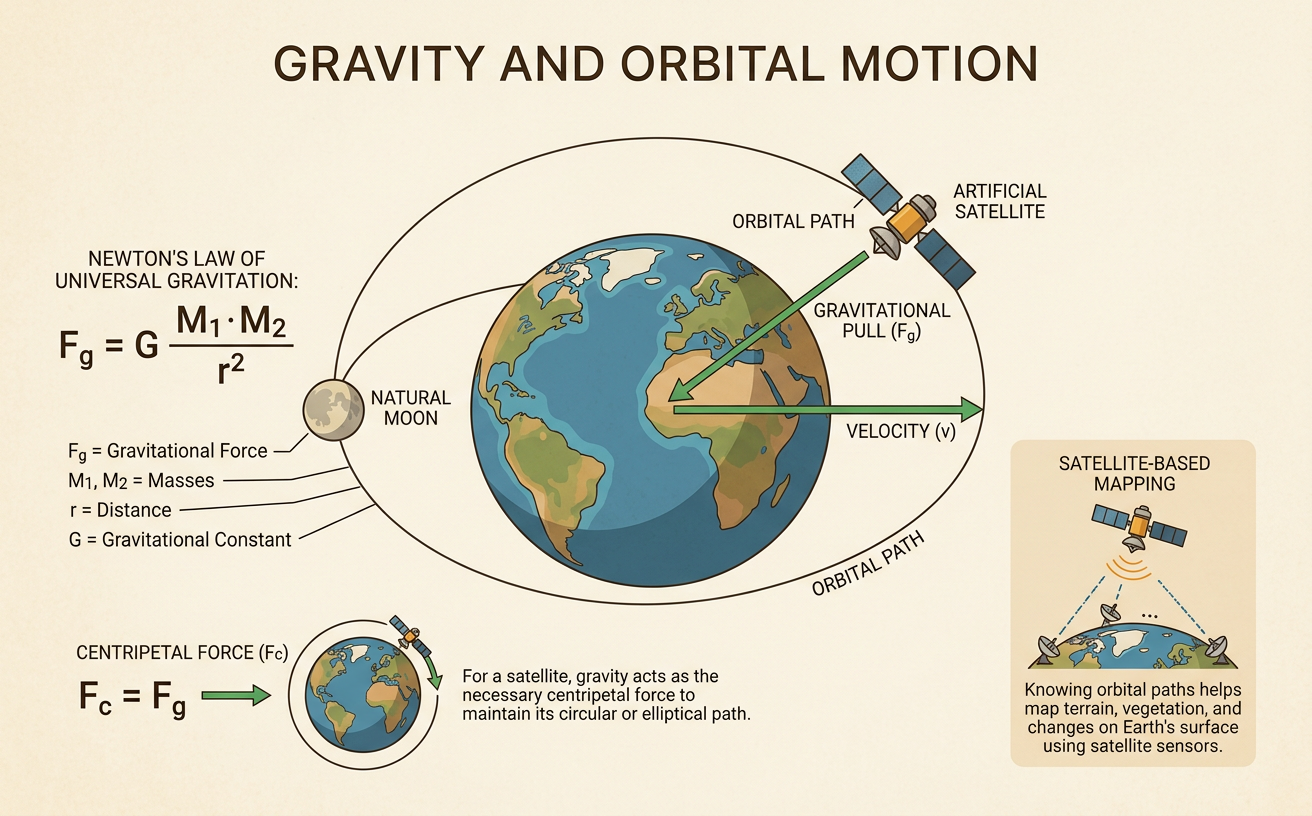
Gravity is an attractive force between every pair of objects that has mass. The force acts along an imaginary line connecting the centers of the objects. Earth pulls a dropped ball toward its center, and the ball pulls Earth toward itself with an equal force in the opposite direction. Because Earth has far more mass, its acceleration is too small to notice, while the ball’s acceleration is easy to observe. Near Earth’s surface, an unsupported object accelerates downward at about 9.8 meters per second squared when air resistance is ignored. Gravity does not require contact, so it can act across the empty space between Earth and the Moon or between Earth and an artificial satellite. This long-range attraction supplies the force needed for orbital motion.

Mass, Distance, and Gravitational Strength
Newton’s law of universal gravitation is F = Gm₁m₂/r². In this equation, F is gravitational force, G is the universal gravitational constant, m₁ and m₂ are the objects’ masses, and r is the distance between their centers. Increasing either mass increases the force in direct proportion. For example, doubling a satellite’s mass doubles the gravitational force on it. Distance has an inverse-square effect: if the center-to-center distance doubles, the force becomes one-fourth as strong. Distance must be measured from Earth’s center, not from its surface. A satellite 400 kilometers above Earth is about 6,770 kilometers from Earth’s center because Earth’s radius is about 6,370 kilometers. Although gravity weakens with distance, it remains strong enough at that altitude to continuously bend the satellite’s path.

Why Satellites Stay in Orbit
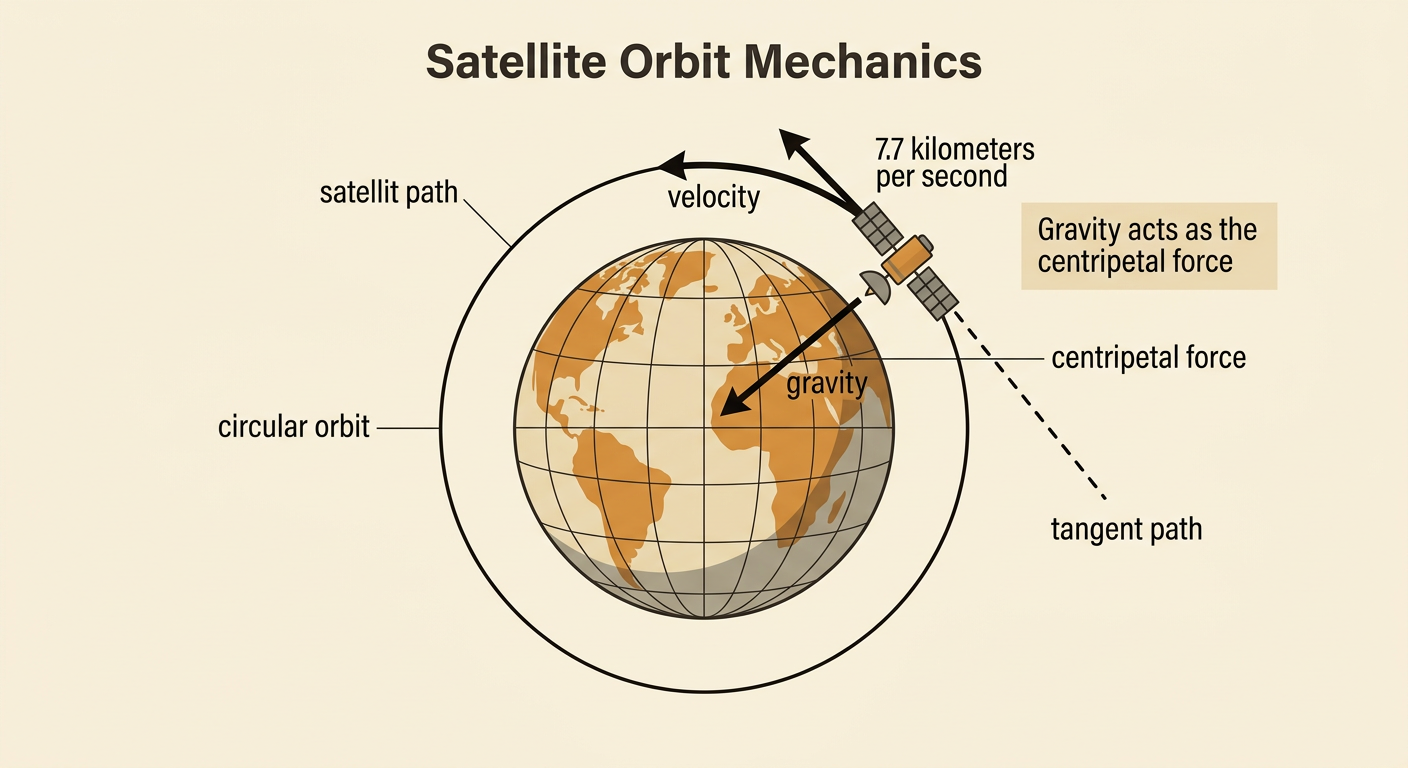
A satellite stays in orbit because it moves forward while gravity constantly accelerates it toward Earth. Without gravity, the satellite would follow a straight path tangent to its orbit. Without enough sideways speed, it would fall into Earth. At the correct speed, it falls toward Earth while Earth’s curved surface falls away beneath it, producing a continuous orbit. In a nearly circular low Earth orbit, a satellite travels about 7.7 kilometers per second. Gravity acts as the centripetal force that changes the direction of the velocity, even when the satellite’s speed remains nearly constant. No outward force is required to maintain the orbit. Engines may adjust an orbit or counter small amounts of atmospheric drag, but gravity provides the main inward force throughout each trip around Earth.
Reading Orbital Diagrams and Data
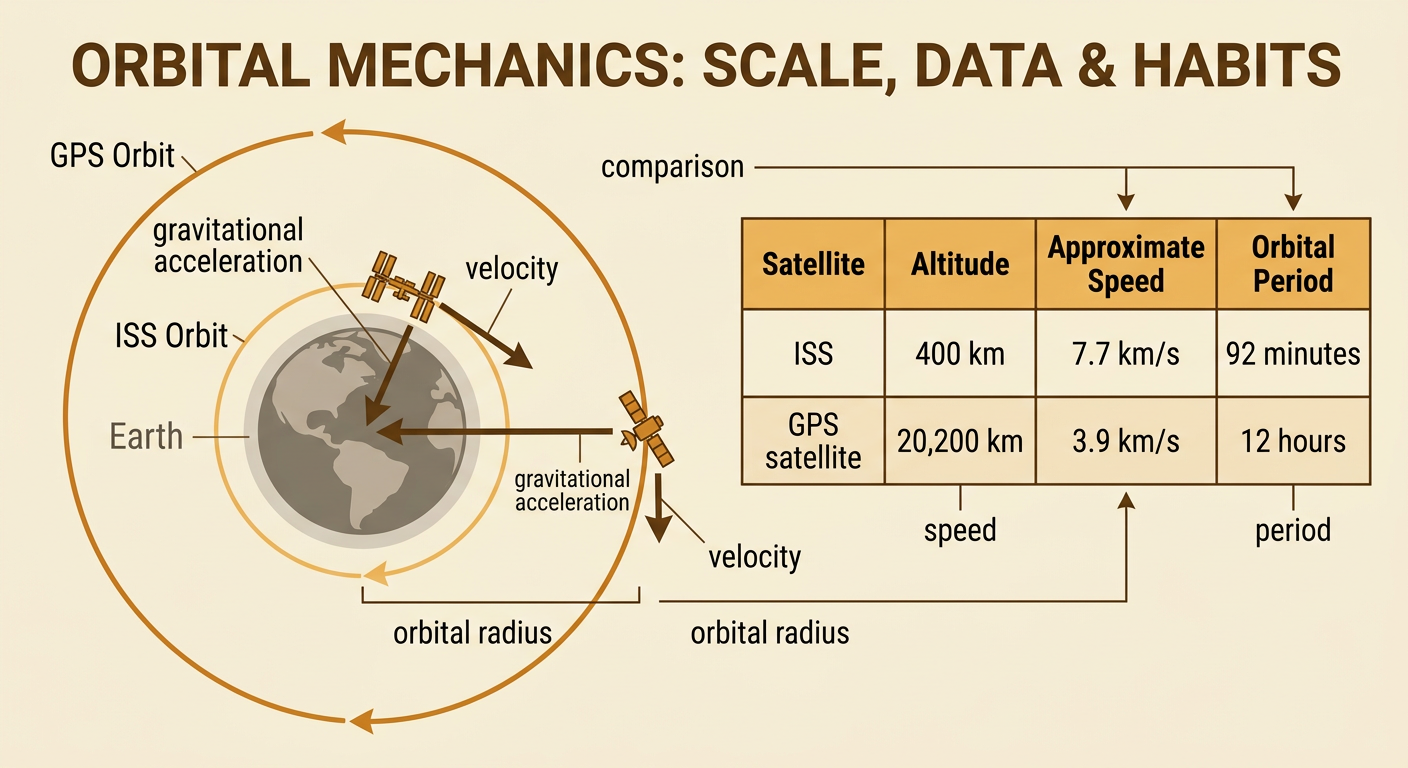
Orbital diagrams and data tables communicate the same motion in different forms. In a diagram, an inward arrow represents gravitational force or acceleration, while a tangent arrow represents velocity. In a data table, orbital radius, speed, and period provide numerical evidence about the orbit. For example, the International Space Station orbits at roughly 400 kilometers above Earth, moves near 7.7 kilometers per second, and completes an orbit in about 92 minutes. A GPS satellite orbits around 20,200 kilometers above Earth, moves near 3.9 kilometers per second, and takes about 12 hours to complete an orbit. These values show a pattern: satellites in larger circular orbits generally move more slowly and have longer periods. Always check whether a diagram is drawn to scale and whether distance means altitude or radius from Earth’s center.
Satellite Mapping in Society
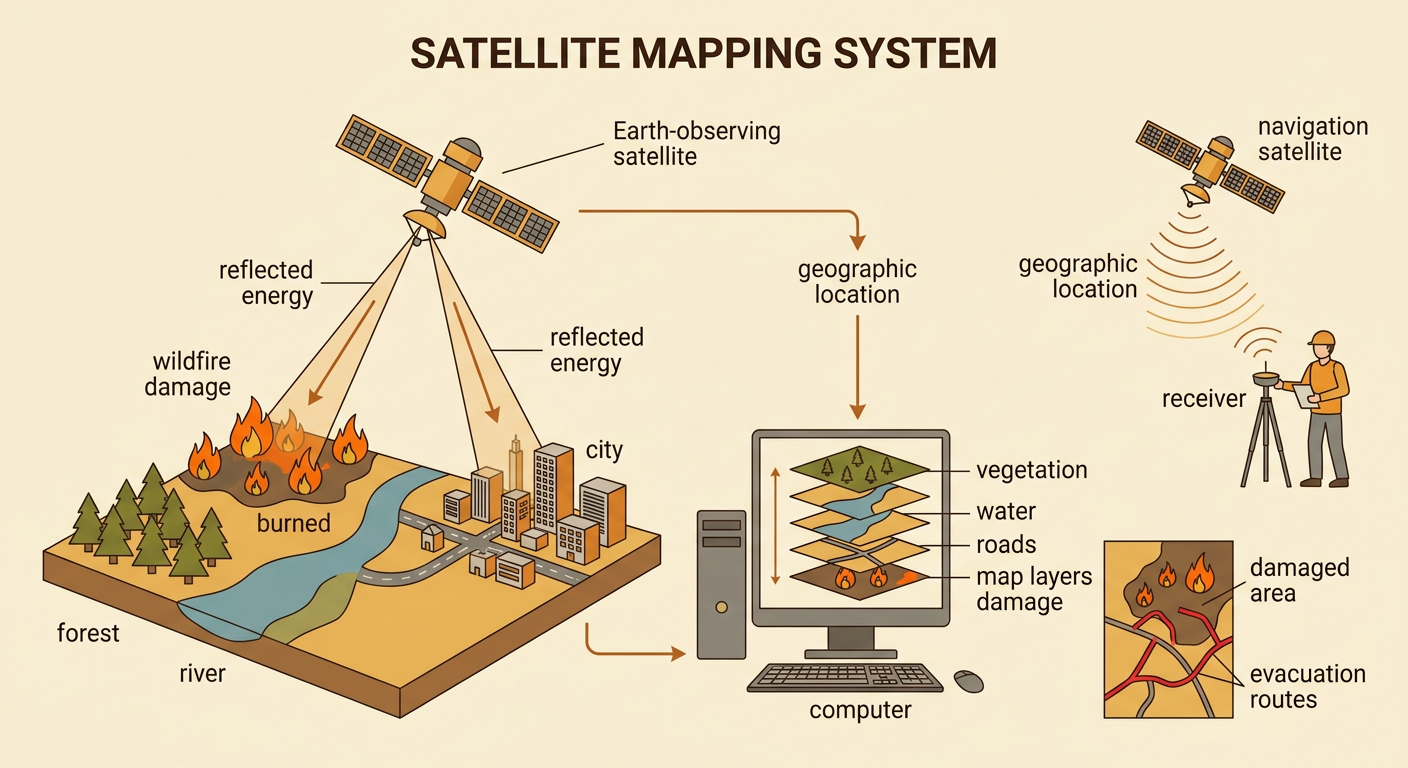
Satellites support mapping by repeatedly collecting location and environmental data over large areas. Earth-observing satellites measure reflected or emitted energy from land, water, vegetation, clouds, and buildings. Computers connect each measurement to a geographic location and organize the information into map layers. For example, scientists can compare satellite images from different dates to map the spread of wildfire damage or changes in forest cover. Navigation satellites also broadcast timed signals that receivers use to estimate position, helping surveyors and mapmakers place roads and boundaries accurately. Communities use satellite-based maps to plan evacuation routes, monitor drought, guide farming, and study patterns of population and land use. Maps must still be interpreted carefully because cloud cover, image resolution, outdated data, and classification choices can affect what patterns appear.
Quick Orbital Motion Check
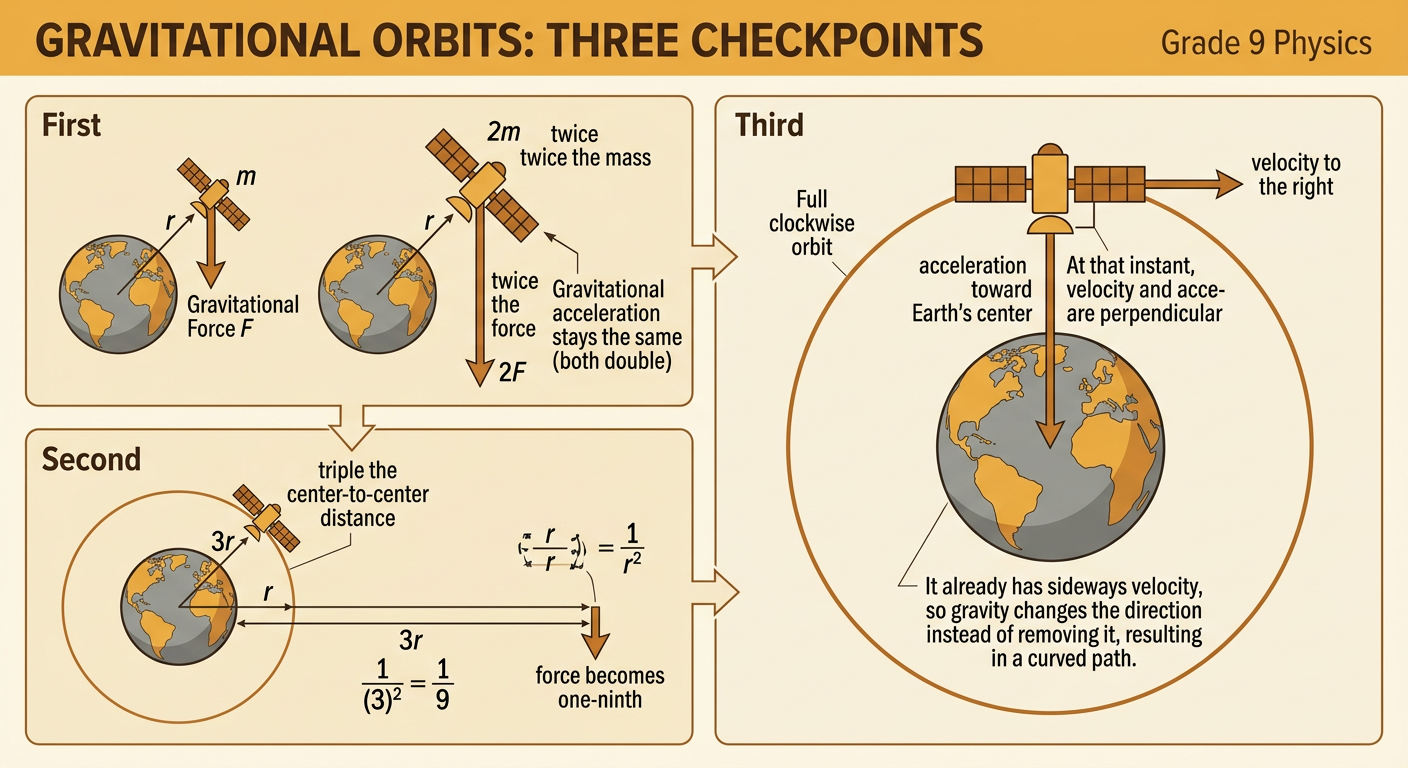
Use these relationships to check your understanding. First, suppose one satellite is replaced by another with twice the mass at the same orbital distance. Newton’s law predicts twice the gravitational force, although the satellite’s gravitational acceleration remains the same because both force and mass double. Second, suppose the center-to-center distance becomes three times larger while both masses stay unchanged. The force becomes one-ninth as strong because distance is squared. Third, examine a satellite moving clockwise at the top of a circular orbit. Its velocity points to the right, tangent to the orbit, while its gravitational acceleration points downward toward Earth’s center. These directions are perpendicular at that instant. The satellite does not move directly downward because it already has sideways velocity. Instead, gravity continually changes the velocity’s direction and keeps the path curved around Earth.