
Gravity and the Solar System
Students use models to explain how gravity and inertia produce the predictable orbits of planets, moons, and other solar system objects.
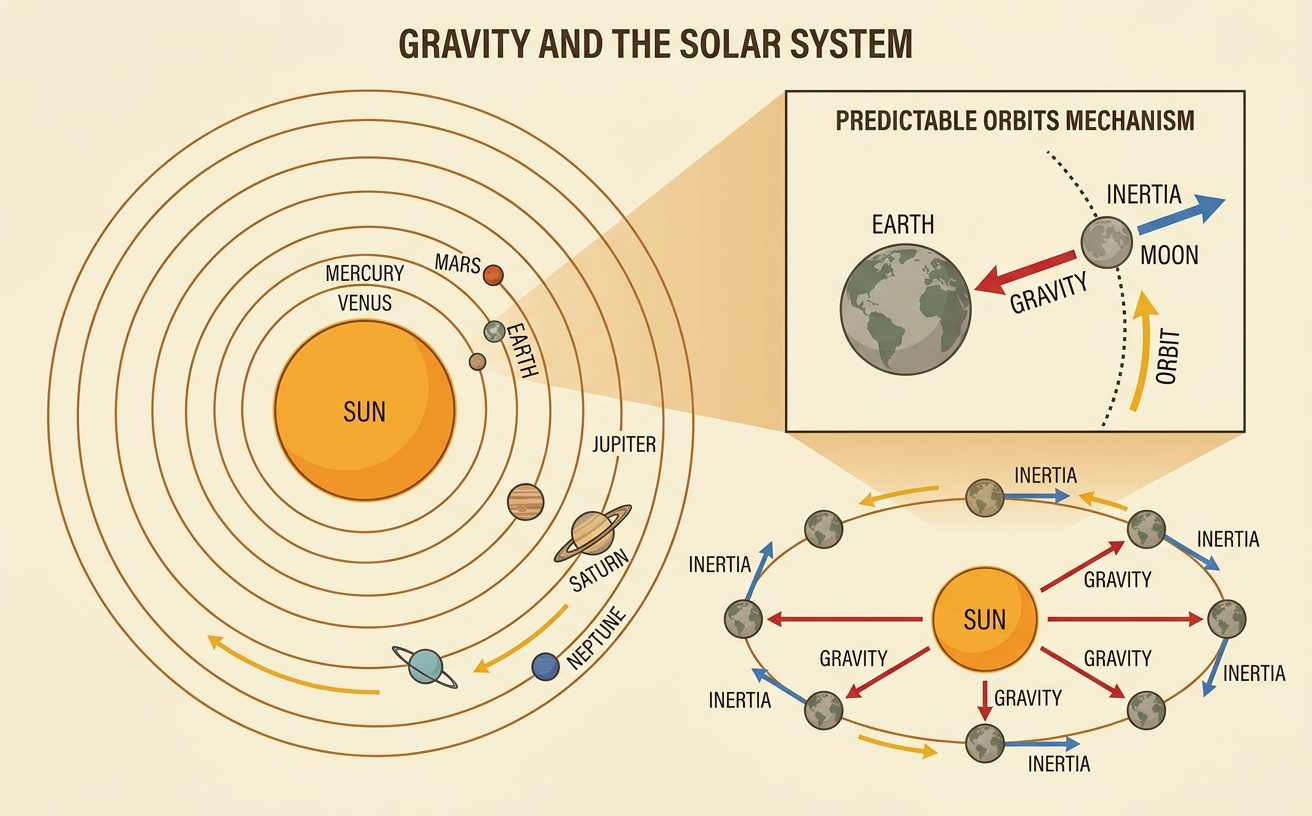
Illustrations are auto-generated and may be placeholders. They can be refreshed to match the narration.
Our Solar System
The solar system includes the Sun and all objects held in orbit around it by gravity. These objects include eight planets, dwarf planets, moons, asteroids, comets, and smaller pieces of rock and ice. Most planets travel around the Sun in nearly circular, elliptical orbits and in the same general direction. Their orbital periods are predictable. For example, Earth completes one orbit around the Sun in about 365.25 days, while more distant Neptune takes about 165 Earth years. Gravity also organizes smaller systems within the solar system. The Moon orbits Earth, and many other planets have their own moons. Although textbook diagrams often place the objects close together, the actual distances between them are enormous compared with their sizes.
Gravity Between Objects
Gravity is an attractive force between every pair of objects that has mass. The force acts across space and pulls each object toward the other. When Earth pulls on an apple, the apple also pulls on Earth with an equal gravitational force in the opposite direction. However, Earth’s enormous mass means its change in motion is too small to notice, while the apple falls visibly toward Earth. The same interaction occurs between celestial bodies. The Sun pulls Earth inward, and Earth pulls the Sun in the opposite direction. Evidence for gravity includes falling objects, ocean tides, and the regular motion of planets and moons. Gravity never pushes objects apart; it always acts along the line between their centers.
Mass and Gravitational Force
Mass is the amount of matter in an object. When the distance between two objects stays the same, increasing either object’s mass increases the gravitational force between them. For example, imagine placing the same spacecraft at equal distances from Earth and Jupiter. Jupiter has much more mass than Earth, so the gravitational attraction between Jupiter and the spacecraft would be stronger. This does not mean that a larger-looking object always has more mass, because density also matters. Scientists use measurements of moons and spacecraft orbits as evidence for a planet’s mass. A moon moving in a particular orbit around a planet reveals how strongly the planet pulls on it. The Sun’s great mass explains why its gravity strongly influences every planet in the solar system.
Distance and Gravitational Force
Gravitational force becomes weaker as the distance between the centers of two objects increases. The decrease is rapid: if the distance doubles, the gravitational force becomes one-fourth as strong, as long as the masses do not change. If the distance triples, the force becomes one-ninth as strong. This pattern is called an inverse-square relationship. For example, a satellite close to Earth experiences a stronger gravitational pull than the same satellite much farther away. Gravity does not suddenly end at the edge of the atmosphere; it continues through space but weakens with distance. This relationship helps explain why the Sun has the greatest influence on nearby planets, while extremely distant objects experience a weaker solar pull. Scientists must measure distance from center to center when comparing gravitational interactions.
Inertia and Orbital Motion
Inertia is the tendency of an object to keep moving in a straight line at a constant speed unless a force changes its motion. An orbit forms because inertia and gravity act together. A planet’s inertia carries it forward, while the Sun’s gravity continuously changes the direction of its motion by pulling it inward. The planet therefore follows a curved path around the Sun instead of traveling straight into space or falling directly into the Sun. Earth is always falling toward the Sun, but its forward motion causes it to keep missing the Sun. Similarly, the Moon’s inertia carries it forward while Earth’s gravity bends its path into an orbit. At every point, an orbiting object’s instantaneous velocity points tangent to its path. If gravity suddenly disappeared, the object would continue along a straight tangent line.