
Gravity: Attraction Between Masses
Students analyze evidence and simple data models to explain that gravity is an attractive force whose strength depends on the masses of objects and the distance between them.

Illustrations are auto-generated and may be placeholders. They can be refreshed to match the narration.
Everyday Evidence of Gravity
Gravity is a force that acts between any two objects with mass. Near Earth’s surface, Earth’s enormous mass makes its gravitational pull easy to observe. When a basketball is released, it speeds up toward the ground. A scale provides another kind of evidence: it measures the supporting force related to the gravitational pull on an object. Gravity also keeps the Moon in orbit around Earth. The Moon is moving forward, but Earth’s gravity continually bends its path into an orbit. These observations come from different situations, yet they support the same idea: objects with mass interact through gravity. Air resistance can affect how quickly objects such as leaves and balls fall, but it does not cause gravity. In a vacuum, where there is no air resistance, different objects fall with the same acceleration near Earth.

Gravity Is Always Attractive
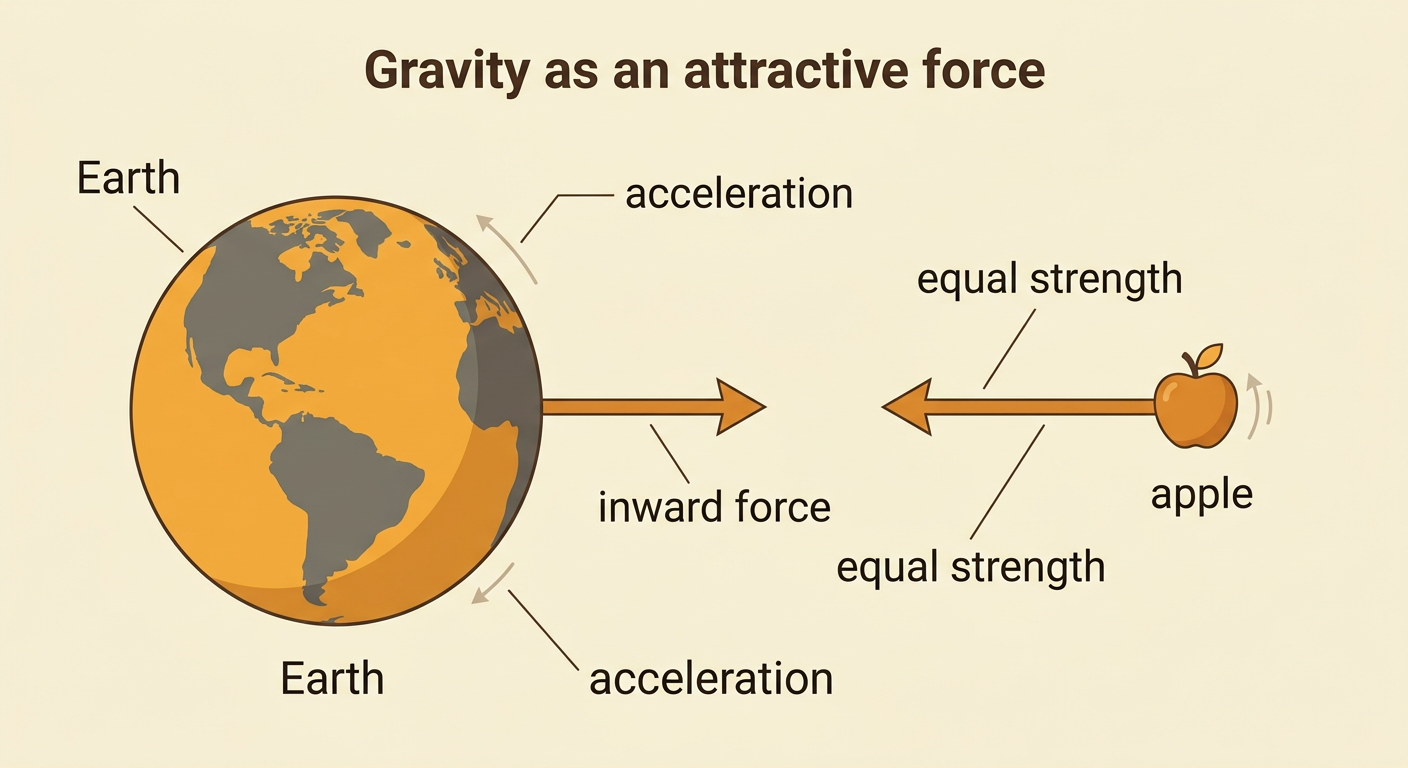
Gravitational force always pulls masses toward one another; it does not push them apart. If two objects are isolated in space, each object experiences a gravitational force directed toward the other. The forces have equal strength and opposite directions, although the objects may respond differently. For example, Earth pulls an apple downward, and the apple pulls Earth upward with an equally strong gravitational force. The apple’s motion is noticeable because its small mass allows it to accelerate much more than Earth does. Earth’s movement is too tiny to notice in this example. A useful force diagram represents gravity with arrows pointing inward from both objects. Outward-pointing gravitational arrows would contradict the evidence and the scientific model. Whether the objects are planets, people, or grains of sand, their gravitational interaction is attractive.
How Mass Affects Gravitational Force
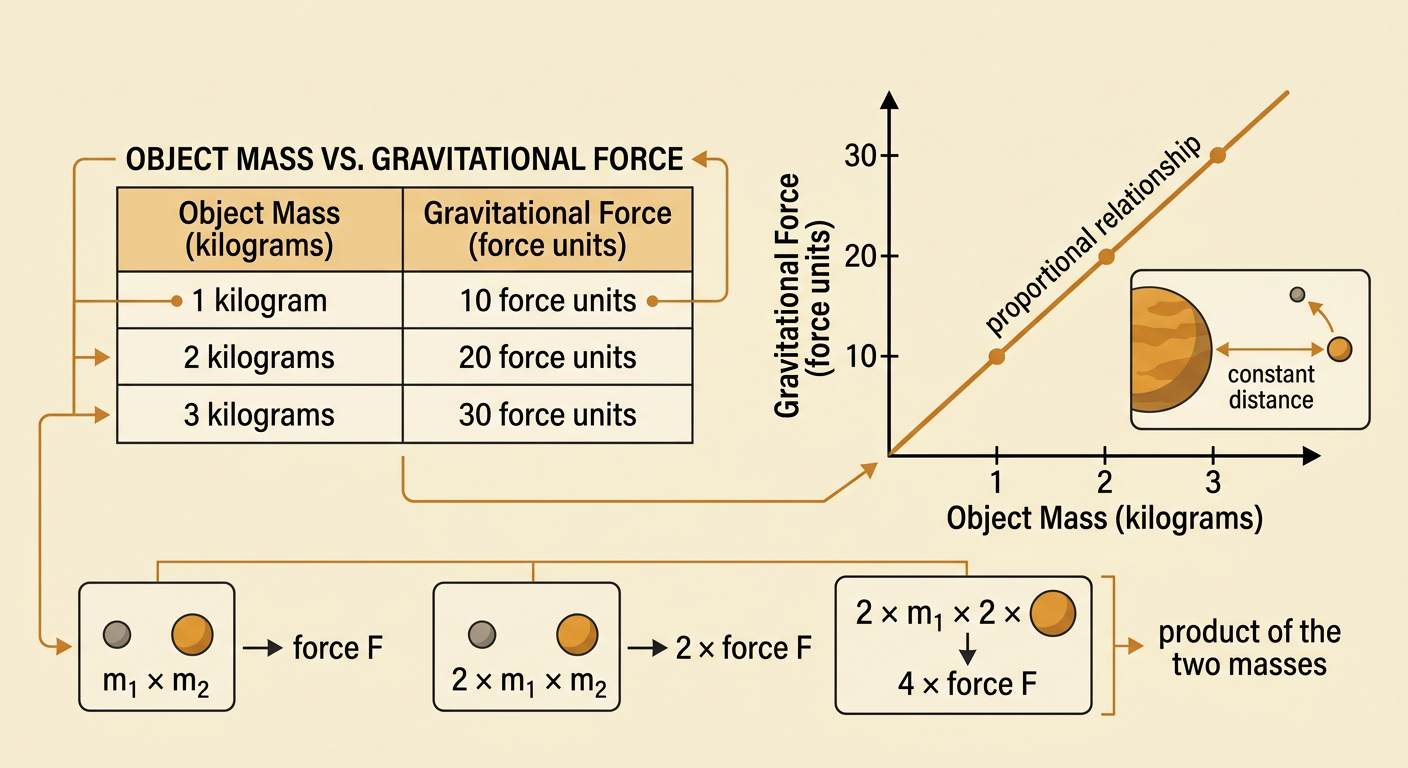
Gravitational force depends on the masses of both interacting objects. When distance and one object’s mass stay constant, doubling the other object’s mass doubles the gravitational force. This is a proportional relationship. Suppose a model shows that a 1-kilogram object experiences 10 force units near a particular planet. At the same distance, a 2-kilogram object would experience 20 force units, and a 3-kilogram object would experience 30 force units. The constant ratio is 10 force units per kilogram. The gravitational relationship can be summarized as force being proportional to the product of the two masses. Therefore, doubling either mass doubles the force, while doubling both masses makes the force four times as great. Scientists compare data only when the distance is controlled because changing distance at the same time would make the effect of mass unclear.
How Distance Affects Gravitational Force
Gravitational force becomes weaker as the distance between the centers of two objects increases. More precisely, gravity follows an inverse-square relationship: multiplying the center-to-center distance by a number divides the force by that number squared. Consider a simple model in which the force is 16 units at a distance of 1 unit. At 2 distance units, the force is 4 units because 16 divided by 2 squared equals 4. At 4 distance units, the force is 1 unit because 16 divided by 4 squared equals 1. Thus, doubling distance makes gravity one-fourth as strong, not one-half as strong. Distance must be measured between the objects’ centers. This pattern helps explain why spacecraft still experience Earth’s gravity far above the surface, even though the pull weakens with increasing distance.

Constructing a Claim-Evidence-Reasoning Explanation
A strong scientific argument includes a claim, specific evidence, and reasoning that connects the evidence to the claim. Begin with a claim such as, “Gravity is attractive, and its strength depends on mass and distance.” Then cite evidence from multiple sources. Observations show that dropped objects move toward Earth, force diagrams show inward pulls, and model data show that doubling one mass doubles force when other variables stay fixed. Distance data show that doubling separation reduces force to one-fourth. In the reasoning, explain why these patterns support the claim rather than merely repeating the numbers. For example, inward motion is consistent with attraction, while the changing ratios show how mass and distance affect strength. Also identify controlled variables and avoid claiming that a model proves more than its evidence supports. Finish by presenting the argument clearly and addressing competing ideas, such as the incorrect claim that gravity can push masses apart.
