Gravity in the Earth-Moon System
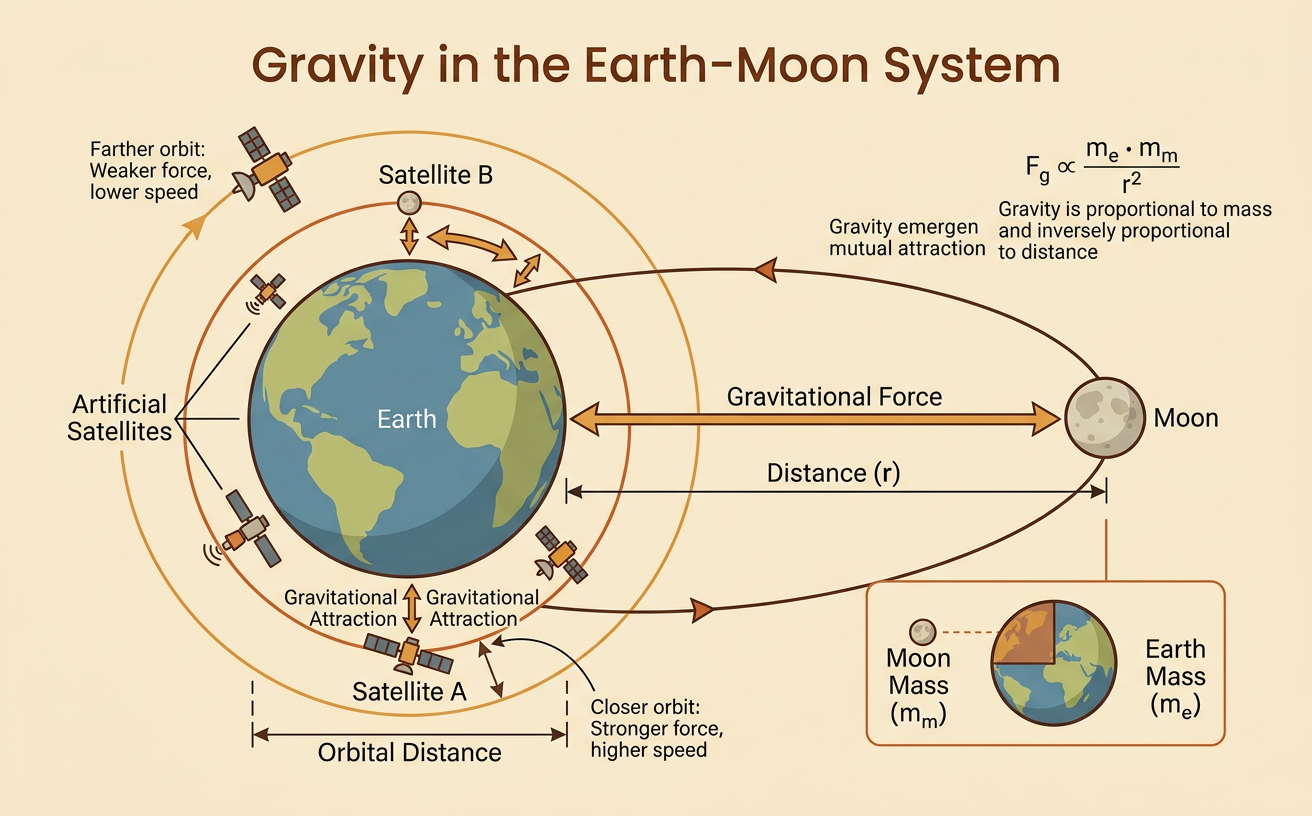
Students analyze diagrams and evidence to explain how mass and distance influence the attractive gravitational interaction between Earth, the Moon, and artificial satellites.
Illustrations are auto-generated and may be placeholders. They can be refreshed to match the narration.
Gravity as an Attractive Force
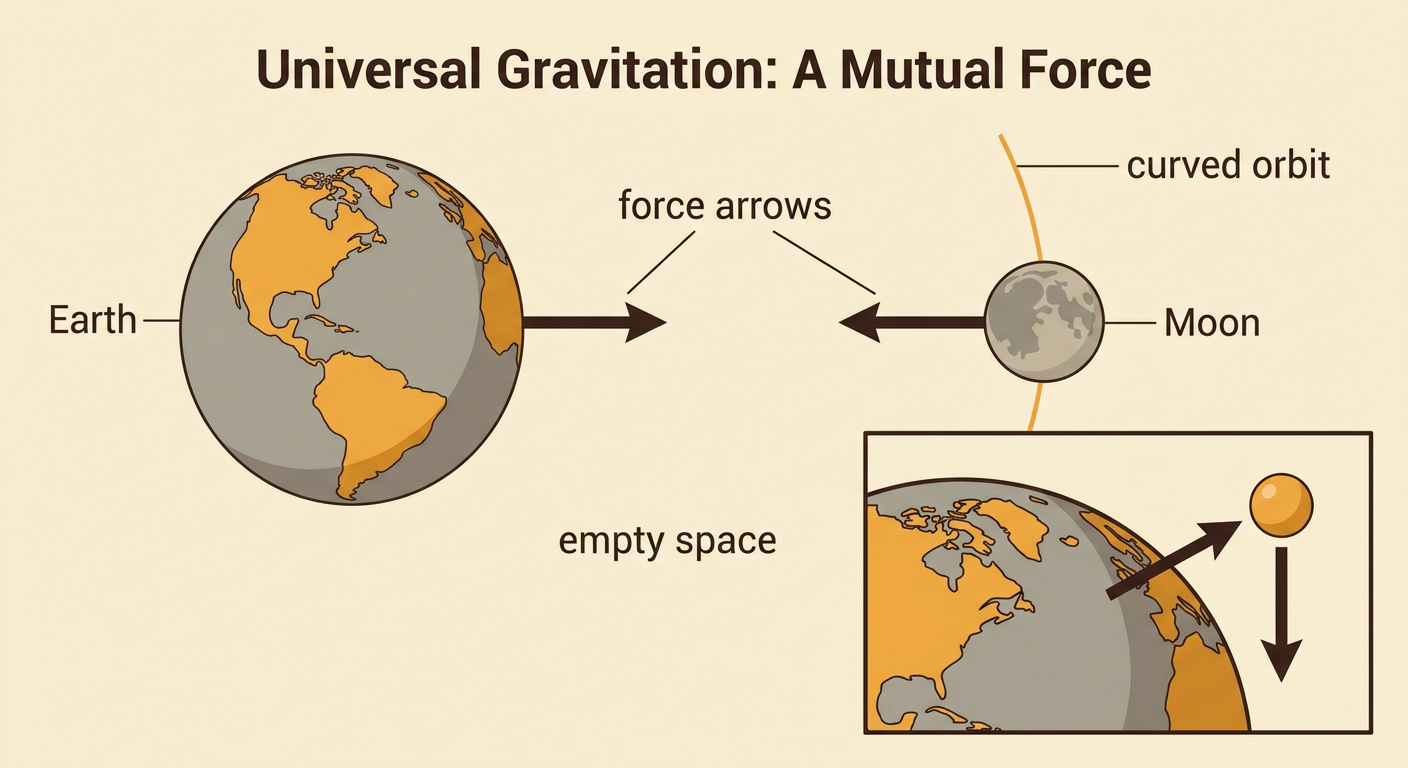
Gravity is a force that acts between every pair of objects with mass. In the Earth-Moon system, each body pulls the other toward itself. This is an attractive interaction: gravity draws objects together and never pushes them apart. Force arrows should point from Earth toward the Moon and from the Moon toward Earth. The forces are equal in strength and opposite in direction, even though Earth responds less because it has much more mass. For example, when a ball falls, Earth pulls the ball downward while the ball pulls Earth upward with the same force. The ball has far less mass, so its change in motion is easy to observe. Gravity acts across empty space, allowing the Moon and satellites to remain in curved orbits without physical contact.
Mass and Gravitational Interaction
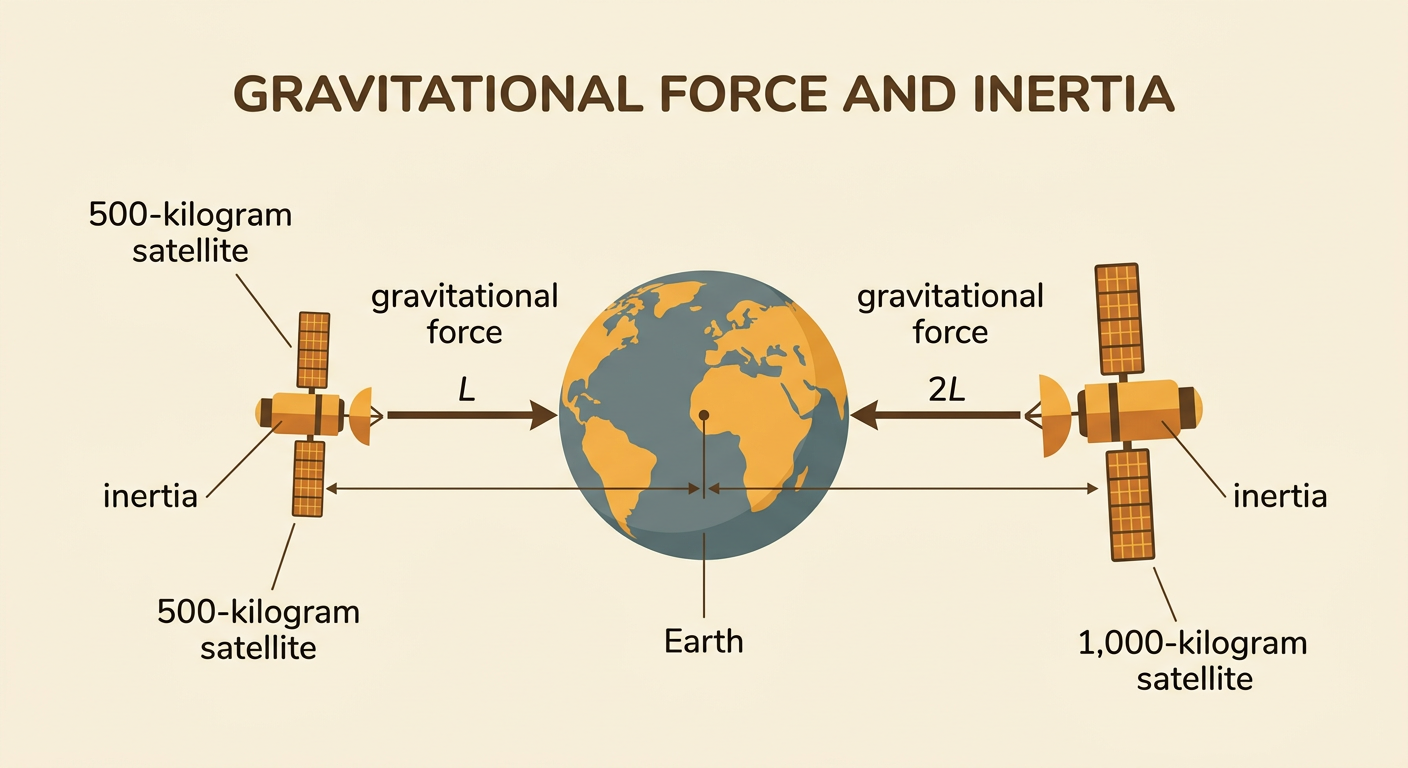
The strength of a gravitational interaction depends on the masses of both objects. When distance remains the same, increasing either mass increases the gravitational force. The force depends on the product of the two masses. For example, imagine two satellites at the same distance from Earth. If one satellite has a mass of 500 kilograms and the other has a mass of 1,000 kilograms, Earth exerts twice as much gravitational force on the 1,000-kilogram satellite. However, that satellite also has twice as much inertia, so both satellites can have the same gravitational acceleration when air resistance is absent. The Moon experiences a much greater gravitational force with Earth than a small satellite does because the Moon has much more mass. Earth, the Moon, and each satellite all contribute mass to their gravitational interactions.
Distance and Gravitational Interaction
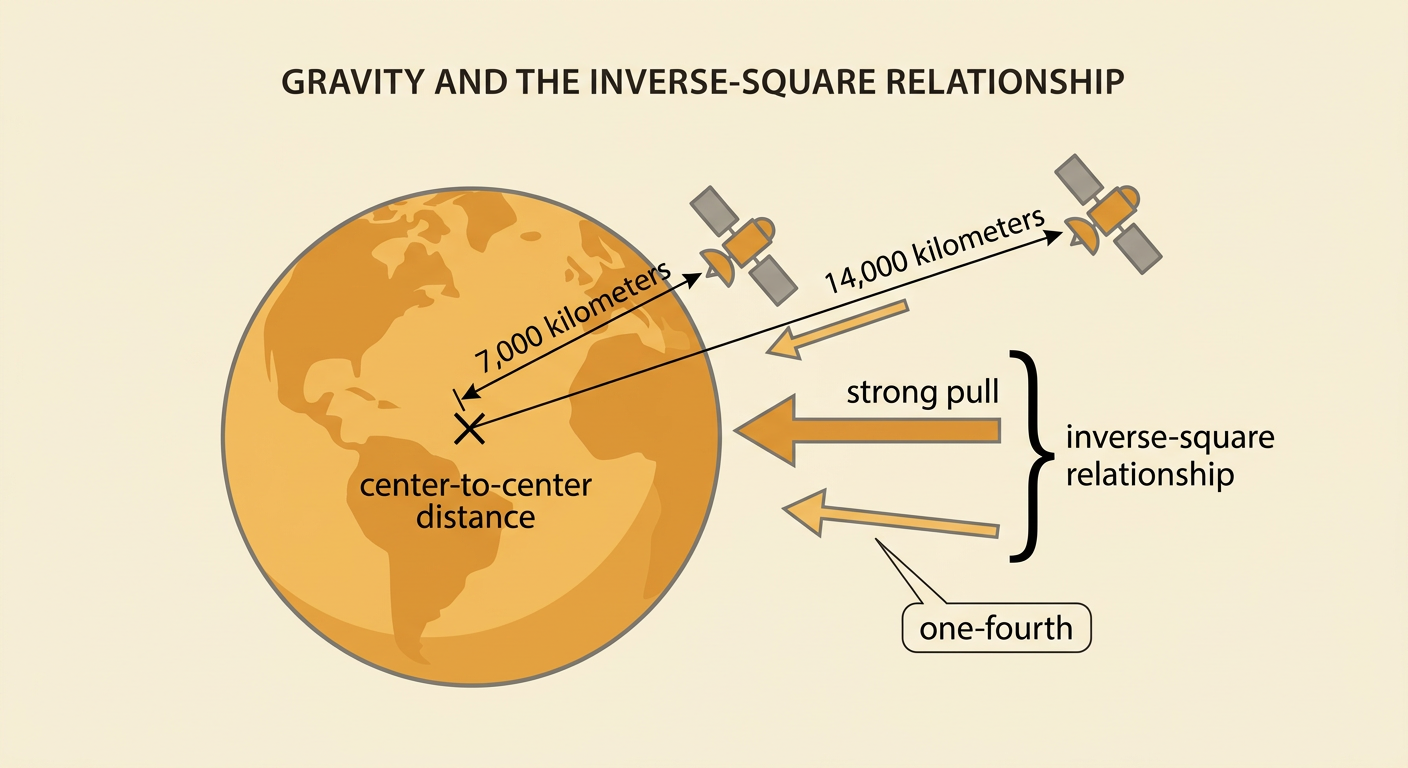
Gravitational force becomes weaker as the distance between two objects increases. Distance must be measured from the center of one object to the center of the other. Gravity follows an inverse-square relationship: if the center-to-center distance doubles, the force becomes one-fourth as strong. If the distance triples, the force becomes one-ninth as strong. For example, consider the same satellite placed first 7,000 kilometers from Earth’s center and then 14,000 kilometers from Earth’s center. At the greater distance, Earth’s gravitational pull on the satellite is only one-fourth of its original strength. This does not mean gravity disappears; it continues across enormous distances. A more distant satellite generally travels more slowly in its orbit than a closer satellite because the gravitational interaction is weaker.
Earth-Moon System Model
Earth and the Moon form a gravitational system. Their average center-to-center distance is about 384,400 kilometers. Earth’s gravity continuously pulls the Moon inward, while the Moon’s sideways motion carries it forward. These motions combine to produce a curved orbit rather than a collision or a straight path into space. The Moon completes one orbit relative to distant stars in about 27.3 days. The Moon also pulls Earth, so both bodies actually orbit a shared balance point called the barycenter. Because Earth is much more massive, this point lies inside Earth, about 4,670 kilometers from Earth’s center. A useful model includes inward force arrows, the Moon’s forward velocity, and its curved path. The model explains the spatial relationship between the two bodies without suggesting that gravity acts in only one direction.

Satellite Evidence
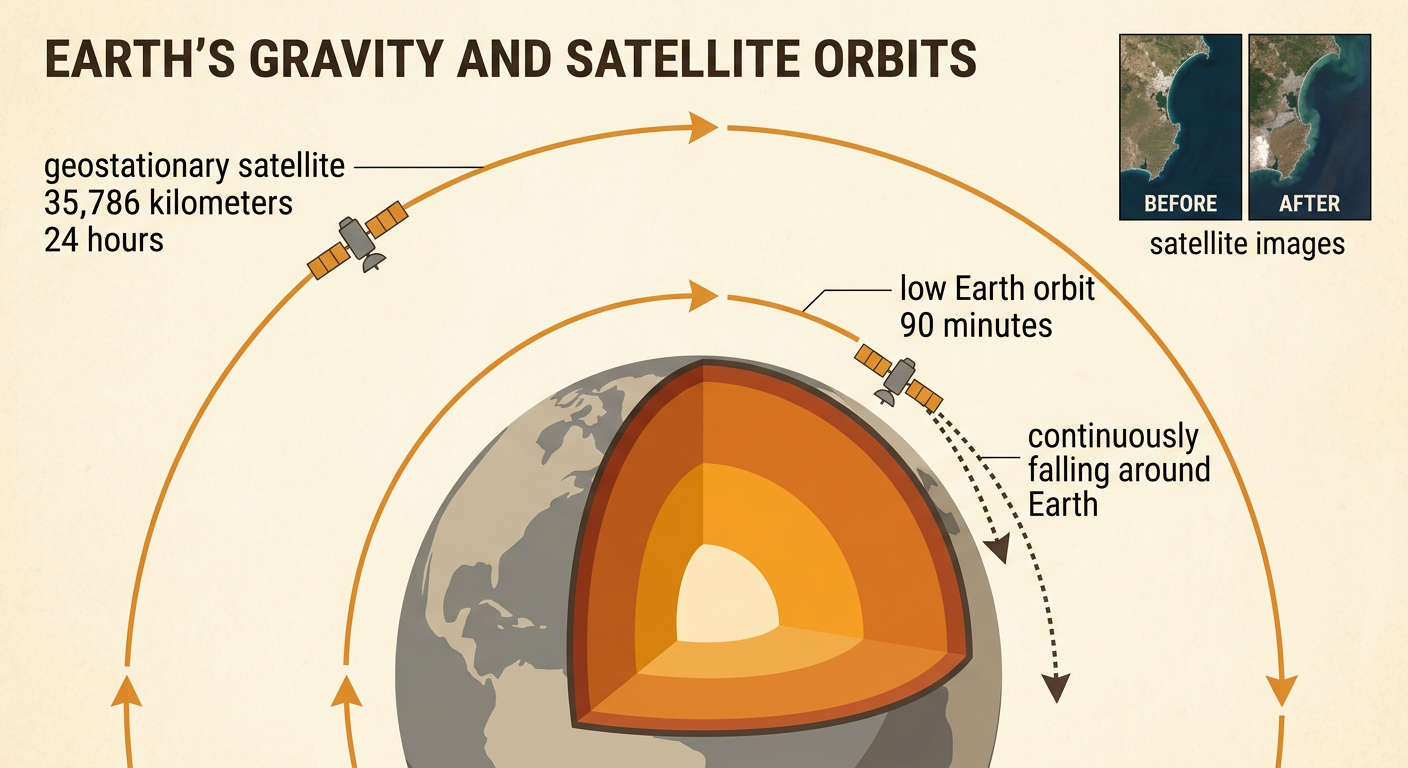
Artificial satellites provide observable evidence that Earth’s gravity acts far above the surface. A low-Earth-orbit satellite may travel only a few hundred kilometers above Earth and circle the planet in about 90 minutes. It is not beyond gravity; it is continuously falling around Earth along a curved path. A geostationary satellite orbits about 35,786 kilometers above the equator and takes about 24 hours to complete one orbit. Its motion matches Earth’s rotation, so it appears to remain above one location. These different orbits show that distance affects gravitational interaction and orbital motion. Satellites also collect repeated images of the same places. Comparing images taken on different dates can reveal changing coastlines, wildfire damage, shrinking ice cover, or expanding cities. Maps and satellite images connect orbital observations with spatial and environmental changes on Earth.
Evidence-Based Explanation
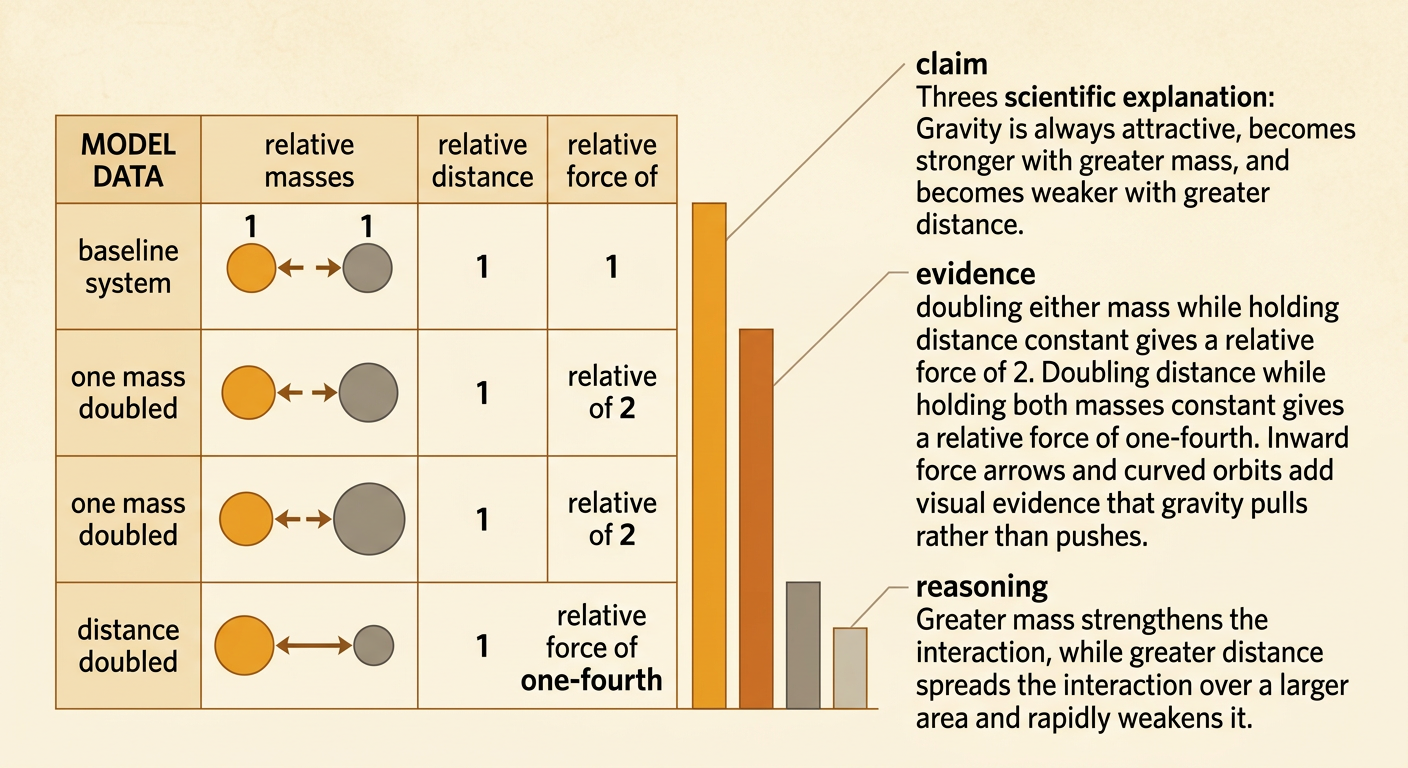
A strong scientific explanation includes a claim, evidence, and reasoning. A suitable claim is that gravitational interactions are always attractive and become stronger with greater mass but weaker with greater distance. Consider scaled model data. A baseline system has relative masses of 1 and 1, a relative distance of 1, and a relative force of 1. Doubling either mass while keeping distance constant produces a relative force of 2. Doubling the distance while keeping both masses constant produces a relative force of one-fourth. These values are evidence for the mass and distance patterns. Inward-pointing force arrows and the curved paths of moons and satellites provide additional evidence that gravity is attractive. The reasoning connects the evidence to the claim: greater mass strengthens the interaction, while increased distance spreads the interaction over a larger area and rapidly reduces its strength.