
Gravity Pulls Objects Toward Earth
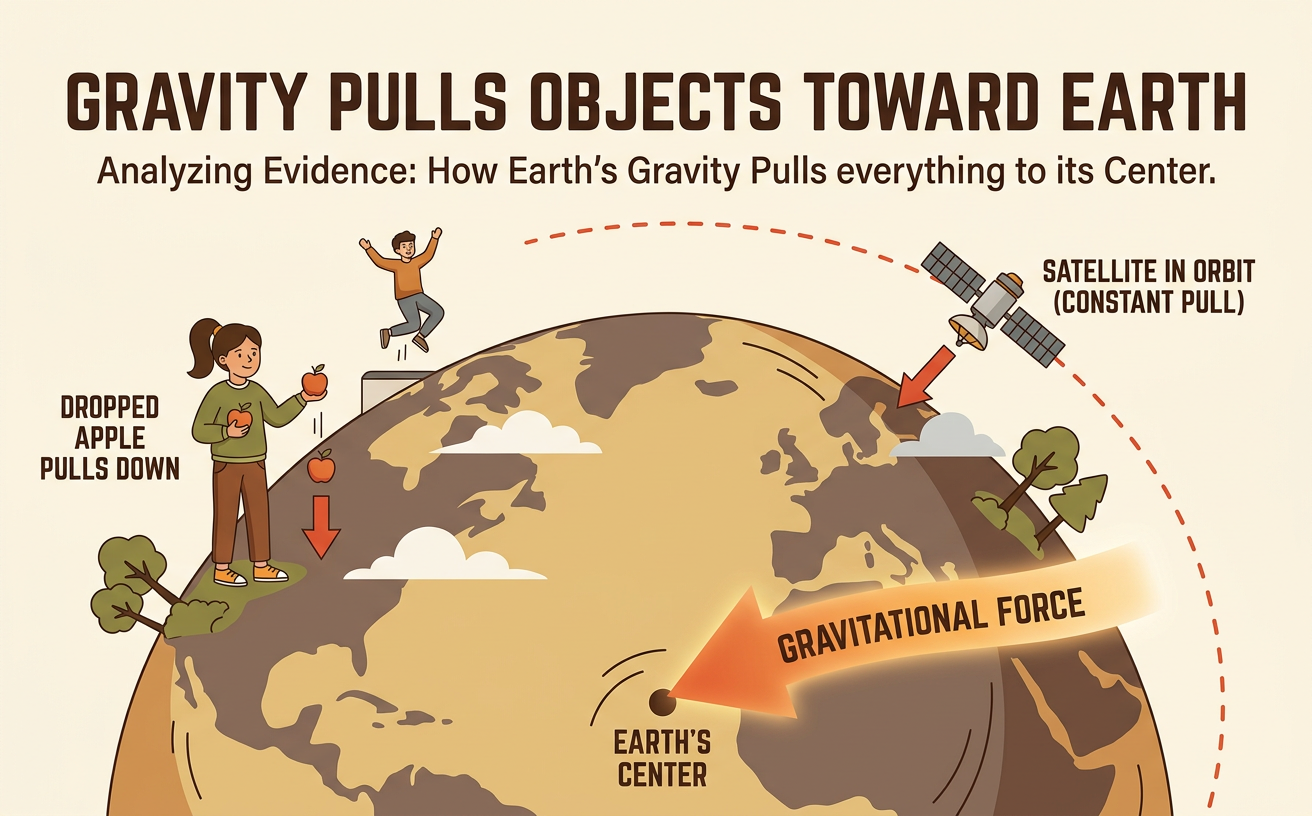
Students analyze observations and evidence to construct an argument that Earth’s gravitational force pulls objects toward its center.
Illustrations are auto-generated and may be placeholders. They can be refreshed to match the narration.
What Is Gravity?
Gravity is a force of attraction between objects that have mass. Earth has a very large mass, so its gravity pulls nearby objects toward the planet’s center. Near Earth’s surface, we describe this direction as down. Gravity acts even when objects are not moving. For example, a book resting on a desk is pulled downward by gravity, but the desk pushes upward on the book and keeps it from falling. If the book slides off the desk, that supporting push disappears, and gravity makes the book accelerate toward the floor. Earth’s gravity also keeps people, oceans, buildings, and the atmosphere from drifting into space. We cannot see gravity itself, but we can observe and measure its effects on objects.

Observing Falling Objects
Dropping an object provides evidence about the direction of Earth’s gravitational force. Hold a rubber ball above the ground and release it without pushing. The ball begins moving downward and speeds up until it hits the ground. Repeating the test from different places gives the same pattern: the released ball moves toward Earth. A flat sheet of paper may fall more slowly because air pushes against its broad surface. If the paper is crumpled into a tight ball, it usually falls faster because it experiences less air resistance. Both forms of the paper are still pulled downward by gravity. Careful observations should include what was released, where it started, the direction it moved, and what happened when it reached the ground.

What Does Down Mean?
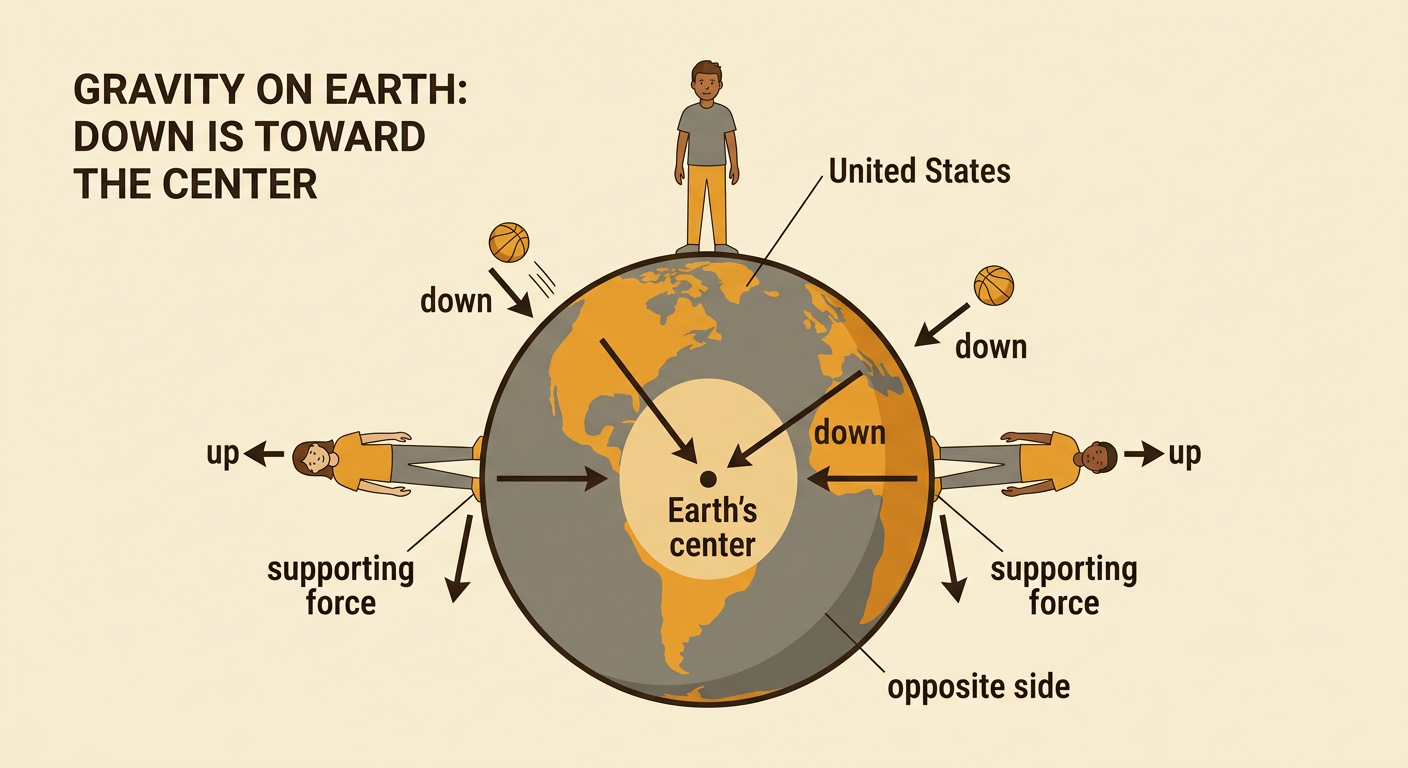
Down does not mean the same direction everywhere in space. On Earth, down means toward Earth’s center. Imagine one student standing in the United States and another standing on the opposite side of the planet. Each student feels upright, and a dropped ball falls toward the ground beneath that student. In a space diagram, the two balls move in different directions, but both move toward the same place: Earth’s center. Up is the direction away from the center. This explains why people on the opposite side of Earth do not fall off. Gravity pulls them toward the ground just as it pulls you toward the ground. The ground then provides an upward supporting force that prevents people and objects from moving farther toward the center.
Analyze the Evidence
Scientists use repeated observations as evidence, not just one event. Consider three observations: a released ball falls to the playground, rain moves toward the ground, and a tossed beanbag returns after rising. These objects differ in size, material, and motion, yet each changes position toward Earth. This shared pattern supports the idea that Earth exerts a downward gravitational force. Other forces can affect what we see. Air resistance slows raindrops, and a hand provides an upward force when tossing a beanbag. However, after the hand stops pushing, gravity continues pulling the beanbag toward Earth. Strong evidence comes from comparing several observations, identifying the repeated pattern, and considering other possible causes. Evidence should be relevant to the claim and described accurately rather than based only on an opinion.

Build a Claim-Evidence-Reasoning Argument
A strong scientific argument includes a claim, evidence, and reasoning. The claim answers the question: Earth’s gravitational force on nearby objects is directed down, toward Earth’s center. Evidence consists of specific observations or reliable information. For example, a released ball fell to the ground, crumpled and flat paper both moved downward, and diagrams from different locations showed arrows pointing toward Earth’s center. Reasoning explains why the evidence supports the claim. Although air resistance changed how quickly the papers fell, both moved toward Earth after release. The observations from several tests and the Earth diagram show a consistent direction, so gravity is the force that best explains the pattern. When writing, state the claim clearly, include evidence from more than one source, connect each piece of evidence to the claim, and use accurate science vocabulary.
