
Gravity Pulls Objects Toward Earth
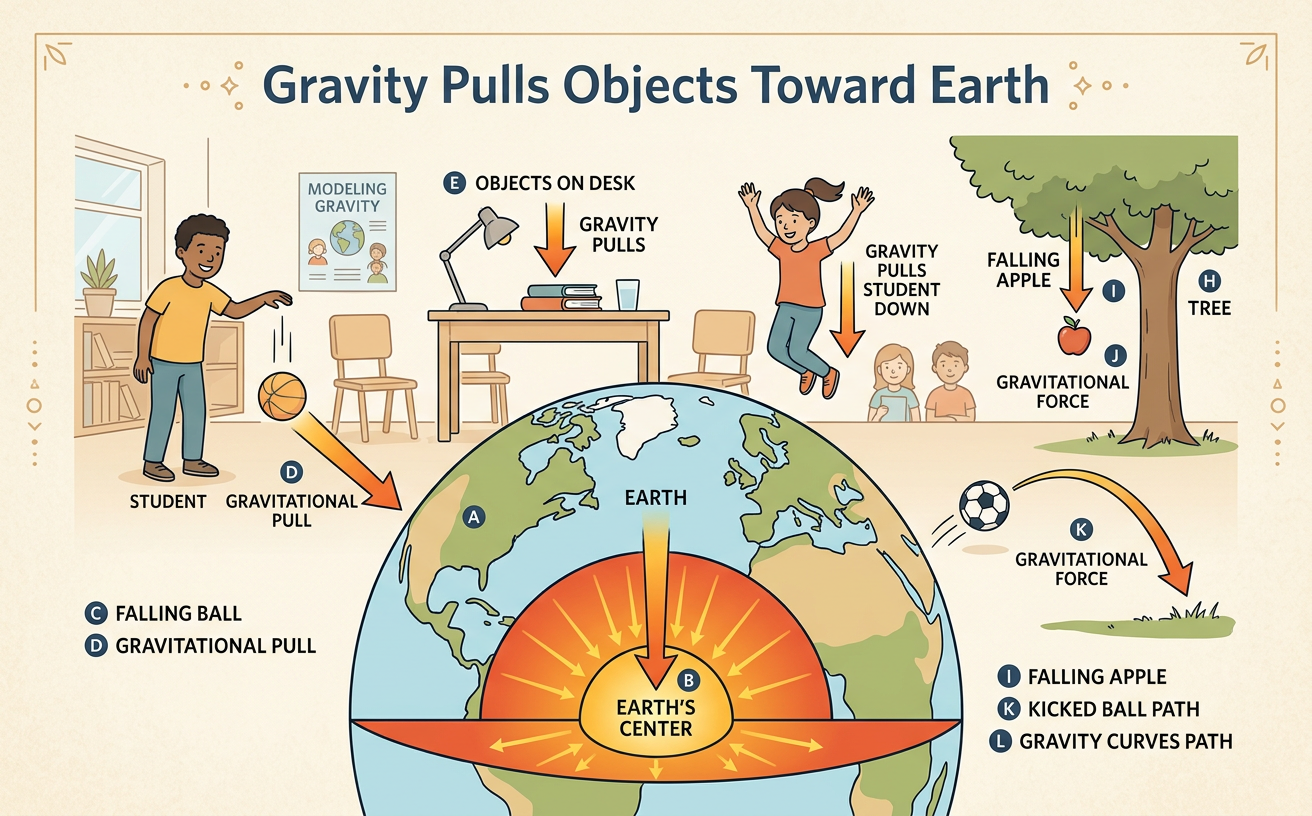
Students use observations and simple models to explain that Earth’s gravitational force pulls objects downward toward its center.
Illustrations are auto-generated and may be placeholders. They can be refreshed to match the narration.
Observe Falling Objects
When an object is released near Earth’s surface, it begins moving downward unless another force stops or redirects it. You can observe this by holding a rubber ball at shoulder height and letting go. The ball moves toward the floor, not toward the ceiling or sideways. Repeating the test from different heights gives the same general result. A dropped leaf or flat sheet of paper may drift because moving air pushes on it, but it still eventually moves downward. Crumpling the paper reduces air resistance and makes its downward motion easier to see. These repeated observations are evidence that a force acts on unsupported objects. The force itself is invisible, but its effect can be observed as a change in an object’s motion toward Earth.

Define Gravity and Downward
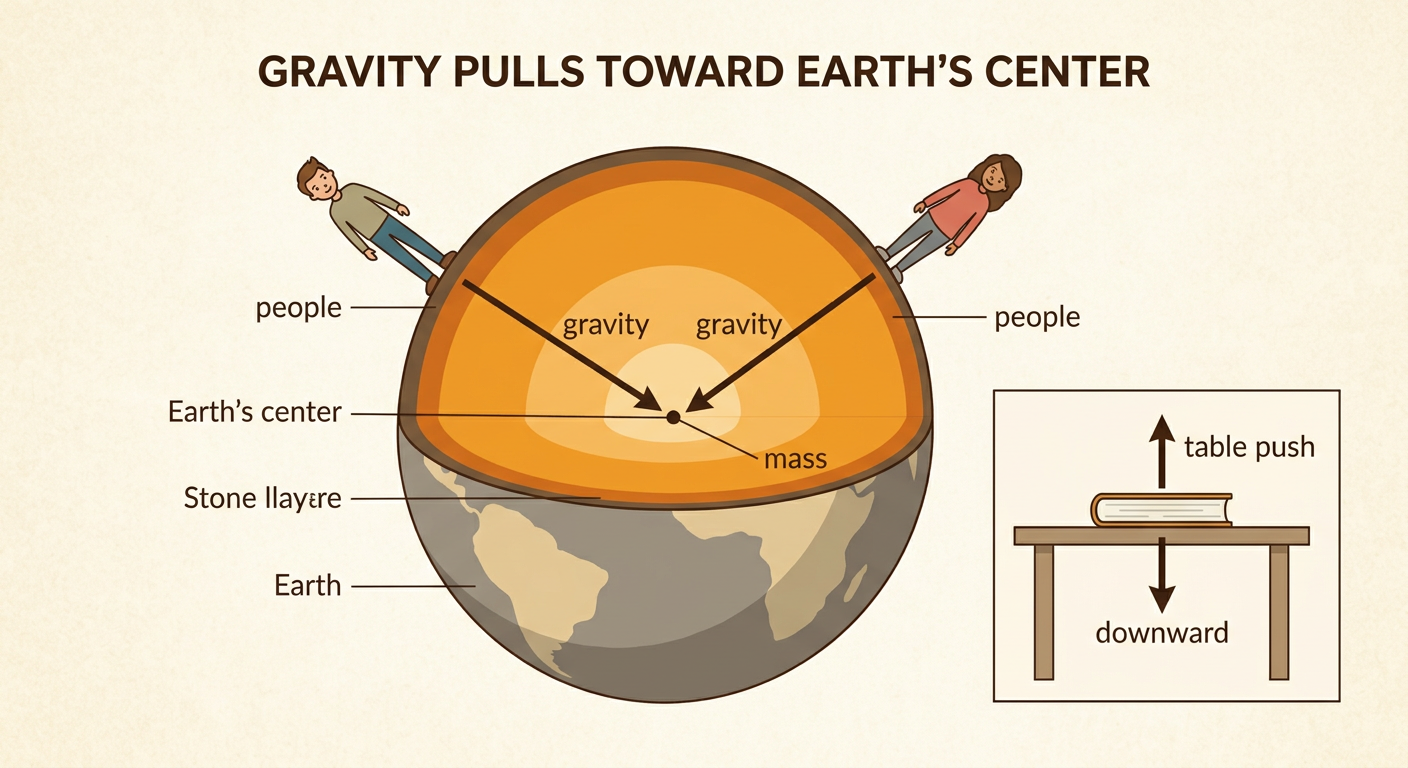
Gravity is an attractive force between objects that have mass. Earth has an enormous amount of mass, so its gravitational force pulls nearby objects toward Earth. Near the surface, we call the direction of this pull downward. More precisely, downward means toward Earth’s center. It does not mean toward the bottom edge of a drawing or map. For example, a person in the United States and a person on the opposite side of the globe both feel that their feet point downward. Their downward directions are different in space, but both directions point toward Earth’s center. Gravity also pulls on objects that are not falling. A book resting on a table is pulled downward, while the table pushes upward and prevents the book from moving.
Model Earth’s Gravitational Pull
A model can make the direction of an invisible force easier to understand. Draw Earth as a circle with a dot at its center. Place small objects, such as a ball, an apple, and a satellite, at several locations around the circle. From each object, draw an arrow pointing toward the center. The arrows represent the direction of Earth’s gravitational force. They point inward from every side rather than in one parallel direction across the page. For example, the gravity arrow for an apple above the top of the circle points down the page, while the arrow for a ball beside the circle points sideways on the page. Both arrows point toward Earth’s center. This model shows force direction, but the sizes of the objects and distances are not drawn to scale.

Compare Gravity in Different Locations
Maps, photographs, satellite images, and globes show Earth in different ways. A flat map is useful for locating mountains, plains, and oceans, but it can make downward look like the bottom of the page. A globe better shows that local downward changes direction around Earth while always pointing toward the center. Consider a hiker on a mountain and a child standing on a beach. Gravity pulls both toward Earth’s center, even though they are at different elevations and in different environments. On a steep mountainside, gravity does not point along the slope. It points generally toward Earth’s center, while the shape of the land affects how rocks or water move downhill. A satellite image can reveal high ridges and low valleys, helping explain why water follows lower paths as gravity pulls it downward.
Build an Evidence-Based Explanation
A strong scientific explanation includes a claim, evidence, and reasoning. The claim can state: Earth’s gravitational force on nearby objects is directed downward, toward Earth’s center. Evidence may include observations that a released ball falls toward the ground, crumpled paper moves downward, and objects released at different surface locations move toward the local ground. A globe model adds evidence by showing that local downward directions all point inward toward Earth’s center. The reasoning connects the evidence to the claim: because unsupported objects repeatedly change their motion toward Earth, a force must be acting in that direction. For example, if a student drops a ball three times and it moves toward the floor each time, those repeated results support the claim. A complete explanation should name the observations, describe the model, and clearly explain how both support the claim.