Gravity Pulls Objects Toward Earth
Students observe falling objects, create force-arrow models, and use evidence to explain that Earth’s gravitational force pulls objects downward toward its center.

Illustrations are auto-generated and may be placeholders. They can be refreshed to match the narration.
Engage with a Falling-Object Demonstration
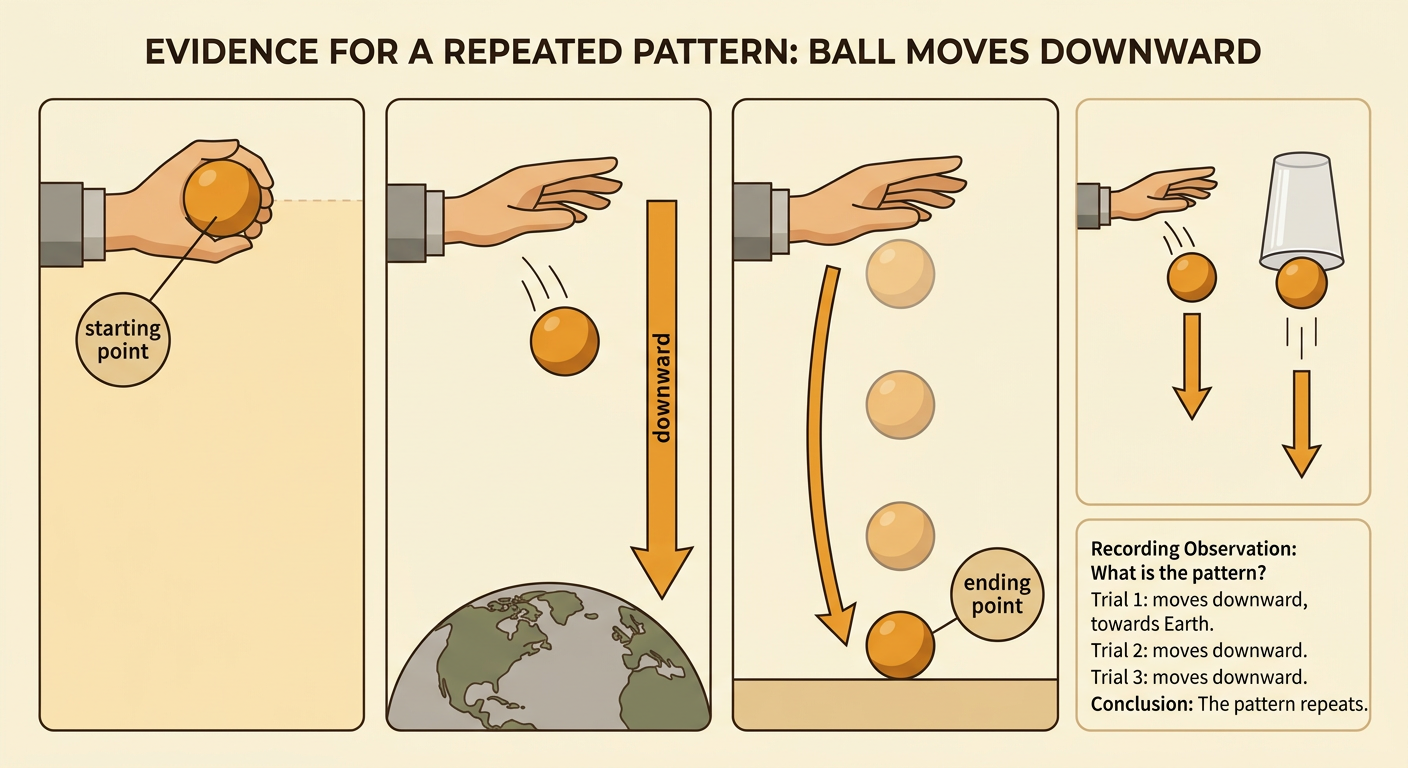
Hold a rubber ball about shoulder height above the floor. Ask students to predict what will happen when the ball is released without being pushed. Release it, observe its motion, and repeat the drop from a lower height. In both trials, the ball moves toward the floor. Next, turn a clear cup upside down and release the ball from beneath it. The ball still falls toward the floor, showing that the result does not depend on which way the object was facing. Record observations rather than guesses: where the ball started, where it ended, and the direction it moved. The demonstration gives evidence of a consistent pattern. Near Earth’s surface, an unsupported object begins moving downward, toward Earth, unless another force prevents or changes that motion.
Identify Gravity as a Force
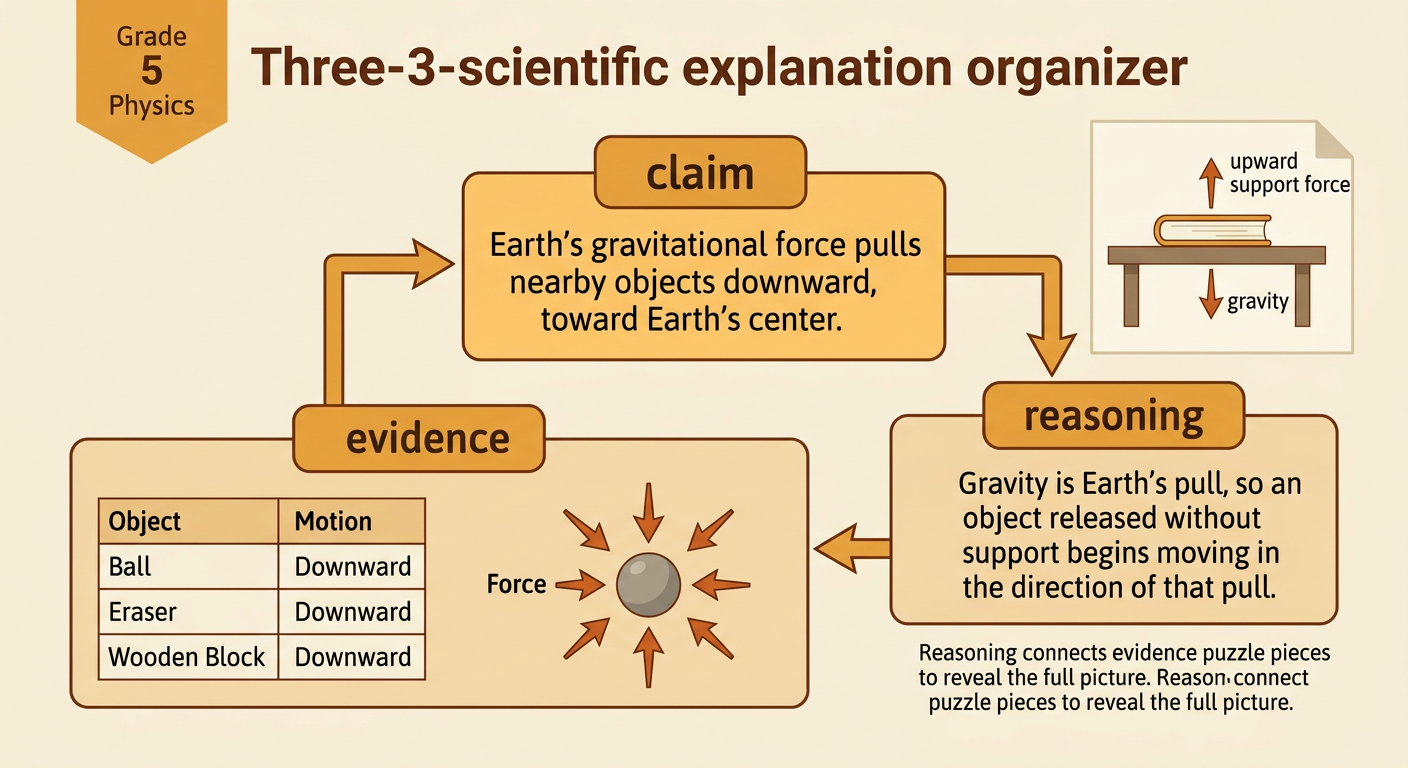
A force is a push or a pull that can change an object’s motion. Gravity is an attractive force between objects that have mass. Earth has very large mass, so its gravitational pull on nearby objects is noticeable. When a pencil slips from a desk, Earth pulls the pencil downward, toward Earth’s center. Gravity acts even though Earth does not touch the pencil. A table can keep a book from falling because the table pushes upward on the book while gravity pulls downward. If the book moves beyond the table’s edge, that upward support disappears and the book falls. Gravity does not mean that every object must always move downward; other forces can balance or overcome it. However, Earth’s gravitational force on the object is still directed downward.

Model Gravity with Directional Arrows
Scientists use force arrows to model forces that may be invisible. The arrow begins on the object receiving the force, and the arrowhead shows the force’s direction. To model Earth’s gravity on an apple near the surface, draw an arrow starting at the apple and pointing straight downward. Label it “gravity.” Do not draw the gravity arrow beside the apple with no connection, because that can make the model unclear. On a globe, “downward” is different at different locations: it always means toward Earth’s center. An apple at the top, side, or bottom of a globe has a gravity arrow aimed inward. Students can treat the arrow as a mathematical representation of direction. Comparing several arrows reveals a pattern: all point toward the same central location, even though they point different ways on the page.

Gather Evidence from Drops and Diagrams
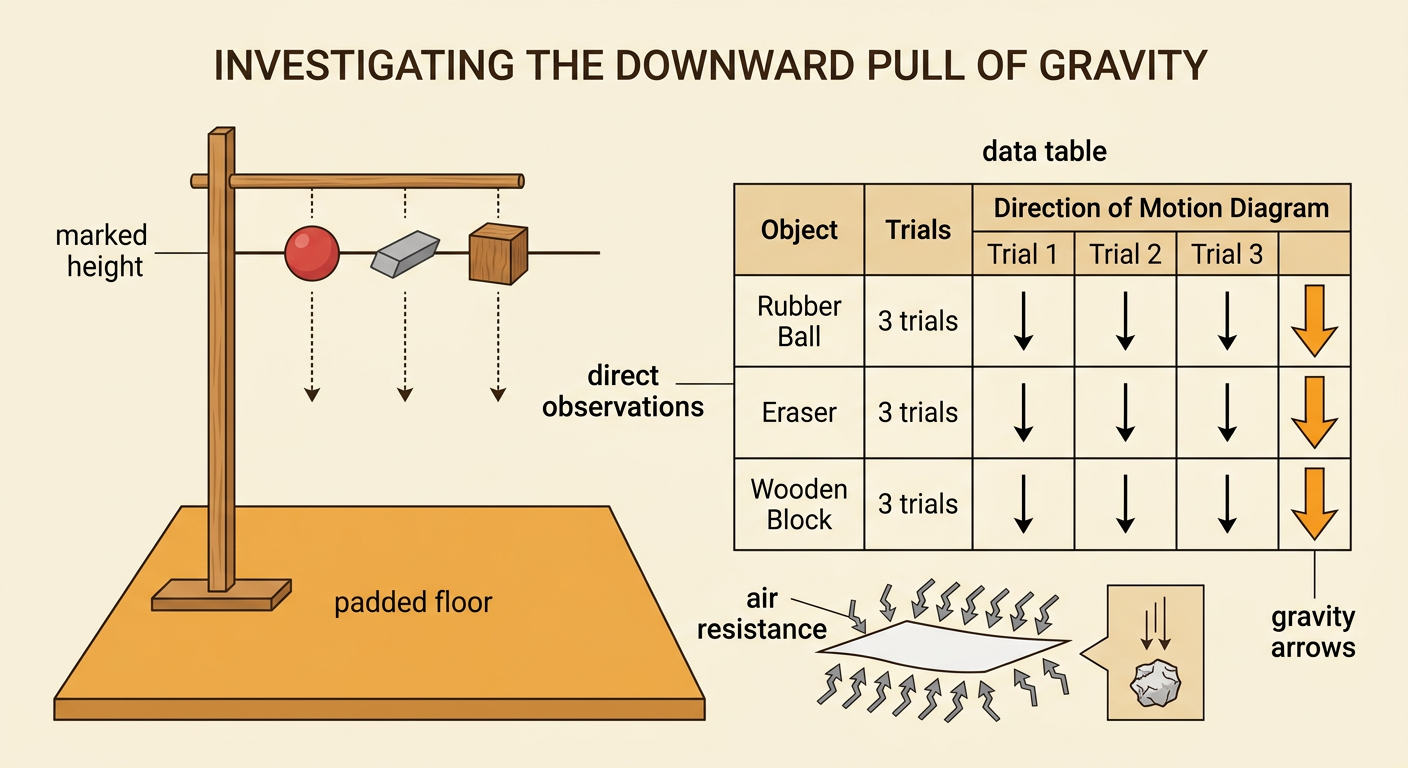
Test the pattern with several safe objects, such as a rubber ball, an eraser, and a wooden block. Release each object from the same marked height without throwing it. In a data table, record the object, number of trials, and observed direction of motion. For example, if the ball moves downward in three out of three trials, record 3 downward drops out of 3. Repeat for each object. Avoid comparing a flat sheet of paper with a ball as proof that gravity differs, because air resistance strongly affects the paper’s motion. Add a force-arrow diagram for every tested object. Then compare two sources of evidence: direct observations from the drops and information represented in the diagrams. A repeated downward pattern supports the idea that Earth’s gravitational force on nearby objects is directed downward.
Write a Claim-Evidence-Reasoning Explanation
Use the investigation to write a claim-evidence-reasoning explanation. The claim answers the question: In what direction does Earth’s gravity pull nearby objects? A strong claim is, “Earth’s gravitational force pulls objects downward, toward Earth’s center.” Evidence should include specific observations and models. For example, state that the ball, eraser, and wooden block each moved downward in three out of three trials, and that every gravity arrow pointed toward Earth’s center. Reasoning explains why the evidence supports the claim: gravity is a pull exerted by Earth, so objects released without support begin moving in the direction of that pull. Also consider a possible objection, such as a book remaining on a table. Explain that the table supplies an upward support force; it does not remove gravity. End by connecting the evidence from both the drops and diagrams to the claim.