
Habitat Detectives: Comparing Living Things
Students observe two habitat images, record the plants and animals they find, and compare the variety of life in each habitat.
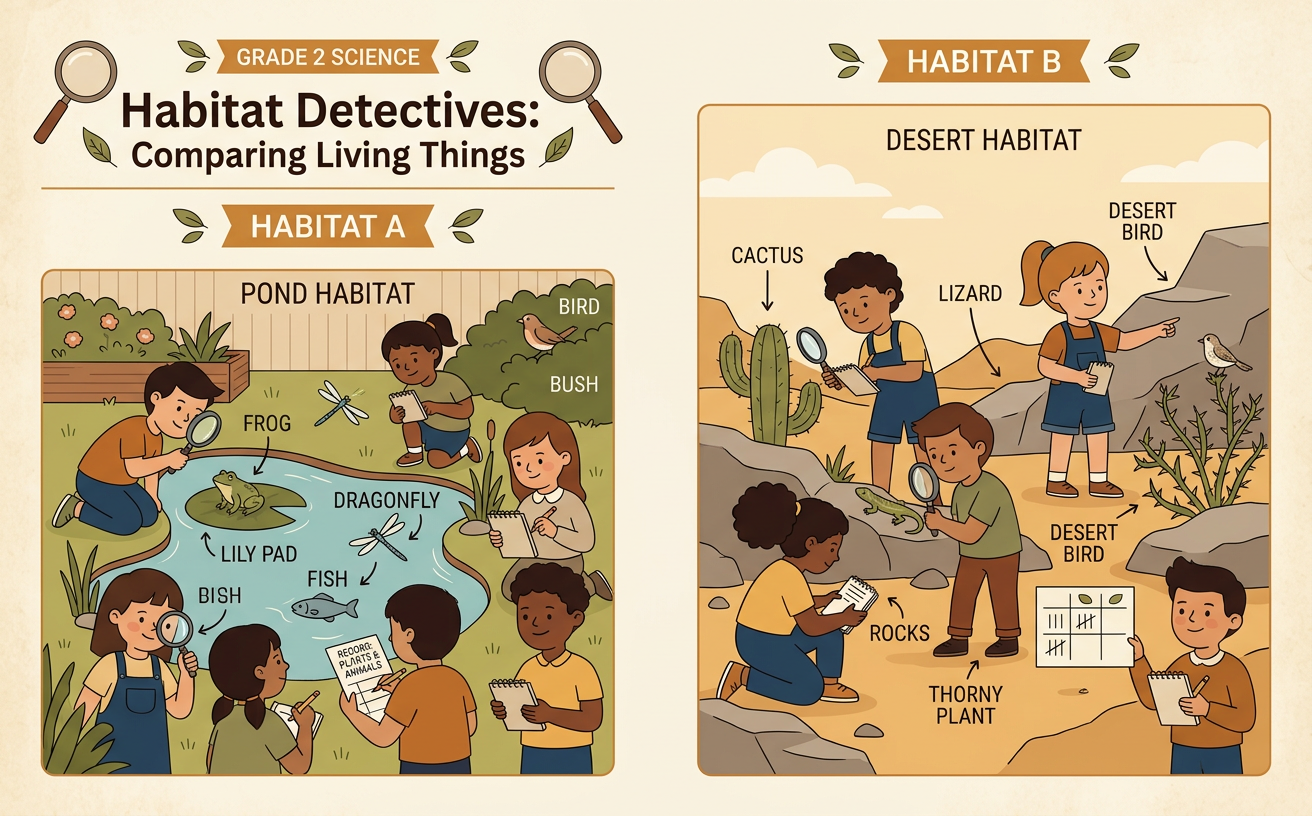
Illustrations are auto-generated and may be placeholders. They can be refreshed to match the narration.
What Is a Habitat?
A habitat is the place where a living thing gets what it needs to survive. Animals need food, water, air, shelter, and space. Plants need sunlight, water, air, nutrients, and room to grow. A habitat can be large, like a forest, or small, like the space under a log. Different habitats support different living things because their conditions are not the same. For example, a frog can live near a pond where it finds water, insects, and hiding places. A rabbit is better suited to a meadow with grasses to eat and soil for a burrow. Scientists observe habitats to learn which plants and animals live there and how the habitat meets their needs.

Observe Two Habitats
Habitat detectives look carefully and record only what they can observe. Study one meadow image and one pond image. In the meadow, you might notice grass, daisies, clover, a rabbit, a butterfly, and an ant. In the pond, you might find cattails, lily pads, a duck, a frog, a fish, and a dragonfly. Scan each image from left to right and from top to bottom so you do not miss small living things. Name each kind of plant or animal instead of using only broad words such as “plant” or “bug.” Do not count rocks, water, soil, or clouds as living things. Ask yourself, “What evidence in the image shows that this living thing belongs in this habitat?”

Tally Plants and Animals
A tally chart helps organize observations. Make four categories: meadow plants, meadow animals, pond plants, and pond animals. Record each different kind of living thing once if you are measuring variety. Suppose the meadow image shows three plant kinds: grass, daisies, and clover. Write one tally for each kind, for a total of three. If it shows a rabbit, butterfly, and ant, record three meadow animal kinds. The pond has two plant kinds, cattails and lily pads, and four animal kinds: duck, frog, fish, and dragonfly. Check each name on your observation list as you add its tally. This keeps you from counting the same kind twice. Then write the numeral beside each group of tally marks.

Create a Class Graph
Use the class tally totals to make a graph with four categories. A picture graph can use one leaf symbol to represent one kind of living thing. Draw three symbols for meadow plants, three for meadow animals, two for pond plants, and four for pond animals. Include a key that says, “One symbol equals one kind.” You can show the same data in a bar graph. Write the four categories along the bottom. Write numbers from zero to four along the side. Draw each bar to the correct number. The pond animal bar should reach four, while the pond plant bar should reach two. Give the graph a title. Check that every category, number, and symbol matches the tally chart before using the graph to answer questions.

Compare Habitat Diversity
Diversity means the variety of living things in a place. To compare diversity, look at how many different kinds were found, not just how many individual organisms appeared. In the example, the meadow has three plant kinds and three animal kinds, for six kinds altogether. The pond has two plant kinds and four animal kinds, also totaling six kinds. Therefore, the two images show the same total number of kinds. However, their diversity is different in another way: the meadow has more plant kinds, while the pond has more animal kinds. Use evidence from the graph when you make a comparison. You might write, “The pond has one more animal kind than the meadow because the bars show four pond animal kinds and three meadow animal kinds.”

Protecting Living Things
Human activities can change habitats. Dropping trash near a pond can pollute the water or harm animals that swallow plastic. Picking many wildflowers can remove food used by butterflies and other insects. Building roads or houses may reduce the space where plants and animals live. People can also make helpful choices. They can place trash in bins, use less plastic, stay on marked paths, plant native flowers, and protect clean water. For example, a class might safely collect litter near a school garden with adult help. Later, students could observe whether more insects visit the clean area. Protecting habitats also protects the variety of life within them. Before acting, ask, “Will this choice keep the habitat clean, safe, and useful for living things?”
