Hammurabi’s Code: Justice and Social Class in Ancient Babylon
Students analyze translated laws from Hammurabi’s Code to determine how Babylonian ideas about justice, punishment, and social class differed from modern principles.
Illustrations are auto-generated and may be placeholders. They can be refreshed to match the narration.
Babylon and King Hammurabi
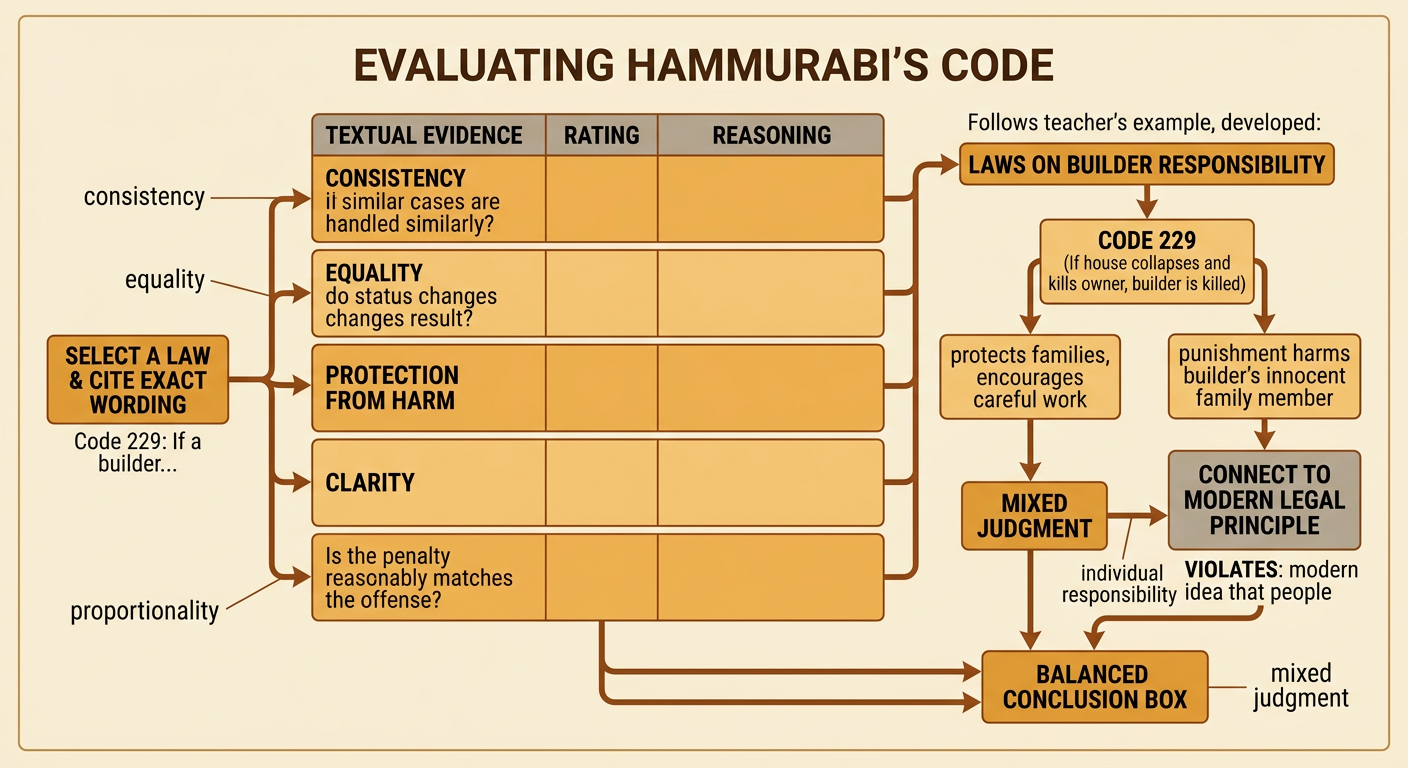
Babylon was a powerful city in Mesopotamia, a region between the Tigris and Euphrates Rivers. Hammurabi ruled Babylon from about 1792 to 1750 BCE and expanded his kingdom through warfare and alliances. He is best known for a collection of nearly 300 laws called Hammurabi’s Code. The laws were carved in cuneiform on a tall stone monument called a stele. At its top, an image shows Hammurabi standing before Shamash, the Babylonian god associated with justice. This scene supported Hammurabi’s claim that his authority to rule came from the gods. The code covered trade, farming, marriage, property, labor, injury, and crime. For example, some laws set payments for renting land or hiring workers. Together, the laws reveal how Babylon’s government tried to organize society and present Hammurabi as a just ruler.

Why Written Laws Mattered
Written laws created a lasting record of rules and penalties. People could not depend only on a ruler, judge, or elder remembering a rule correctly. Hammurabi placed his code on a public monument, although most Babylonians probably could not read its difficult cuneiform writing. Scribes and officials could read and apply the laws, while the monument announced that the king supported order and justice. Written laws also made it easier for officials in different parts of the kingdom to refer to similar standards. For example, a law stated what should happen if a builder constructed a house poorly and it collapsed. Recording such a rule identified the builder’s responsibility before a dispute occurred. However, written laws did not guarantee equal or fair treatment. The wording of the code shows that penalties could depend on a person’s social position, gender, occupation, or wealth.

Reading Laws as Primary Sources
Hammurabi’s Code is a primary source because it was created during the time being studied. Historians examine its exact words for evidence, but they also ask who created it, why it was created, and whose experiences are missing. A law can show what leaders wanted people to do, but it does not prove that everyone obeyed or that every penalty was enforced. Consider a translated law stating that if a person stole property belonging to a temple or palace, that person would be put to death. A student might cite this wording as evidence that the government treated theft from major institutions as a serious offense. The student should not conclude that all theft received the same punishment without checking other laws. Because modern translations can use different wording, readers should identify the translation and compare passages when possible. Strong analysis separates direct evidence from reasonable inference.

Justice and Social Class
Babylonian justice often followed the idea that a punishment should match an injury, sometimes called “an eye for an eye.” However, penalties were not equal for everyone. The code identified social ranks, including free people of higher status, commoners, and enslaved people. For example, one translated law says that if a man destroyed the eye of another man of equal rank, his own eye would be destroyed. Another law says that if he destroyed the eye of a commoner, he paid silver instead. These laws treated the same physical injury differently according to social class. Other penalties also varied according to whether the injured person was free or enslaved. Modern U.S. legal principles state that people should receive equal protection under the law, although historians and citizens still examine whether systems achieve that goal in practice. Comparing these principles helps students recognize that a written code can promote order while preserving inequality.

Evaluating the Code
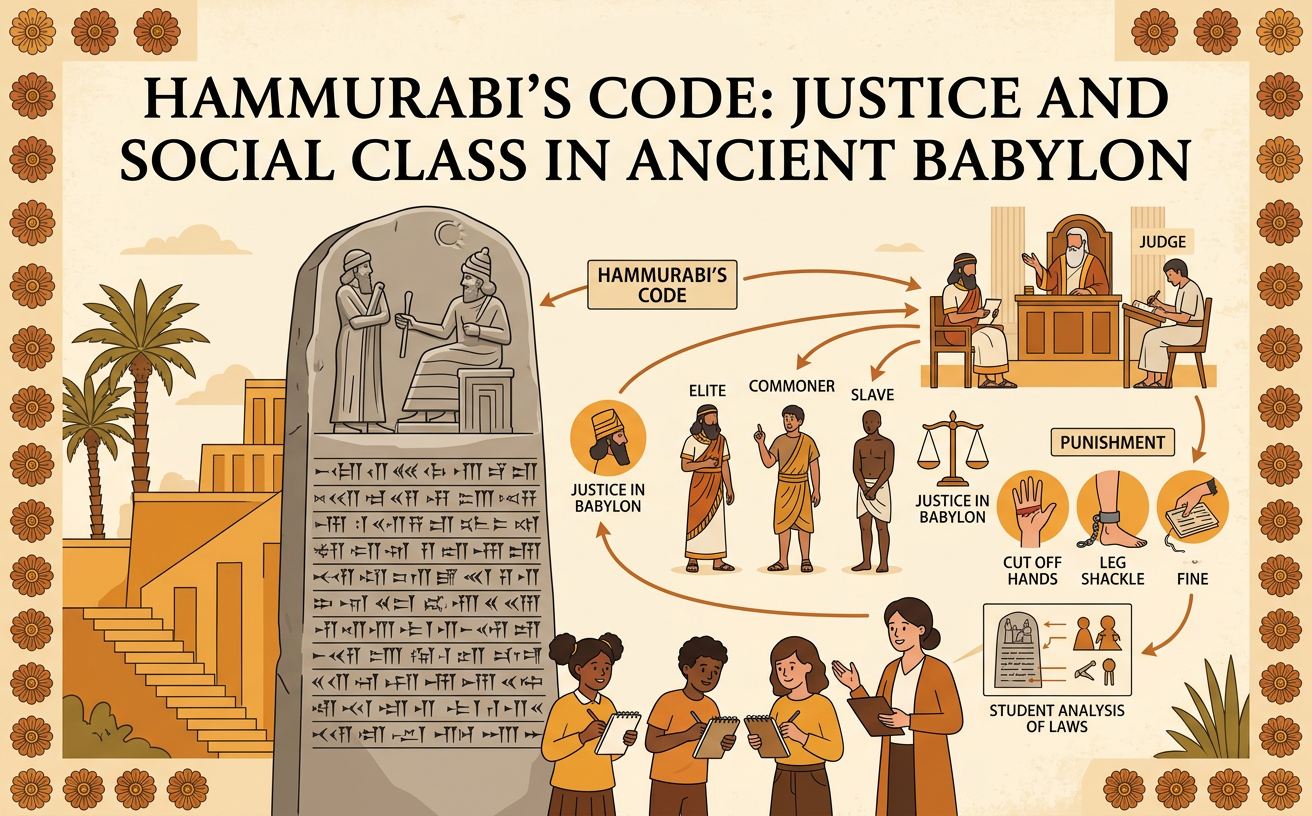
To evaluate Hammurabi’s Code, students should use clear criteria rather than deciding only whether a punishment seems harsh. Useful criteria include consistency, equality, protection from harm, clarity, and proportionality between an offense and its penalty. First, select a law and cite its exact wording. Next, score or describe how well it meets each criterion. Then compare it with another law and with a modern legal principle. For example, a law holding a builder responsible for an unsafe house may protect families and encourage careful work. Yet a penalty that harms the builder’s family member would fail a modern standard of individual responsibility because that person did not commit the offense. Evidence may therefore support a mixed judgment: the code offered written expectations and solutions to disputes, but it also used unequal status rules and collective or severe punishments. A strong conclusion acknowledges both accomplishments and limitations and explains which evidence led to the evaluation.