
Homes in Nature: Matching Living Things to Habitats
Students use pictures and a simple habitat model to match plants and animals with places that provide the food, water, shelter, light, and space they need.
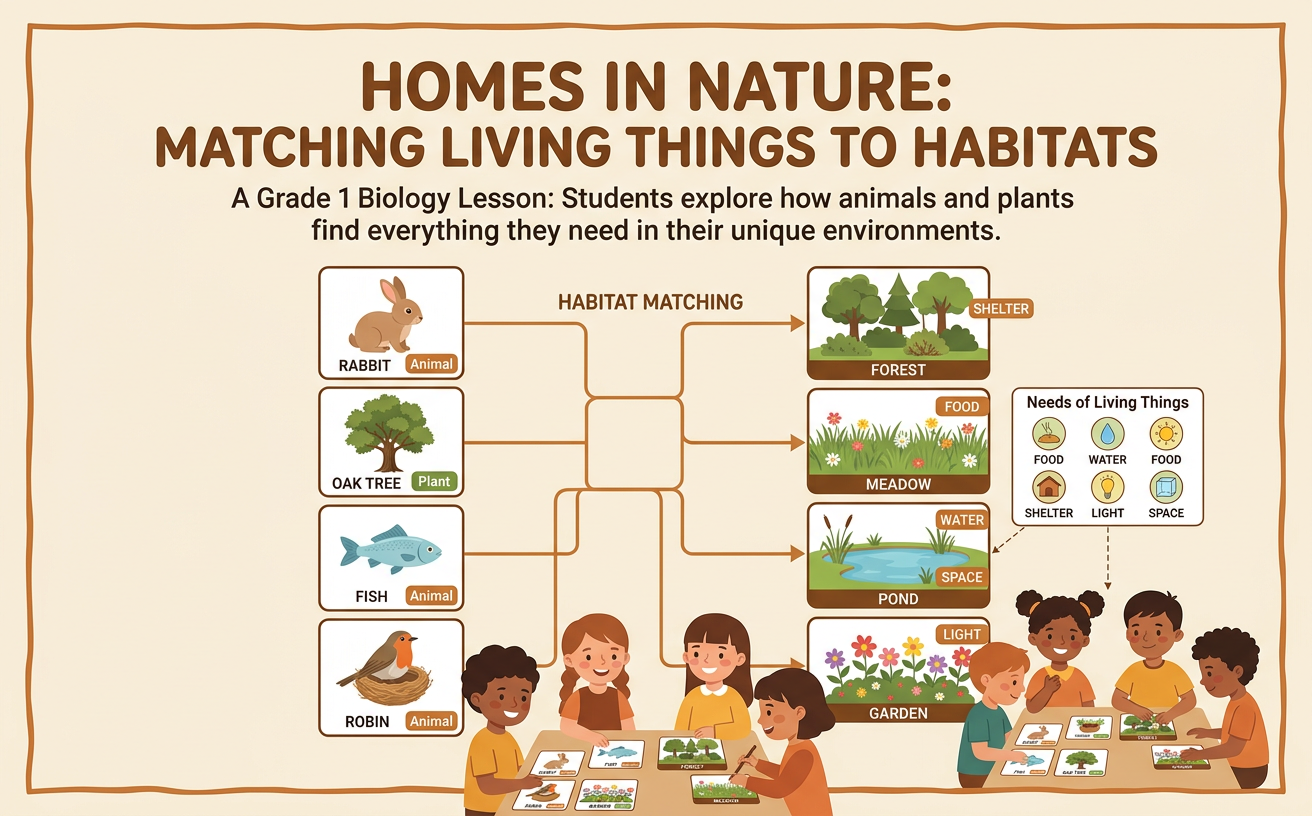
Illustrations are auto-generated and may be placeholders. They can be refreshed to match the narration.
What Is a Habitat?
A habitat is the place where a living thing lives and meets its needs. A habitat provides food, water, shelter, light, and space. Different living things need different kinds of habitats. A squirrel can live in a forest because trees provide nuts, places to climb, and holes for shelter. A fish cannot live in a tree. It needs water with enough food, oxygen, and space to swim. Plants also have habitats. They need light, water, air, nutrients, and room to grow. Look closely at a photograph or map of a place. What plants, animals, water, and shelter do you notice? These clues can help you identify the habitat and explain why a living thing can survive there.

Explore Forest, Desert, Pond, and Grassland Habitats
Habitats can look very different. A forest has many trees, shade, fallen leaves, and places for animals to hide. A desert receives little rain and may have dry soil, strong sunlight, and widely spaced plants. A pond is a small body of freshwater where fish, frogs, insects, and water plants can live. A grassland has many grasses, few trees, and broad open spaces. Photographs and simple maps help us compare these places. For example, a frog may live near a pond because it needs water and can find insects there. A cactus fits a desert because it can store water and grow where rain is scarce. As you explore each habitat, notice its land, water, plants, weather, and amount of open space.
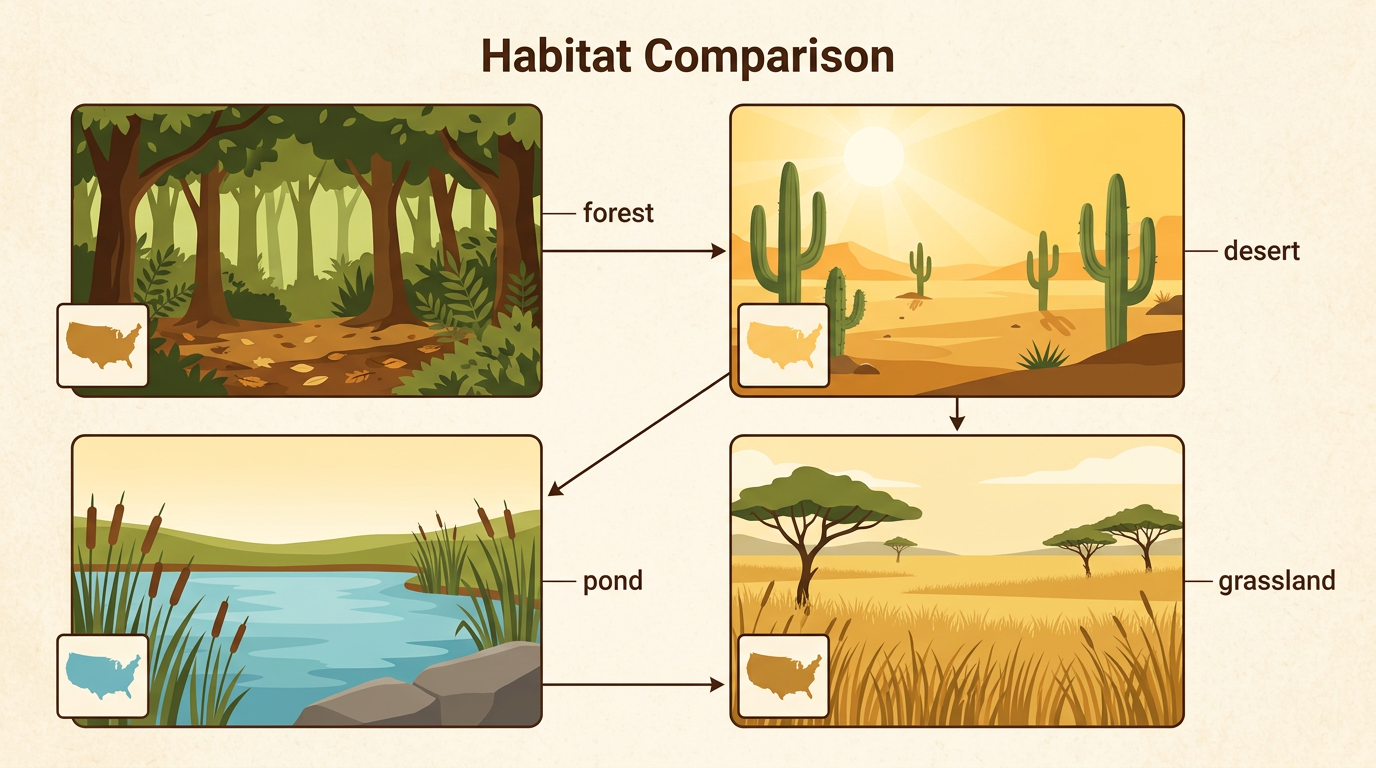
Notice What Each Habitat Provides
Every habitat provides a set of resources, but the resources are not the same everywhere. Forest trees offer seeds, fruit, shade, and shelter. A pond provides water, water plants, and small animals that can be food. Grasslands give grazing animals grasses to eat and open space to move. Desert plants and animals find limited water and use rocks, burrows, or plant shade for shelter. Light is important too. Green plants use light, water, and air to make their own food. For example, a pond lily grows where its roots can stay in muddy soil while its leaves reach sunlight above the water. Think of each habitat as a needs box. Ask: Where is the water? What can provide food? Where can a living thing hide, grow, or move?

Match Plants and Animals to Their Habitats
To match a living thing to a habitat, look for evidence about its needs and body parts. Webbed feet help a duck paddle in a pond. Thick fur helps a fox stay warm in a forest. Deep roots and water-storing stems help some desert plants survive with little rain. Long grass provides food and hiding places for grasshoppers in a grassland. Sort picture cards into four groups: forest, desert, pond, and grassland. Then count the cards in each group and record the totals in a picture graph or table. Compare the groups by using words such as more, fewer, or equal. If three cards match the pond and two match the desert, the pond group has one more card. Explain every match with a clue, not just a guess.

Build and Explain a Habitat Model
A model is a simple way to show how parts of a habitat are connected. Choose one habitat and build it in a tray, box, or drawing. Add land or water, plants, animals, light, food sources, shelter, and enough space. You may use paper, clay, blocks, or natural materials that are safe to handle. For a grassland model, you could add paper grasses, a grasshopper, a bird, a small water hole, and a nest. Use arrows to show relationships. An arrow might point from grass to a grasshopper because the grass provides food and shelter. Another arrow might point from the water hole to a bird. Explain your model in order: name the habitat, describe its features, and tell how each feature helps a living thing meet a need.
